







Back to all resources

CO2-arme Ergebnisse

Beeinflussen Sie den Brief

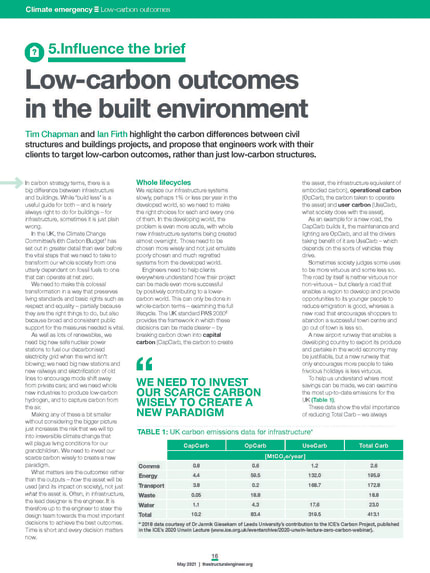
Tim Chapman und Ian Firth heben die CO2-Unterschiede zwischen Zivilbauten und Gebäudeprojekten hervor und schlagen vor, dass Ingenieure mit ihren Kunden zusammenarbeiten, um kohlenstoffarme Ergebnisse zu erzielen, anstatt nur kohlenstoffarme Strukturen.

In Bezug auf die CO2-Strategie gibt es einen großen Unterschied zwischen Infrastruktur und Gebäuden. Während „weniger bauen“ für beide ein nützlicher Leitfaden ist – und für Gebäude fast immer richtig ist – ist es bei der Infrastruktur manchmal einfach falsch.

Im Vereinigten Königreich hat das 6. CO2-Budget1 des Ausschusses für Klimaänderungen detaillierter denn je die entscheidenden Schritte dargelegt, die wir unternehmen müssen, um unsere gesamte Gesellschaft von einer völlig abhängigen von fossilen Brennstoffen zu einer Gesellschaft zu machen, die bei Netto Null betrieben werden kann.

Wir müssen diese kolossale Transformation so gestalten, dass der Lebensstandard und Grundrechte wie Respekt und Gleichberechtigung gewahrt werden – zum Teil, weil dies richtig ist, aber auch, weil eine breite und konsequente öffentliche Unterstützung für die erforderlichen Maßnahmen unerlässlich ist.

Neben vielen erneuerbaren Energien brauchen wir große neue sichere Atomkraftwerke, um unser dekarbonisiertes Stromnetz zu versorgen, wenn der Wind nicht weht; wir brauchen große neue Bahnhöfe und neue Eisenbahnen und die Elektrifizierung alter Strecken, um die Verkehrsverlagerung weg von Privatautos zu fördern; und wir brauchen ganz neue Industrien, um kohlenstoffarmen Wasserstoff zu produzieren und Kohlenstoff aus der Luft zu gewinnen.

Wenn wir diese etwas kleiner machen, ohne das Gesamtbild zu berücksichtigen, erhöht sich nur das Risiko, dass wir in einen irreversiblen Klimawandel geraten, der die Lebensbedingungen unserer Enkelkinder beeinträchtigt. Wir müssen unseren knappen Kohlenstoff mit Bedacht investieren, um ein neues Paradigma zu schaffen.

Was zählt, sind die Ergebnisse und nicht die Ergebnisse – wie der Vermögenswert verwendet wird (und seine Auswirkungen auf die Gesellschaft), nicht nur, was der Vermögenswert ist. In der Infrastruktur ist der leitende Designer oft der Ingenieur. Es liegt daher am Ingenieur, das Konstruktionsteam zu den wichtigsten Entscheidungen zu führen, um die besten Ergebnisse zu erzielen. Die Zeit ist knapp und jede Entscheidung zählt jetzt.
Reclaimed and Reused: Recommended LCA Modeling Guidance to Support EPDs for Reused Construction Materials

Material reuse is one strategy for reducing the embodied carbon of construction. While the preparation of previously used materials for reuse has an environmental impact, it avoids many of the resource extraction and manufacturing impacts of building with newly manufactured products. Given the amount of demolition and deconstruction across North America (and beyond), there is a vast potential for material reuse to expand in scale. However, barriers to material reuse scaling exist.

DEQ Low Embodied Carbon Housing Program: Roadmap to Success

Embodied Carbon Pathways to 2050 for the United States, a collaboration between the Carbon Leadership Forum (CLF), RMI, and the University of Washington (UW) Life Cycle Lab, provides an assessment of embodied carbon from US construction materials and explores pathways to align with a 1.5°C global warming limit.

International Embodied Carbon Data Availability: A Review of Environmental Product Declaration (EPD) Availability in Europe, China, and Australia

CLF completed a landscape analysis of product-level embodied carbon data availability in regions outside North America with the goals of: (i) understanding how LCA/EPD data availability varies globally; (ii) informing where targeted initiatives are needed to increase the availability of data; and (iii) determining whether adequate EPD data exists to develop CLF Material Baselines outside North America. This report summarizes our findings and provides initial insights into what data is available to inform low-carbon procurement efforts in Australia, China, and Europe.

The CLF Benchmark Explorer

Emissions from the operations of buildings and infrastructure are significant, well-understood contributors to national and global greenhouse gas emissions. However, the contribution of embodied carbon—emissions associated with the manufacturing, transportation, installation, maintenance, and disposal of construction materials across the life cycle of a building or asset—is neglected by comparison. Even at the global level, embodied carbon estimates are typically based on manufacturing emissions from the production of a handful of the highest-impact materials (e.g. concrete, steel, aluminum, and wood).

Embodied Carbon Pathways to 2050 for the United States

Embodied Carbon Pathways to 2050 for the United States, a collaboration between the Carbon Leadership Forum (CLF), RMI, and the University of Washington (UW) Life Cycle Lab, provides an assessment of embodied carbon from US construction materials and explores pathways to align with a 1.5°C global warming limit.

Washington State Carbon Emissions Estimation: 2025 – 2050

Emissions from the operations of buildings and infrastructure are significant, well-understood contributors to national and global greenhouse gas emissions. However, the contribution of embodied carbon—emissions associated with the manufacturing, transportation, installation, maintenance, and disposal of construction materials across the life cycle of a building or asset—is neglected by comparison. Even at the global level, embodied carbon estimates are typically based on manufacturing emissions from the production of a handful of the highest-impact materials (e.g. concrete, steel, aluminum, and wood).

View all policy resources in our resource library