







Back to all resources

Low-Carbon Outcomes

Influence the Brief

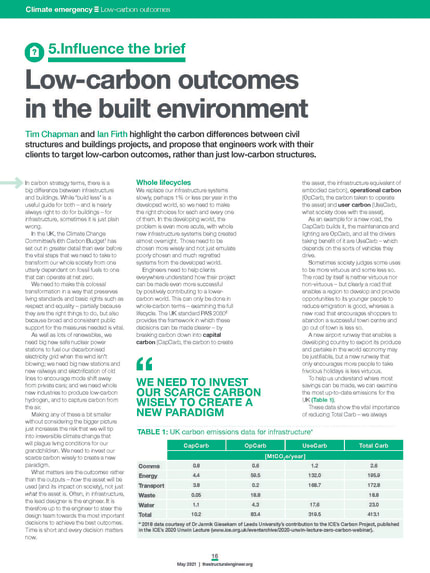
Tim Chapman and Ian Firth highlight the carbon differences between civil structures and buildings projects, and propose that engineers work with their clients to target low-carbon outcomes, rather than just low-carbon structures.

In carbon strategy terms, there is a  big difference between infrastructure and buildings. While ‘build less’ is a useful guide for both – and is nearly always right to do for buildings – for infrastructure, sometimes it is just plain wrong.

In the UK, the Climate Change Committee’s 6th Carbon Budget1 has set out in greater detail than ever before the vital steps that we need to take to transform our whole society from one utterly dependent on fossil fuels to one that can operate at net zero.

We need to make this colossal transformation in a way that preserves living standards and basic rights such as respect and equality – partially because they are the right things to do, but also because broad and consistent public support for the measures needed is vital.

As well as lots of renewables, we need big new safe nuclear power stations to fuel our decarbonised electricity grid when the wind isn’t blowing; we need big new stations and new railways and electrification of old lines to encourage mode shift away from private cars; and we need whole new industries to produce low-carbon hydrogen, and to capture carbon from the air.

Making any of these a bit smaller without considering the bigger picture just increases the risk that we will tip into irreversible climate change that will plague living conditions for our grandchildren. We need to invest our scarce carbon wisely to create a new paradigm.

What matters are the outcomes rather than the outputs – how the asset will be used (and its impact on society), not just what the asset is. Often, in infrastructure, the lead designer is the engineer. It is therefore up to the engineer to steer the design team towards the most important decisions to achieve the best outcomes. Time is short and every decision matters now.
Reclaimed and Reused: Recommended LCA Modeling Guidance to Support EPDs for Reused Construction Materials

Material reuse is one strategy for reducing the embodied carbon of construction. While the preparation of previously used materials for reuse has an environmental impact, it avoids many of the resource extraction and manufacturing impacts of building with newly manufactured products. Given the amount of demolition and deconstruction across North America (and beyond), there is a vast potential for material reuse to expand in scale. However, barriers to material reuse scaling exist.

DEQ Low Embodied Carbon Housing Program: Roadmap to Success

Embodied Carbon Pathways to 2050 for the United States, a collaboration between the Carbon Leadership Forum (CLF), RMI, and the University of Washington (UW) Life Cycle Lab, provides an assessment of embodied carbon from US construction materials and explores pathways to align with a 1.5°C global warming limit.

International Embodied Carbon Data Availability: A Review of Environmental Product Declaration (EPD) Availability in Europe, China, and Australia

CLF completed a landscape analysis of product-level embodied carbon data availability in regions outside North America with the goals of: (i) understanding how LCA/EPD data availability varies globally; (ii) informing where targeted initiatives are needed to increase the availability of data; and (iii) determining whether adequate EPD data exists to develop CLF Material Baselines outside North America. This report summarizes our findings and provides initial insights into what data is available to inform low-carbon procurement efforts in Australia, China, and Europe.

The CLF Benchmark Explorer

Emissions from the operations of buildings and infrastructure are significant, well-understood contributors to national and global greenhouse gas emissions. However, the contribution of embodied carbon—emissions associated with the manufacturing, transportation, installation, maintenance, and disposal of construction materials across the life cycle of a building or asset—is neglected by comparison. Even at the global level, embodied carbon estimates are typically based on manufacturing emissions from the production of a handful of the highest-impact materials (e.g. concrete, steel, aluminum, and wood).

Embodied Carbon Pathways to 2050 for the United States

Embodied Carbon Pathways to 2050 for the United States, a collaboration between the Carbon Leadership Forum (CLF), RMI, and the University of Washington (UW) Life Cycle Lab, provides an assessment of embodied carbon from US construction materials and explores pathways to align with a 1.5°C global warming limit.

Washington State Carbon Emissions Estimation: 2025 – 2050

Emissions from the operations of buildings and infrastructure are significant, well-understood contributors to national and global greenhouse gas emissions. However, the contribution of embodied carbon—emissions associated with the manufacturing, transportation, installation, maintenance, and disposal of construction materials across the life cycle of a building or asset—is neglected by comparison. Even at the global level, embodied carbon estimates are typically based on manufacturing emissions from the production of a handful of the highest-impact materials (e.g. concrete, steel, aluminum, and wood).

View all policy resources in our resource library