






Material reuse is one strategy for reducing the embodied carbon of construction. While the preparation of previously used materials for reuse has an environmental impact, it avoids many of the resource extraction and manufacturing impacts of building with newly manufactured products. Given the amount of demolition and deconstruction across North America (and beyond), there is a vast potential for material reuse to expand in scale. However, barriers to material reuse scaling exist.
About
This report focuses on addressing the methodological barriers to measuring and disclosing the environmental impacts of reused construction products using environmental product declarations (EPDs). Reused material EPDs could be helpful in scaling material reuse because:
- Low-carbon procurement policies and programs like Buy Clean tend to use EPDs to represent a product’s embodied carbon footprint. The EPD provides the carbon case (i.e., a credible demonstration of greenhouse gas emission reductions) for a given product, technology, or production process.
- There are currently no North American EPDs for reuse construction products (this report’s term for a previously used product that has been salvaged and is ready for reuse). This lack of EPDs and their associated carbon case can effectively exclude reused materials from low-carbon procurement policies and other regulatory programs that require EPDs.
- One contributing barrier to reuse product EPD development is the lack of product category rules (PCR) for reuse construction products. PCRs provide the guidance and “recipe” for how to model a construction product’s embodied carbon and other environmental impacts in an EPD. By helping to ensure reliability and consistency across EPDs, PCRs support the credibility of EPDs for use in decision-making.
- Without clear PCR guidance for reused construction products, there is no straightforward route to creating reuse product EPDs.
To address this gap, the Carbon Leadership Forum (CLF) and Eastern Research Group (ERG) collaborated to advance the discussion on reuse construction product PCR guidance and modeling. In this report:
- We recommend life cycle assessment (LCA) methods and propose PCR language for reuse product EPDs.
- We present initial LCA model results for reuse lumber, steel, and brick.
- We make recommendations for future work to build upon these efforts.
Acknowledgments
This project was a collaboration between CLF and Eastern Research Group (ERG), including the following ERG staff: Kristina Farrell worked at ERG during most of the project’s development. Paige Weiler led a portion of the LCA modeling effort, provided LCA modeling guidance throughout, and combed through the literature to find usable data. Troy Hottle provided input during early project development and reviewed a later report draft.
Brad Guy, a champion of material reuse, participated in many of our early discussions where we hashed through LCA and reuse topics and provided us with a small slice of his accumulated knowledge. Juliana Berglund-Brown at MIT shared with our team her valuable perspective related to her paper on steel reuse (cited many times in this report). Brad Guy, Shawn Wood of USGBC (at US EPA when we started this project), and Meghan Lewis, CLF Program Director, reviewed a draft of this report. Rachelle Habchi, CLF Low-Carbon Products Lead, researched existing reuse EPDs and related standards during a precursor task to this project. Sindhu Raju, CLF Program Assistant, laid out the report and provided other production help.
Copyright
Reclaimed and Reused: A Recommended LCA Modeling Approach to Support EPDs for Reused Construction Materials is licensed under a Creative Commons Attribution 4.0 International License.
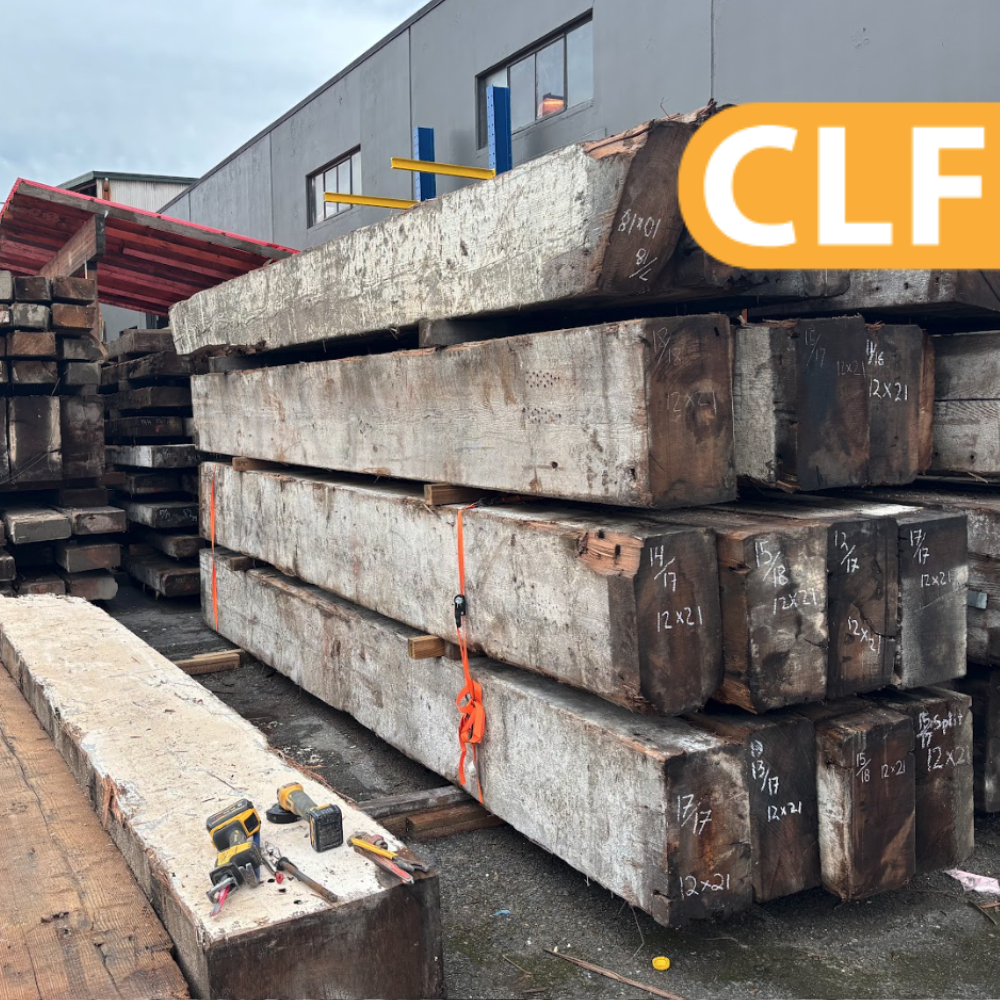
Cover image by Earthwise Architectural Salvage.
Authors
- Brook Waldman, Low-Carbon Products Manager, CLF
- Kristina Farrell, Low-Carbon Buildings Lead, CLF
- Paige Weiler, LCA and Sustainability Analyst, ERG
- Jordan Palmeri, Senior Manager Low-Carbon Products, CLF
Author contributions: Writing – original draft: B.W., K.F., J.P., Rachelle Habchi; Writing – review and editing: B.W., J.P., M.L., & P.W.; Conceptualization: M.L., J.P., K.F.; Methodology: B.W., K.F., J.P., P.W., & R.H.; Data Collection and Data Analysis: K.F., P.W., & B.W.; Visualization and Graphics: B.W., Sindhu Raju.
Citation
Waldman, B., Farrell, K., Weiler, P., & Palmeri, J. (2026). Reclaimed and Reused: A Recommended LCA Modeling Approach to Support EPDs for Reused Construction Materials. Carbon Leadership Forum.