






Back to all resources

Embodied Carbon Policy Reduction Calculator

The Policy Reduction Calculator is a web-based tool developed by the Carbon Leadership Forum to provide policymakers with data-driven insights on low embodied carbon policies in North America.

About

The Embodied Carbon Policy Reduction Calculator is an extension of the proof-of-concept study completed by the Carbon Leadership Forum and C40 Cities in 2022. Since then, there have been significant improvements in data quality and methodologies for calculating embodied carbon reductions at the building level. This tool builds off this progress to provide policymakers with up-to-date data and methodologies for calculating jurisdiction-level embodied carbon projections. 

The Policy Reduction Calculator is a tool developed to provide policymakers with data-driven insights on low-carbon policies. It allows decision-makers to:

  • Establish basic estimates of the business-as-usual embodied carbon impacts of a jurisdiction over time,
  • Create and customize embodied carbon reduction policies using three basic policy frameworks, and
  • Compare the relative reduction potential of each created policy to the business-as-usual baseline.

The goal of this tool is to provide decision-makers with the data they need to support and evaluate impactful embodied carbon policy. The tool provides an estimated reduction potential of the following different kinds of embodied carbon policies:

  • Material policies (Product GWP limits for concrete and steel)
  • Whole building life cycle assessment policies (Building Reduction Target policies and Building Embodied Carbon Budget policies)
  • Reuse policies (incentives for renovating and adapting existing buildings instead of building new)

Acknowledgments

The development of this calculator was heavily informed by a pilot completed in 2022. A huge thank you to C40 – for commissioning and co-developing the original pilot calculator – and to the cities who participated in the pilot. Please find more information here.

Copyright

Published under Creative Commons Attribution-ShareAlike 4.0 International (CC BY-SA 4.0)
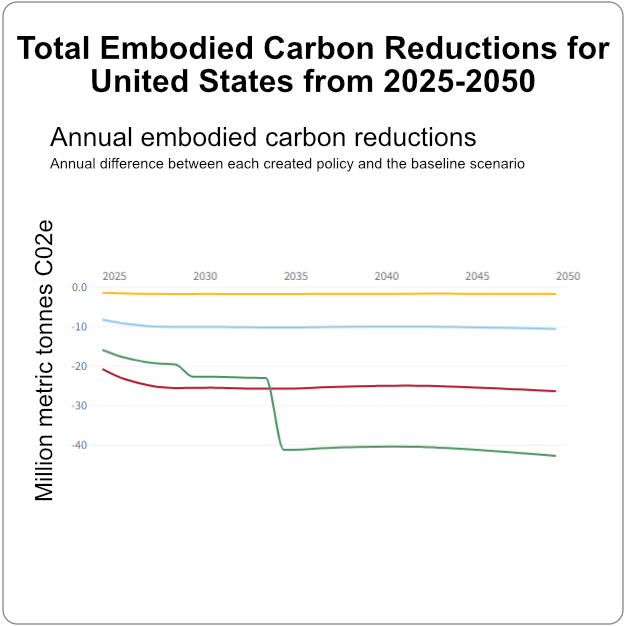
chart<br />

Authors

    The individuals from the Carbon Leadership Forum who worked on this dashboard are:

    • Manuel Chafart, Lead
    • Aurora Jensen, Senior Manager
    • Brad Benke, Manager
    • Meghan Lewis, Program Director

    Citation

    Chafart, M., Jensen, A., Benke, B., Lewis, M. (2026). CLF Embodied Carbon Policy Reduction Calculator (Version 1.0) Computer Software. Carbon Leadership Forum. https://ec-policy-reduction-calculator.carbonleadershipforum.org/

    Reclaimed and Reused: Recommended LCA Modeling Guidance to Support EPDs for Reused Construction Materials

    Material reuse is one strategy for reducing the embodied carbon of construction. While the preparation of previously used materials for reuse has an environmental impact, it avoids many of the resource extraction and manufacturing impacts of building with newly manufactured products. Given the amount of demolition and deconstruction across North America (and beyond), there is a vast potential for material reuse to expand in scale. However, barriers to material reuse scaling exist.

    DEQ Low Embodied Carbon Housing Program: Roadmap to Success

    Embodied Carbon Pathways to 2050 for the United States, a collaboration between the Carbon Leadership Forum (CLF), RMI, and the University of Washington (UW) Life Cycle Lab, provides an assessment of embodied carbon from US construction materials and explores pathways to align with a 1.5°C global warming limit.

    International Embodied Carbon Data Availability: A Review of Environmental Product Declaration (EPD) Availability in Europe, China, and Australia

    CLF completed a landscape analysis of product-level embodied carbon data availability in regions outside North America with the goals of: (i) understanding how LCA/EPD data availability varies globally; (ii) informing where targeted initiatives are needed to increase the availability of data; and (iii) determining whether adequate EPD data exists to develop CLF Material Baselines outside North America. This report summarizes our findings and provides initial insights into what data is available to inform low-carbon procurement efforts in Australia, China, and Europe.

    The CLF Benchmark Explorer

    Emissions from the operations of buildings and infrastructure are significant, well-understood contributors to national and global greenhouse gas emissions. However, the contribution of embodied carbon—emissions associated with the manufacturing, transportation, installation, maintenance, and disposal of construction materials across the life cycle of a building or asset—is neglected by comparison. Even at the global level, embodied carbon estimates are typically based on manufacturing emissions from the production of a handful of the highest-impact materials (e.g. concrete, steel, aluminum, and wood).

    Embodied Carbon Pathways to 2050 for the United States

    Embodied Carbon Pathways to 2050 for the United States, a collaboration between the Carbon Leadership Forum (CLF), RMI, and the University of Washington (UW) Life Cycle Lab, provides an assessment of embodied carbon from US construction materials and explores pathways to align with a 1.5°C global warming limit.

    Washington State Carbon Emissions Estimation: 2025 – 2050

    Emissions from the operations of buildings and infrastructure are significant, well-understood contributors to national and global greenhouse gas emissions. However, the contribution of embodied carbon—emissions associated with the manufacturing, transportation, installation, maintenance, and disposal of construction materials across the life cycle of a building or asset—is neglected by comparison. Even at the global level, embodied carbon estimates are typically based on manufacturing emissions from the production of a handful of the highest-impact materials (e.g. concrete, steel, aluminum, and wood).

    2025 CLF North American Material Baselines

    The CLF North American Material Baselines Report provides a snapshot of the state of environmental product declarations (EPDs) for North American-produced building materials. This report includes: Background and methodology, CLF Baselines (industry-average embodied carbon values), and a Detailed results by material category

    View all policy resources in our resource library