






Back to all resources

Kohlenstoff speichernde Materialien

Zusammenfassender Bericht | Februar 2021

Das Zwischenstaatliche Gremium für Klimawandel (IPCC): „Um die Erwärmung auf 1,5 ° C zu begrenzen, muss zusätzlich zur Emissionsreduzierung Kohlenstoff aus der Atmosphäre entfernt werden.“

Autoren

Das Forschungsteam des Carbon Leadership Forum am College of Built Environments der University of Washington:

  • Julie Kriegh, PhD, AIA, Wissenschaftlicher Mitarbeiter, Carbon Leadership Forum, Fakultät für Architektur, College of Built Environments, University of Washington.
  • Chris Magwood, Direktor, Endeavour Center, Schule für nachhaltiges Bauen, Peterborough, Ontario, Kanada.
  • Wil Srubar III, PhD, außerordentlicher Professor, Universität von Colorado Boulder, Bau-, Umwelt- und Architekturingenieurwesen, Materialwissenschaft und Ingenieurwesen.

Version: Februar 2021

Danksagung

Das Forschungsteam möchte Microsoft für die Finanzierung dieser Forschung und den folgenden Personen danken: Danielle Decatur, Microsoft, Principal Program Manager of Datacenter Sustainability; Sean James, Microsoft, Direktor der Rechenzentrumsforschung; Ben Stanley, WSP-Berater für Nachhaltigkeit, Energie und Klimawandel und Projektmanager und das WSP-Team Sebastian Danio-Beck, Ryan Dick, Sarah Buffaloe und Lama Bitar für ihre Arbeit an dem Projekt einschließlich der WBLCA und der technischen Unterstützung; Kurt Swensson, PhD, PE, KSi-Berater für Tragwerksplanung für seine Arbeit an den technischen Modellen und Spezifikationen des Rechenzentrums; Monica Huang, Forschungsingenieurin, und Brook Waldman, Forscherin und Beraterin beim Carbon Leadership Forum für ihre Unterstützung bei der Erstellung dieses Berichts.
Zitat

Kriegh, J., Magwood, C., Srubar, W. (2021).  Kohlenstoff speichernde Materialien: Zusammenfassender Bericht.

Eine kohlenstoffpositive Zukunft in drei bis fünf Jahren?

Das Carbon Leadership Forum an der University of Washington hat kürzlich ein viermonatiges Forschungsprojekt mit einem großen US-amerikanischen Technologieunternehmen abgeschlossen, um das Potenzial der Verwendung kohlenstoffarmer und kohlenstoffspeichernder Materialien in Neubauten zu verstehen. Das Projekt konzentrierte sich auf kohlenstoffintensive Hotspot-Materialien (z. B. Betonfundamente und Plattenböden, isolierte Dach- und Wandpaneele sowie strukturelle Rahmen) in leichten Industriegebäuden.

Die Studie ergab, dass eine beträchtliche Reduktion (~ 60%) des verkörperten Kohlenstoffs in zwei bis drei Jahren möglich ist, indem leicht verfügbare kohlenstoffarme Materialien in größerem Umfang eingesetzt werden. Darüber hinaus prognostiziert diese Arbeit, dass die Förderung eines kohlenstoffspeichernden Materialversorgungssystems durch Investitionen in die Entwicklung und Herstellung von aufstrebenden kohlenstoffspeichernden Materialindustrien eine kohlenstoffpositive Zukunft für einzelne Projekte in drei bis fünf Jahren ermöglichen wird (siehe Abbildung 1).
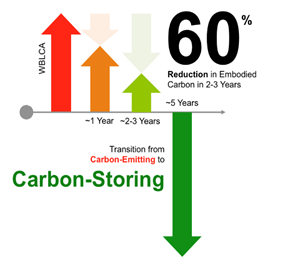
Abbildung 1. Mögliche Reduzierung der CO2-Emissionen (Kredit: Wil Srubar).

Reclaimed and Reused: Recommended LCA Modeling Guidance to Support EPDs for Reused Construction Materials

Material reuse is one strategy for reducing the embodied carbon of construction. While the preparation of previously used materials for reuse has an environmental impact, it avoids many of the resource extraction and manufacturing impacts of building with newly manufactured products. Given the amount of demolition and deconstruction across North America (and beyond), there is a vast potential for material reuse to expand in scale. However, barriers to material reuse scaling exist.

DEQ Low Embodied Carbon Housing Program: Roadmap to Success

Embodied Carbon Pathways to 2050 for the United States, a collaboration between the Carbon Leadership Forum (CLF), RMI, and the University of Washington (UW) Life Cycle Lab, provides an assessment of embodied carbon from US construction materials and explores pathways to align with a 1.5°C global warming limit.

International Embodied Carbon Data Availability: A Review of Environmental Product Declaration (EPD) Availability in Europe, China, and Australia

CLF completed a landscape analysis of product-level embodied carbon data availability in regions outside North America with the goals of: (i) understanding how LCA/EPD data availability varies globally; (ii) informing where targeted initiatives are needed to increase the availability of data; and (iii) determining whether adequate EPD data exists to develop CLF Material Baselines outside North America. This report summarizes our findings and provides initial insights into what data is available to inform low-carbon procurement efforts in Australia, China, and Europe.

The CLF Benchmark Explorer

Emissions from the operations of buildings and infrastructure are significant, well-understood contributors to national and global greenhouse gas emissions. However, the contribution of embodied carbon—emissions associated with the manufacturing, transportation, installation, maintenance, and disposal of construction materials across the life cycle of a building or asset—is neglected by comparison. Even at the global level, embodied carbon estimates are typically based on manufacturing emissions from the production of a handful of the highest-impact materials (e.g. concrete, steel, aluminum, and wood).

Embodied Carbon Pathways to 2050 for the United States

Embodied Carbon Pathways to 2050 for the United States, a collaboration between the Carbon Leadership Forum (CLF), RMI, and the University of Washington (UW) Life Cycle Lab, provides an assessment of embodied carbon from US construction materials and explores pathways to align with a 1.5°C global warming limit.

Washington State Carbon Emissions Estimation: 2025 – 2050

Emissions from the operations of buildings and infrastructure are significant, well-understood contributors to national and global greenhouse gas emissions. However, the contribution of embodied carbon—emissions associated with the manufacturing, transportation, installation, maintenance, and disposal of construction materials across the life cycle of a building or asset—is neglected by comparison. Even at the global level, embodied carbon estimates are typically based on manufacturing emissions from the production of a handful of the highest-impact materials (e.g. concrete, steel, aluminum, and wood).

View all policy resources in our resource library