






Back to all resources

Matériaux de stockage de carbone

Rapport de synthèse | Février 2021

Le Groupe d'experts intergouvernemental sur l'évolution du climat (GIEC): «Pour limiter le réchauffement à 1,5 ° C, il faudra éliminer le carbone de l'atmosphère en plus de réduire les émissions.»

Auteurs

L'équipe de recherche du Carbon Leadership Forum de l'Université de Washington College of Built Environments:

  • Julie Kriegh, PhD, AIA, chercheur scientifique, Carbon Leadership Forum, Département d'architecture, College of Built Environments, University of Washington.
  • Chris Magwood, directeur, Endeavour Centre, The Sustainable Building School, Peterborough, Ontario, Canada.
  • Wil Srubar III, PhD, professeur agrégé, Université du Colorado à Boulder, génie civil, environnemental et architectural, programme de science et génie des matériaux.

Version: février 2021

Remerciements

L'équipe de recherche tient à remercier Microsoft pour le financement de cette recherche et les personnes suivantes : Danielle Decatur, Microsoft, responsable du programme principal de Datacenter Sustainability ; Sean James, Microsoft, directeur de la recherche sur les centres de données ; Ben Stanley, consultant et chef de projet pour la durabilité, l'énergie et le changement climatique de WSP et l'équipe de WSP Sebastian Danio-Beck, Ryan Dick, Sarah Buffaloe et Lama Bitar pour leur travail sur le projet, y compris la WBLCA et le soutien technique ; Kurt Swensson, PhD, PE, consultant en ingénierie structurelle KSi pour son travail sur la révision des modèles d'ingénierie et des spécifications des centres de données ; Monica Huang, ingénieur de recherche, et Brook Waldman, chercheur et consultant auprès du Carbon Leadership Forum pour leur aide dans la préparation de ce rapport.
Citation

Kriegh, J., Magwood, C., Srubar, W. (2021).  Matériaux de stockage du carbone: rapport de synthèse.

Un avenir carbone positif dans trois à cinq ans?

Le Carbon Leadership Forum de l'Université de Washington a récemment achevé un projet de recherche de quatre mois avec une grande entreprise technologique américaine pour comprendre le potentiel de l'utilisation de matériaux à faible teneur en carbone et stockant du carbone dans les nouvelles constructions. Le projet était axé sur les matériaux des points chauds à forte intensité de carbone (p. Ex., Fondations en béton et planchers de dalles, panneaux de toit et de mur isolés et charpente structurelle) dans les bâtiments industriels légers.

L'étude a révélé qu'une réduction importante (~ 60%) du carbone incorporé est possible dans deux à trois ans en généralisant l'utilisation de matériaux à faible teneur en carbone facilement disponibles. En outre, ce travail prédit que la promotion d'un système d'approvisionnement en matériaux stockant le carbone en investissant dans le développement et la fabrication d'industries naissantes de matériaux stockant le carbone rendra possible un avenir positif en carbone pour des projets individuels dans trois à cinq ans (voir Figure 1).
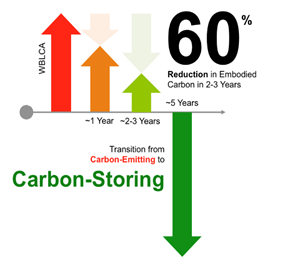
Figure 1. Réductions potentielles de carbone (crédit: Wil Srubar).

Reclaimed and Reused: Recommended LCA Modeling Guidance to Support EPDs for Reused Construction Materials

Material reuse is one strategy for reducing the embodied carbon of construction. While the preparation of previously used materials for reuse has an environmental impact, it avoids many of the resource extraction and manufacturing impacts of building with newly manufactured products. Given the amount of demolition and deconstruction across North America (and beyond), there is a vast potential for material reuse to expand in scale. However, barriers to material reuse scaling exist.

DEQ Low Embodied Carbon Housing Program: Roadmap to Success

Embodied Carbon Pathways to 2050 for the United States, a collaboration between the Carbon Leadership Forum (CLF), RMI, and the University of Washington (UW) Life Cycle Lab, provides an assessment of embodied carbon from US construction materials and explores pathways to align with a 1.5°C global warming limit.

International Embodied Carbon Data Availability: A Review of Environmental Product Declaration (EPD) Availability in Europe, China, and Australia

CLF completed a landscape analysis of product-level embodied carbon data availability in regions outside North America with the goals of: (i) understanding how LCA/EPD data availability varies globally; (ii) informing where targeted initiatives are needed to increase the availability of data; and (iii) determining whether adequate EPD data exists to develop CLF Material Baselines outside North America. This report summarizes our findings and provides initial insights into what data is available to inform low-carbon procurement efforts in Australia, China, and Europe.

The CLF Benchmark Explorer

Emissions from the operations of buildings and infrastructure are significant, well-understood contributors to national and global greenhouse gas emissions. However, the contribution of embodied carbon—emissions associated with the manufacturing, transportation, installation, maintenance, and disposal of construction materials across the life cycle of a building or asset—is neglected by comparison. Even at the global level, embodied carbon estimates are typically based on manufacturing emissions from the production of a handful of the highest-impact materials (e.g. concrete, steel, aluminum, and wood).

Embodied Carbon Pathways to 2050 for the United States

Embodied Carbon Pathways to 2050 for the United States, a collaboration between the Carbon Leadership Forum (CLF), RMI, and the University of Washington (UW) Life Cycle Lab, provides an assessment of embodied carbon from US construction materials and explores pathways to align with a 1.5°C global warming limit.

Washington State Carbon Emissions Estimation: 2025 – 2050

Emissions from the operations of buildings and infrastructure are significant, well-understood contributors to national and global greenhouse gas emissions. However, the contribution of embodied carbon—emissions associated with the manufacturing, transportation, installation, maintenance, and disposal of construction materials across the life cycle of a building or asset—is neglected by comparison. Even at the global level, embodied carbon estimates are typically based on manufacturing emissions from the production of a handful of the highest-impact materials (e.g. concrete, steel, aluminum, and wood).

View all policy resources in our resource library