






Back to all resources

Materiales que almacenan carbono

Informe resumido | Febrero 2021

El Panel Intergubernamental sobre Cambio Climático (IPCC): "Limitar el calentamiento a 1,5 grados C requerirá eliminar el carbono de la atmósfera además de reducir las emisiones".

Autores

El equipo de investigación del Carbon Leadership Forum de la Facultad de Ambientes Construidos de la Universidad de Washington:

  • Julie Kriegh, PhD, AIA, Investigador Científico, Carbon Leadership Forum, Departamento de Arquitectura, Facultad de Ambientes Construidos, Universidad de Washington.
  • Chris Magwood, director, Endeavour Center, The Sustainable Building School, Peterborough, Ontario, Canadá.
  • Wil Srubar III, PhD, Profesor Asociado, Universidad de Colorado Boulder, Programa de Ingeniería Civil, Ambiental y Arquitectónica, Ciencia de Materiales e Ingeniería.

Versión: febrero de 2021

Expresiones de gratitud

El equipo de investigación desea agradecer a Microsoft por financiar esta investigación ya las siguientes personas: Danielle Decatur, Microsoft, Gerente Principal de Programas de Sostenibilidad del Centro de Datos; Sean James, Microsoft, director de investigación de centros de datos; Ben Stanley, consultor y gerente de proyecto de WSP Sustainability, Energy and Climate Change y el equipo de WSP Sebastian Danio-Beck, Ryan Dick, Sarah Buffaloe y Lama Bitar por su trabajo en el proyecto, incluida la WBLCA y el apoyo técnico; Kurt Swensson, PhD, PE, consultor de ingeniería estructural de KSi por su trabajo en la revisión de modelos y especificaciones de ingeniería del centro de datos; Monica Huang, ingeniera de investigación, y Brook Waldman, investigador y consultor del Carbon Leadership Forum por su ayuda en la preparación de este informe.
Citación

Kriegh, J., Magwood, C., Srubar, W. (2021).  Materiales que almacenan carbono: Informe resumido.

¿Un futuro con carbono positivo en tres a cinco años?

El Carbon Leadership Forum de la Universidad de Washington ha completado recientemente un proyecto de investigación de cuatro meses con una importante empresa de tecnología de EE. UU. Para comprender el potencial del uso de materiales con bajo contenido de carbono y almacenamiento de carbono en nuevas construcciones. El proyecto se centró en materiales de puntos calientes con alto contenido de carbono (p. Ej., Cimientos de hormigón y pisos de losas, techos y paneles de paredes aislados y marcos estructurales) en edificios industriales ligeros.

El estudio encontró que una reducción considerable (~ 60%) en el carbono incorporado es posible en dos o tres años al llevar a un uso más amplio los materiales bajos en carbono fácilmente disponibles. Además, este trabajo predice que fomentar un sistema de suministro de material de almacenamiento de carbono mediante la inversión en el desarrollo y la fabricación de industrias de materiales de almacenamiento de carbono incipientes hará posible un futuro de carbono positivo para proyectos individuales en tres a cinco años (ver Figura 1).
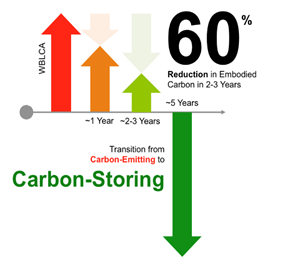
Figura 1. Reducciones potenciales de carbono (crédito: Wil Srubar).

Reclaimed and Reused: Recommended LCA Modeling Guidance to Support EPDs for Reused Construction Materials

Material reuse is one strategy for reducing the embodied carbon of construction. While the preparation of previously used materials for reuse has an environmental impact, it avoids many of the resource extraction and manufacturing impacts of building with newly manufactured products. Given the amount of demolition and deconstruction across North America (and beyond), there is a vast potential for material reuse to expand in scale. However, barriers to material reuse scaling exist.

DEQ Low Embodied Carbon Housing Program: Roadmap to Success

Embodied Carbon Pathways to 2050 for the United States, a collaboration between the Carbon Leadership Forum (CLF), RMI, and the University of Washington (UW) Life Cycle Lab, provides an assessment of embodied carbon from US construction materials and explores pathways to align with a 1.5°C global warming limit.

International Embodied Carbon Data Availability: A Review of Environmental Product Declaration (EPD) Availability in Europe, China, and Australia

CLF completed a landscape analysis of product-level embodied carbon data availability in regions outside North America with the goals of: (i) understanding how LCA/EPD data availability varies globally; (ii) informing where targeted initiatives are needed to increase the availability of data; and (iii) determining whether adequate EPD data exists to develop CLF Material Baselines outside North America. This report summarizes our findings and provides initial insights into what data is available to inform low-carbon procurement efforts in Australia, China, and Europe.

The CLF Benchmark Explorer

Emissions from the operations of buildings and infrastructure are significant, well-understood contributors to national and global greenhouse gas emissions. However, the contribution of embodied carbon—emissions associated with the manufacturing, transportation, installation, maintenance, and disposal of construction materials across the life cycle of a building or asset—is neglected by comparison. Even at the global level, embodied carbon estimates are typically based on manufacturing emissions from the production of a handful of the highest-impact materials (e.g. concrete, steel, aluminum, and wood).

Embodied Carbon Pathways to 2050 for the United States

Embodied Carbon Pathways to 2050 for the United States, a collaboration between the Carbon Leadership Forum (CLF), RMI, and the University of Washington (UW) Life Cycle Lab, provides an assessment of embodied carbon from US construction materials and explores pathways to align with a 1.5°C global warming limit.

Washington State Carbon Emissions Estimation: 2025 – 2050

Emissions from the operations of buildings and infrastructure are significant, well-understood contributors to national and global greenhouse gas emissions. However, the contribution of embodied carbon—emissions associated with the manufacturing, transportation, installation, maintenance, and disposal of construction materials across the life cycle of a building or asset—is neglected by comparison. Even at the global level, embodied carbon estimates are typically based on manufacturing emissions from the production of a handful of the highest-impact materials (e.g. concrete, steel, aluminum, and wood).

View all policy resources in our resource library