







Back to all resources

Bodenbelastungen und der Klimanotstand

Will Hawkins, Angus Peters und Tim Mander plädieren dafür, dass Designer Überspezifikationen in Frage stellen und die Chance nutzen, die reduzierte Bodenbelastungen für eine kohlenstoffarme Konstruktion bieten.

Um die Klimaziele in Einklang zu bringen, müssen wir den Embodied Carbon von Gebäudestrukturen jedes Jahr um 10% reduzieren. Die Verwendung geringerer Bemessungslasten könnte als niedrig hängende Früchte angesehen werden, um den Materialverbrauch zu reduzieren; eine einfache Änderung, die alle tragenden Gebäudekomponenten betrifft, keine Änderung der Entwurfsmethoden, keine neue Bautechnologie und minimale Abstimmung mit anderen Mitgliedern des Entwurfsteams erfordert. In diesem Artikel werden die realen Nutzlasten in Gebäuden, deren Vergleich mit verschiedenen Konstruktionsvorschriften weltweit und die möglichen Einsparungen bei Embodied Carbon untersucht.

Gemessene Belastung in Gebäuden

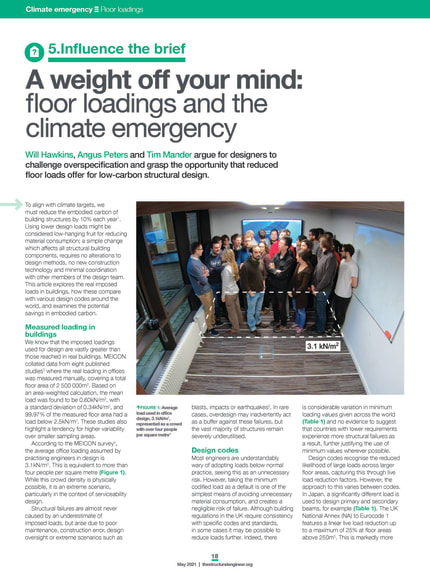
Wir wissen, dass die bei der Bemessung verwendeten Lasten weitaus höher sind als die in realen Gebäuden erreichten. MEICON hat Daten aus acht veröffentlichten Studien zusammengetragen, in denen die tatsächliche Belastung in Büros manuell gemessen wurde und eine Gesamtnutzfläche von 2.500.000/m2 abdeckte. Basierend auf einer flächengewichteten Berechnung ergab sich eine mittlere Last von 0,60 kN/m2 mit einer Standardabweichung von 0,34 kN/m2 und 99,971 TP1T der gemessenen Bodenfläche hatten eine Last von weniger als 2,5 kN/m2. Diese Studien zeigen auch eine Tendenz zu einer höheren Variabilität über kleinere Stichprobenbereiche.
Reclaimed and Reused: Recommended LCA Modeling Guidance to Support EPDs for Reused Construction Materials

Material reuse is one strategy for reducing the embodied carbon of construction. While the preparation of previously used materials for reuse has an environmental impact, it avoids many of the resource extraction and manufacturing impacts of building with newly manufactured products. Given the amount of demolition and deconstruction across North America (and beyond), there is a vast potential for material reuse to expand in scale. However, barriers to material reuse scaling exist.

DEQ Low Embodied Carbon Housing Program: Roadmap to Success

Embodied Carbon Pathways to 2050 for the United States, a collaboration between the Carbon Leadership Forum (CLF), RMI, and the University of Washington (UW) Life Cycle Lab, provides an assessment of embodied carbon from US construction materials and explores pathways to align with a 1.5°C global warming limit.

International Embodied Carbon Data Availability: A Review of Environmental Product Declaration (EPD) Availability in Europe, China, and Australia

CLF completed a landscape analysis of product-level embodied carbon data availability in regions outside North America with the goals of: (i) understanding how LCA/EPD data availability varies globally; (ii) informing where targeted initiatives are needed to increase the availability of data; and (iii) determining whether adequate EPD data exists to develop CLF Material Baselines outside North America. This report summarizes our findings and provides initial insights into what data is available to inform low-carbon procurement efforts in Australia, China, and Europe.

The CLF Benchmark Explorer

Emissions from the operations of buildings and infrastructure are significant, well-understood contributors to national and global greenhouse gas emissions. However, the contribution of embodied carbon—emissions associated with the manufacturing, transportation, installation, maintenance, and disposal of construction materials across the life cycle of a building or asset—is neglected by comparison. Even at the global level, embodied carbon estimates are typically based on manufacturing emissions from the production of a handful of the highest-impact materials (e.g. concrete, steel, aluminum, and wood).

Embodied Carbon Pathways to 2050 for the United States

Embodied Carbon Pathways to 2050 for the United States, a collaboration between the Carbon Leadership Forum (CLF), RMI, and the University of Washington (UW) Life Cycle Lab, provides an assessment of embodied carbon from US construction materials and explores pathways to align with a 1.5°C global warming limit.

Washington State Carbon Emissions Estimation: 2025 – 2050

Emissions from the operations of buildings and infrastructure are significant, well-understood contributors to national and global greenhouse gas emissions. However, the contribution of embodied carbon—emissions associated with the manufacturing, transportation, installation, maintenance, and disposal of construction materials across the life cycle of a building or asset—is neglected by comparison. Even at the global level, embodied carbon estimates are typically based on manufacturing emissions from the production of a handful of the highest-impact materials (e.g. concrete, steel, aluminum, and wood).

View all policy resources in our resource library