







Back to all resources

I carichi a terra e l'emergenza climatica

Will Hawkins, Angus Peters e Tim Mander sostengono che i progettisti mettano in discussione le specifiche eccessive e colgano l'opportunità che i carichi ridotti del pavimento offrono per la progettazione strutturale a basse emissioni di carbonio.

Per allinearci con gli obiettivi climatici, dobbiamo ridurre il carbonio incorporato nelle strutture edilizie di 10% ogni anno. L'utilizzo di carichi di progettazione inferiori potrebbe essere considerato un frutto a bassa pendenza per ridurre il consumo di materiale; un semplice cambiamento che interessa tutti i componenti strutturali dell'edificio, non richiede alterazioni ai metodi di progettazione, nessuna nuova tecnologia di costruzione e coordinamento minimo con gli altri membri del team di progettazione. Questo articolo esplora i reali carichi imposti negli edifici, come questi si confrontano con i vari codici di progettazione in tutto il mondo ed esamina i potenziali risparmi nel carbonio incorporato.

Carico misurato negli edifici

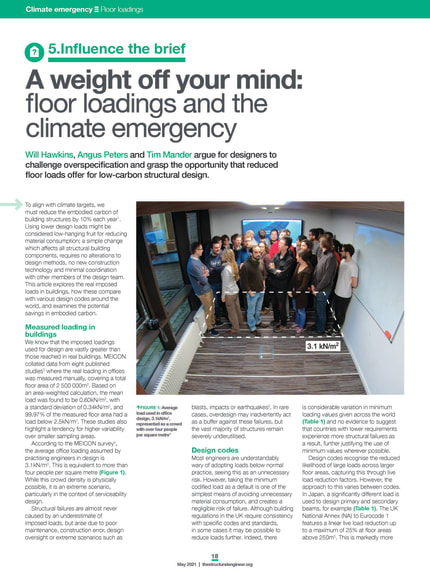
Sappiamo che i carichi imposti utilizzati per la progettazione sono di gran lunga maggiori di quelli raggiunti negli edifici reali. MEICON ha raccolto dati da otto studi pubblicati in cui il carico reale negli uffici è stato misurato manualmente, coprendo una superficie totale di 2.500.000/m2. Sulla base di un calcolo ponderato per area, il carico medio è risultato pari a 0,60 kN/m2, con una deviazione standard di 0,34 kN/m2, e 99,97% dell'area del pavimento misurata aveva un carico inferiore a 2,5 kN/m2. Questi studi evidenziano anche una tendenza a una maggiore variabilità su aree di campionamento più piccole.
Reclaimed and Reused: Recommended LCA Modeling Guidance to Support EPDs for Reused Construction Materials

Material reuse is one strategy for reducing the embodied carbon of construction. While the preparation of previously used materials for reuse has an environmental impact, it avoids many of the resource extraction and manufacturing impacts of building with newly manufactured products. Given the amount of demolition and deconstruction across North America (and beyond), there is a vast potential for material reuse to expand in scale. However, barriers to material reuse scaling exist.

DEQ Low Embodied Carbon Housing Program: Roadmap to Success

Embodied Carbon Pathways to 2050 for the United States, a collaboration between the Carbon Leadership Forum (CLF), RMI, and the University of Washington (UW) Life Cycle Lab, provides an assessment of embodied carbon from US construction materials and explores pathways to align with a 1.5°C global warming limit.

International Embodied Carbon Data Availability: A Review of Environmental Product Declaration (EPD) Availability in Europe, China, and Australia

CLF completed a landscape analysis of product-level embodied carbon data availability in regions outside North America with the goals of: (i) understanding how LCA/EPD data availability varies globally; (ii) informing where targeted initiatives are needed to increase the availability of data; and (iii) determining whether adequate EPD data exists to develop CLF Material Baselines outside North America. This report summarizes our findings and provides initial insights into what data is available to inform low-carbon procurement efforts in Australia, China, and Europe.

The CLF Benchmark Explorer

Emissions from the operations of buildings and infrastructure are significant, well-understood contributors to national and global greenhouse gas emissions. However, the contribution of embodied carbon—emissions associated with the manufacturing, transportation, installation, maintenance, and disposal of construction materials across the life cycle of a building or asset—is neglected by comparison. Even at the global level, embodied carbon estimates are typically based on manufacturing emissions from the production of a handful of the highest-impact materials (e.g. concrete, steel, aluminum, and wood).

Embodied Carbon Pathways to 2050 for the United States

Embodied Carbon Pathways to 2050 for the United States, a collaboration between the Carbon Leadership Forum (CLF), RMI, and the University of Washington (UW) Life Cycle Lab, provides an assessment of embodied carbon from US construction materials and explores pathways to align with a 1.5°C global warming limit.

Washington State Carbon Emissions Estimation: 2025 – 2050

Emissions from the operations of buildings and infrastructure are significant, well-understood contributors to national and global greenhouse gas emissions. However, the contribution of embodied carbon—emissions associated with the manufacturing, transportation, installation, maintenance, and disposal of construction materials across the life cycle of a building or asset—is neglected by comparison. Even at the global level, embodied carbon estimates are typically based on manufacturing emissions from the production of a handful of the highest-impact materials (e.g. concrete, steel, aluminum, and wood).

View all policy resources in our resource library