







Back to all resources

Charges au sol et urgence climatique

Will Hawkins, Angus Peters et Tim Mander plaident pour que les concepteurs remettent en question la surspécification et saisissent l'opportunité que les charges de plancher réduites offrent pour la conception structurelle à faible émission de carbone.

Pour nous aligner sur les objectifs climatiques, nous devons réduire le carbone incorporé des structures des bâtiments de 10% chaque année. L'utilisation de charges de conception inférieures pourrait être considérée comme un fruit à faible pendaison pour réduire la consommation de matière ; un simple changement qui affecte tous les composants structurels du bâtiment, ne nécessite aucune modification des méthodes de conception, aucune nouvelle technologie de construction et une coordination minimale avec les autres membres de l'équipe de conception. Cet article explore les charges réelles imposées dans les bâtiments, comment elles se comparent aux différents codes de conception dans le monde et examine les économies potentielles de carbone incorporé.

Charge mesurée dans les bâtiments

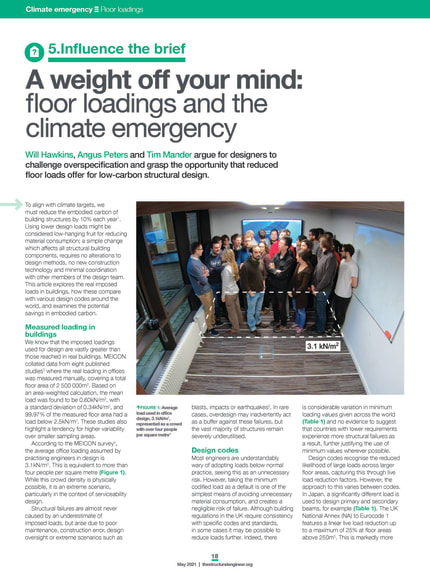
Nous savons que les charges imposées utilisées pour la conception sont largement supérieures à celles atteintes dans les bâtiments réels. MEICON a rassemblé les données de huit études publiées où la charge réelle dans les bureaux a été mesurée manuellement, couvrant une superficie totale de 2 500 000/m2. Sur la base d'un calcul pondéré en fonction de la surface, la charge moyenne s'est avérée être de 0,60 kN/m2, avec un écart type de 0,34 kN/m2, et 99,97% de la surface de plancher mesurée avait une charge inférieure à 2,5 kN/m2. Ces études mettent également en évidence une tendance à une plus grande variabilité sur des zones d'échantillonnage plus petites.
Reclaimed and Reused: Recommended LCA Modeling Guidance to Support EPDs for Reused Construction Materials

Material reuse is one strategy for reducing the embodied carbon of construction. While the preparation of previously used materials for reuse has an environmental impact, it avoids many of the resource extraction and manufacturing impacts of building with newly manufactured products. Given the amount of demolition and deconstruction across North America (and beyond), there is a vast potential for material reuse to expand in scale. However, barriers to material reuse scaling exist.

DEQ Low Embodied Carbon Housing Program: Roadmap to Success

Embodied Carbon Pathways to 2050 for the United States, a collaboration between the Carbon Leadership Forum (CLF), RMI, and the University of Washington (UW) Life Cycle Lab, provides an assessment of embodied carbon from US construction materials and explores pathways to align with a 1.5°C global warming limit.

International Embodied Carbon Data Availability: A Review of Environmental Product Declaration (EPD) Availability in Europe, China, and Australia

CLF completed a landscape analysis of product-level embodied carbon data availability in regions outside North America with the goals of: (i) understanding how LCA/EPD data availability varies globally; (ii) informing where targeted initiatives are needed to increase the availability of data; and (iii) determining whether adequate EPD data exists to develop CLF Material Baselines outside North America. This report summarizes our findings and provides initial insights into what data is available to inform low-carbon procurement efforts in Australia, China, and Europe.

The CLF Benchmark Explorer

Emissions from the operations of buildings and infrastructure are significant, well-understood contributors to national and global greenhouse gas emissions. However, the contribution of embodied carbon—emissions associated with the manufacturing, transportation, installation, maintenance, and disposal of construction materials across the life cycle of a building or asset—is neglected by comparison. Even at the global level, embodied carbon estimates are typically based on manufacturing emissions from the production of a handful of the highest-impact materials (e.g. concrete, steel, aluminum, and wood).

Embodied Carbon Pathways to 2050 for the United States

Embodied Carbon Pathways to 2050 for the United States, a collaboration between the Carbon Leadership Forum (CLF), RMI, and the University of Washington (UW) Life Cycle Lab, provides an assessment of embodied carbon from US construction materials and explores pathways to align with a 1.5°C global warming limit.

Washington State Carbon Emissions Estimation: 2025 – 2050

Emissions from the operations of buildings and infrastructure are significant, well-understood contributors to national and global greenhouse gas emissions. However, the contribution of embodied carbon—emissions associated with the manufacturing, transportation, installation, maintenance, and disposal of construction materials across the life cycle of a building or asset—is neglected by comparison. Even at the global level, embodied carbon estimates are typically based on manufacturing emissions from the production of a handful of the highest-impact materials (e.g. concrete, steel, aluminum, and wood).

View all policy resources in our resource library