







Back to all resources

Floor Loadings and the Climate Emergency

Will Hawkins, Angus Peters and Tim Mander argue for designers to challenge overspecification and grasp the opportunity that reduced floor loads offer for low-carbon structural design.

To align with climate targets, we must reduce the embodied carbon of building structures by 10% each year. Using lower design loads might be considered low-hanging fruit for reducing material consumption; a simple change which affects all structural building components, requires no alterations to design methods, no new construction technology and minimal coordination with other members of the design team. This article explores the real imposed loads in buildings, how these compare with various design codes around the world, and examines the potential savings in embodied carbon.

Measured loading in buildings

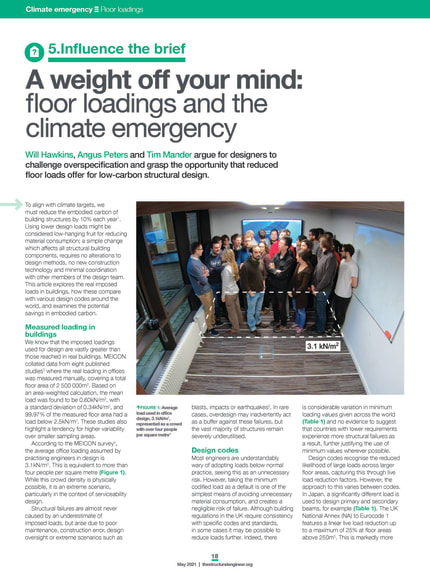
We know that the imposed loadings used for design are vastly greater than those reached in real buildings. MEICON collated data from eight published studies where the real loading in offices was measured manually, covering a total floor area of 2,500,000/m2. Based on an area-weighted calculation, the mean load was found to be 0.60kN/m2, with a standard deviation of 0.34kN/m2, and 99.97% of the measured floor area had a load below 2.5kN/m2. These studies also highlight a tendency for higher variability over smaller sampling areas.
Embodied Carbon Policy Reduction Calculator

The Policy Reduction Calculator is a web-based tool developed by the Carbon Leadership Forum to provide policymakers with data-driven insights on low embodied carbon policies in North America.

Reclaimed and Reused: Recommended LCA Modeling Guidance to Support EPDs for Reused Construction Materials

Material reuse is one strategy for reducing the embodied carbon of construction. While the preparation of previously used materials for reuse has an environmental impact, it avoids many of the resource extraction and manufacturing impacts of building with newly manufactured products. Given the amount of demolition and deconstruction across North America (and beyond), there is a vast potential for material reuse to expand in scale. However, barriers to material reuse scaling exist.

DEQ Low Embodied Carbon Housing Program: Roadmap to Success

Embodied Carbon Pathways to 2050 for the United States, a collaboration between the Carbon Leadership Forum (CLF), RMI, and the University of Washington (UW) Life Cycle Lab, provides an assessment of embodied carbon from US construction materials and explores pathways to align with a 1.5°C global warming limit.

International Embodied Carbon Data Availability: A Review of Environmental Product Declaration (EPD) Availability in Europe, China, and Australia

CLF completed a landscape analysis of product-level embodied carbon data availability in regions outside North America with the goals of: (i) understanding how LCA/EPD data availability varies globally; (ii) informing where targeted initiatives are needed to increase the availability of data; and (iii) determining whether adequate EPD data exists to develop CLF Material Baselines outside North America. This report summarizes our findings and provides initial insights into what data is available to inform low-carbon procurement efforts in Australia, China, and Europe.

The CLF Benchmark Explorer

Emissions from the operations of buildings and infrastructure are significant, well-understood contributors to national and global greenhouse gas emissions. However, the contribution of embodied carbon—emissions associated with the manufacturing, transportation, installation, maintenance, and disposal of construction materials across the life cycle of a building or asset—is neglected by comparison. Even at the global level, embodied carbon estimates are typically based on manufacturing emissions from the production of a handful of the highest-impact materials (e.g. concrete, steel, aluminum, and wood).

Embodied Carbon Pathways to 2050 for the United States

Embodied Carbon Pathways to 2050 for the United States, a collaboration between the Carbon Leadership Forum (CLF), RMI, and the University of Washington (UW) Life Cycle Lab, provides an assessment of embodied carbon from US construction materials and explores pathways to align with a 1.5°C global warming limit.

Washington State Carbon Emissions Estimation: 2025 – 2050

Emissions from the operations of buildings and infrastructure are significant, well-understood contributors to national and global greenhouse gas emissions. However, the contribution of embodied carbon—emissions associated with the manufacturing, transportation, installation, maintenance, and disposal of construction materials across the life cycle of a building or asset—is neglected by comparison. Even at the global level, embodied carbon estimates are typically based on manufacturing emissions from the production of a handful of the highest-impact materials (e.g. concrete, steel, aluminum, and wood).

View all policy resources in our resource library