







Back to all resources

Risultati a basse emissioni di carbonio

Influenza il brief

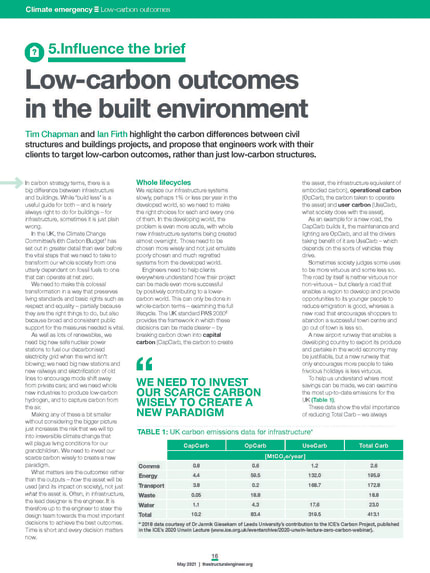
Tim Chapman e Ian Firth evidenziano le differenze di carbonio tra strutture civili e progetti di edifici e propongono che gli ingegneri lavorino con i loro clienti per mirare a risultati a basse emissioni di carbonio, piuttosto che solo a strutture a basse emissioni di carbonio.

In termini di strategia per il carbonio, c'è una grande differenza tra infrastrutture ed edifici. Sebbene 'costruire di meno' sia una guida utile per entrambi – ed è quasi sempre giusto farlo per gli edifici – per le infrastrutture, a volte è semplicemente sbagliato.

Nel Regno Unito, il sesto bilancio del carbonio del Comitato per il cambiamento climatico1 ha stabilito in modo più dettagliato che mai i passi vitali che dobbiamo compiere per trasformare la nostra intera società da una società completamente dipendente dai combustibili fossili a una che può operare a zero netto.

Dobbiamo realizzare questa colossale trasformazione in modo da preservare gli standard di vita e i diritti fondamentali come il rispetto e l'uguaglianza, in parte perché sono le cose giuste da fare, ma anche perché è vitale un sostegno pubblico ampio e coerente per le misure necessarie.

Oltre a molte energie rinnovabili, abbiamo bisogno di nuove grandi e sicure centrali nucleari per alimentare la nostra rete elettrica decarbonizzata quando non soffia il vento; abbiamo bisogno di nuove grandi stazioni e nuove ferrovie e dell'elettrificazione delle vecchie linee per incoraggiare il passaggio dalle auto private; e abbiamo bisogno di industrie completamente nuove per produrre idrogeno a basse emissioni di carbonio e per catturare il carbonio dall'aria.

Rendere uno di questi un po' più piccolo senza considerare il quadro più ampio non fa altro che aumentare il rischio di finire in un cambiamento climatico irreversibile che affligge le condizioni di vita dei nostri nipoti. Dobbiamo investire saggiamente il nostro scarso carbonio per creare un nuovo paradigma.

Ciò che conta sono i risultati piuttosto che i risultati: come verrà utilizzato il bene (e il suo impatto sulla società), non solo che cosa è il bene. Spesso, nelle infrastrutture, il progettista capo è l'ingegnere. Spetta quindi all'ingegnere guidare il team di progettazione verso le decisioni più importanti per ottenere i migliori risultati. Il tempo stringe e ogni decisione conta adesso.
Reclaimed and Reused: Recommended LCA Modeling Guidance to Support EPDs for Reused Construction Materials

Material reuse is one strategy for reducing the embodied carbon of construction. While the preparation of previously used materials for reuse has an environmental impact, it avoids many of the resource extraction and manufacturing impacts of building with newly manufactured products. Given the amount of demolition and deconstruction across North America (and beyond), there is a vast potential for material reuse to expand in scale. However, barriers to material reuse scaling exist.

DEQ Low Embodied Carbon Housing Program: Roadmap to Success

Embodied Carbon Pathways to 2050 for the United States, a collaboration between the Carbon Leadership Forum (CLF), RMI, and the University of Washington (UW) Life Cycle Lab, provides an assessment of embodied carbon from US construction materials and explores pathways to align with a 1.5°C global warming limit.

International Embodied Carbon Data Availability: A Review of Environmental Product Declaration (EPD) Availability in Europe, China, and Australia

CLF completed a landscape analysis of product-level embodied carbon data availability in regions outside North America with the goals of: (i) understanding how LCA/EPD data availability varies globally; (ii) informing where targeted initiatives are needed to increase the availability of data; and (iii) determining whether adequate EPD data exists to develop CLF Material Baselines outside North America. This report summarizes our findings and provides initial insights into what data is available to inform low-carbon procurement efforts in Australia, China, and Europe.

The CLF Benchmark Explorer

Emissions from the operations of buildings and infrastructure are significant, well-understood contributors to national and global greenhouse gas emissions. However, the contribution of embodied carbon—emissions associated with the manufacturing, transportation, installation, maintenance, and disposal of construction materials across the life cycle of a building or asset—is neglected by comparison. Even at the global level, embodied carbon estimates are typically based on manufacturing emissions from the production of a handful of the highest-impact materials (e.g. concrete, steel, aluminum, and wood).

Embodied Carbon Pathways to 2050 for the United States

Embodied Carbon Pathways to 2050 for the United States, a collaboration between the Carbon Leadership Forum (CLF), RMI, and the University of Washington (UW) Life Cycle Lab, provides an assessment of embodied carbon from US construction materials and explores pathways to align with a 1.5°C global warming limit.

Washington State Carbon Emissions Estimation: 2025 – 2050

Emissions from the operations of buildings and infrastructure are significant, well-understood contributors to national and global greenhouse gas emissions. However, the contribution of embodied carbon—emissions associated with the manufacturing, transportation, installation, maintenance, and disposal of construction materials across the life cycle of a building or asset—is neglected by comparison. Even at the global level, embodied carbon estimates are typically based on manufacturing emissions from the production of a handful of the highest-impact materials (e.g. concrete, steel, aluminum, and wood).

View all policy resources in our resource library