






Back to all resources

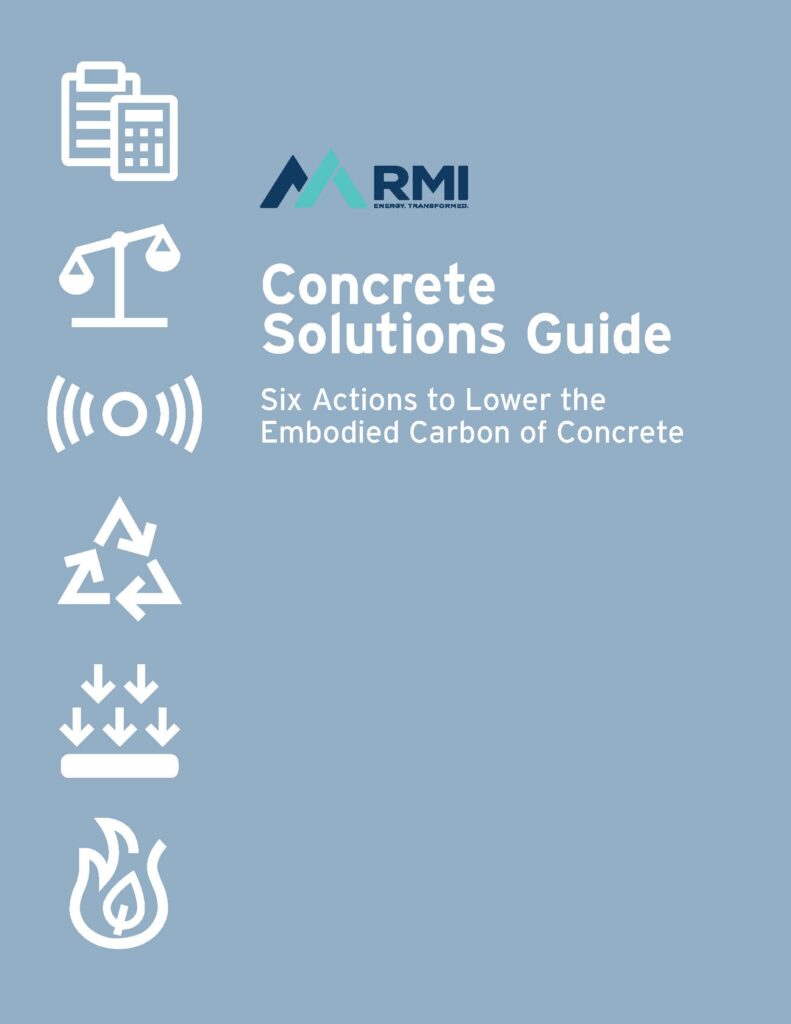
RMI-Leitfaden für Betonlösungen

Der im August 2021 veröffentlichte RMI Concrete Solutions Guide bietet einen benutzerfreundlichen Überblick über bewährte und skalierbare Lösungen zur Reduzierung des Beitrags von Beton zum Klimawandel. Der Leitfaden hebt sechs wichtige Möglichkeiten zur Reduzierung des in Betonprodukten enthaltenen Kohlenstoffs hervor, ohne die finanzielle oder materielle Leistung zu beeinträchtigen:

  1. Kennen Sie Ihre Zahlen: Leistungsorientierte Spezifikationen
  2. Mix It Up: Ergänzende zementäre Materialien (SCMs)
  3. Plug and Play: Sensoren können Zeit, Geld und Material sparen
  4. Kreislaufwirtschaft akzeptieren: Betonrecycling
  5. Carbon as a Service: CO2-Sequestrierung in Beton
  6. Nutzen Sie Green Heat: Dekarbonisieren Sie die Ofentechnologie

Laut RMI sind „die meisten der beschriebenen Lösungen marktreif – das Ergebnis jahrzehntelanger Forschung und Praxistests. Diese Lösungen tragen nicht nur dazu bei, die Umweltziele von Betonabnehmern voranzutreiben, sondern bieten den Herstellern auch Möglichkeiten zur Kostensenkung und zum Aufbau einer Führungsrolle in einer sich wandelnden Branche.“

Der RMI-Leitfaden für konkrete Lösungen zielt darauf ab, Lösungen bereitzustellen, die für das komplexe Netzwerk von Interessengruppen in der Zement- und Beton-Wertschöpfungskette nützlich sind, von Betonherstellern und Zementherstellern bis hin zu Entwicklern, Designern, Auftragnehmern und politischen Entscheidungsträgern.
Reclaimed and Reused: Recommended LCA Modeling Guidance to Support EPDs for Reused Construction Materials

Material reuse is one strategy for reducing the embodied carbon of construction. While the preparation of previously used materials for reuse has an environmental impact, it avoids many of the resource extraction and manufacturing impacts of building with newly manufactured products. Given the amount of demolition and deconstruction across North America (and beyond), there is a vast potential for material reuse to expand in scale. However, barriers to material reuse scaling exist.

DEQ Low Embodied Carbon Housing Program: Roadmap to Success

Embodied Carbon Pathways to 2050 for the United States, a collaboration between the Carbon Leadership Forum (CLF), RMI, and the University of Washington (UW) Life Cycle Lab, provides an assessment of embodied carbon from US construction materials and explores pathways to align with a 1.5°C global warming limit.

International Embodied Carbon Data Availability: A Review of Environmental Product Declaration (EPD) Availability in Europe, China, and Australia

CLF completed a landscape analysis of product-level embodied carbon data availability in regions outside North America with the goals of: (i) understanding how LCA/EPD data availability varies globally; (ii) informing where targeted initiatives are needed to increase the availability of data; and (iii) determining whether adequate EPD data exists to develop CLF Material Baselines outside North America. This report summarizes our findings and provides initial insights into what data is available to inform low-carbon procurement efforts in Australia, China, and Europe.

The CLF Benchmark Explorer

Emissions from the operations of buildings and infrastructure are significant, well-understood contributors to national and global greenhouse gas emissions. However, the contribution of embodied carbon—emissions associated with the manufacturing, transportation, installation, maintenance, and disposal of construction materials across the life cycle of a building or asset—is neglected by comparison. Even at the global level, embodied carbon estimates are typically based on manufacturing emissions from the production of a handful of the highest-impact materials (e.g. concrete, steel, aluminum, and wood).

Embodied Carbon Pathways to 2050 for the United States

Embodied Carbon Pathways to 2050 for the United States, a collaboration between the Carbon Leadership Forum (CLF), RMI, and the University of Washington (UW) Life Cycle Lab, provides an assessment of embodied carbon from US construction materials and explores pathways to align with a 1.5°C global warming limit.

Washington State Carbon Emissions Estimation: 2025 – 2050

Emissions from the operations of buildings and infrastructure are significant, well-understood contributors to national and global greenhouse gas emissions. However, the contribution of embodied carbon—emissions associated with the manufacturing, transportation, installation, maintenance, and disposal of construction materials across the life cycle of a building or asset—is neglected by comparison. Even at the global level, embodied carbon estimates are typically based on manufacturing emissions from the production of a handful of the highest-impact materials (e.g. concrete, steel, aluminum, and wood).

View all policy resources in our resource library