





Published December 2025
by Amy Hattan, Corporate Responsibility Officer, Thornton Tomasetti
When we last published in CLF’s Scheinwerfer four years ago, we had entered a new stage, bolstered by an industry that had awoken to the critical need for embodied carbon reduction. We were fostering a growing interest in the topic among our technical staff and took an active role in encouraging widespread embodied carbon reduction as an inaugural member of the Engagement der Bauingenieure 2050 (SE 2050). Early embodied carbon reduction projects, like the historic Kochhaus in London and Amazon’s headquarters in Arlington, Virginia, tested our know-how, and we released our open-source embodied carbon assessment tool, Leuchtfeuer.
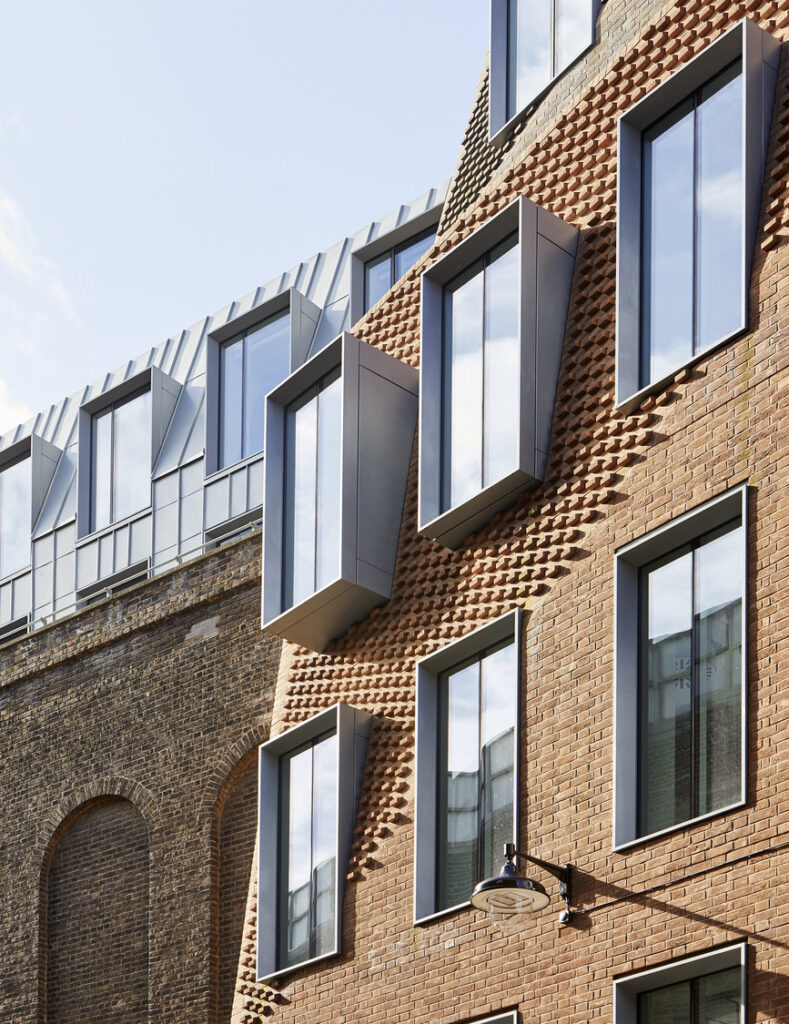
Hobhouse Court – In the heart of Central London, Hobhouse is a 7,000-square-metre mixed-use development that combines material retention with efficient design. The concrete replacement material contains 60% to 80% ground granulated blast-furnace slag. Credit: (c) Hufton+Crow
Today, in our third stage, embodied carbon reduction strategies are regularly integrated into our work. We continue to build capacity across disciplines and channel our efforts toward meaningful impact. Our internal embodied carbon community of practice has grown to 250 members across various practice areas. This organized network of our people has accelerated our progress, especially among our structural engineers, who responded to our internal call to action for every engineer to contribute to a project assessment for the SE 2050 database. In addition, our Sustainability and Resilience practice has seen growth of our life cycle assessment (LCA) work, and we are advancing our embodied carbon work in several other practices including Transportation and Façade Engineering. We also share our growing knowledge with others through our Here’s How: Embodied Carbon podcast series.
This increase in activity reflects the rising interest from clients and partners in embodied carbon reduction as a strategy to meet sustainability goals. We’ve been testing our mettle on exciting new projects that raise the bar on emissions reduction, such as Stonecutter, the lowest embodied carbon building recorded in the City of London, and Vitrum by Breakthrough, a life science building in Cambridge, U.K., that achieved a 31% reduction in embodied carbon from the LETI 2030 baseline.
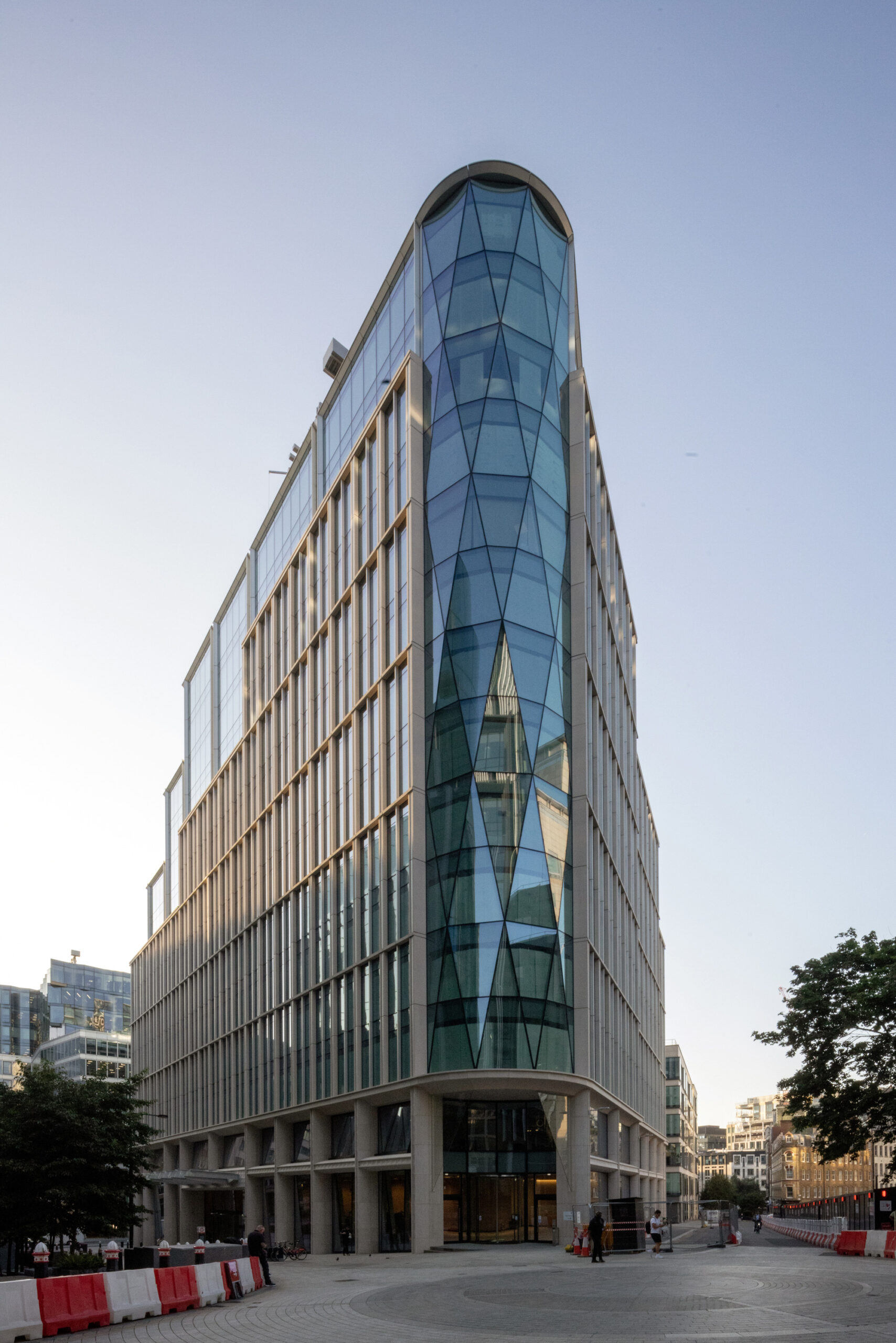
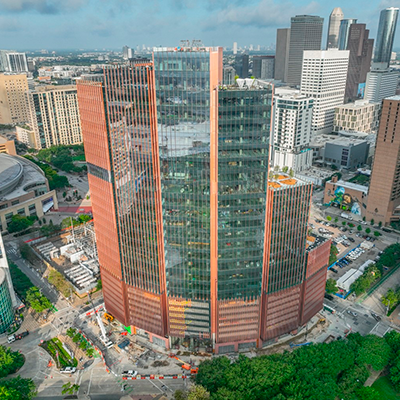
Stonecutter, a newly completed 13-story, 245,000-square-foot office building in the City of London, achieves an embodied carbon score below the London Plan’s aspirational 600 kg CO₂/m² target. Credit: Bess Adler/Thornton Tomasetti
The current stage of our journey is defined by the exploration of novel materials and new strategies. Mass timber has become a defining area for our structural work and an effective approach for lowering embodied carbon. Notable examples include Ascent in Milwaukee, which is currently the tallest mass timber structure in the world, and the Roux Institute at Northeast University, an innovative academic building that uses wood that is 80% sourced from sustainably managed forests and achieves a 25% carbon savings. We are also developing specifications for designing with low-carbon materials and supporting clients in the exploration of adjacent solutions, such as carbon capture and storage. Beyond our Beacon tool, we are integrating embodied carbon tracking into more of the structural design tools we use every day, including applications like Skipper.
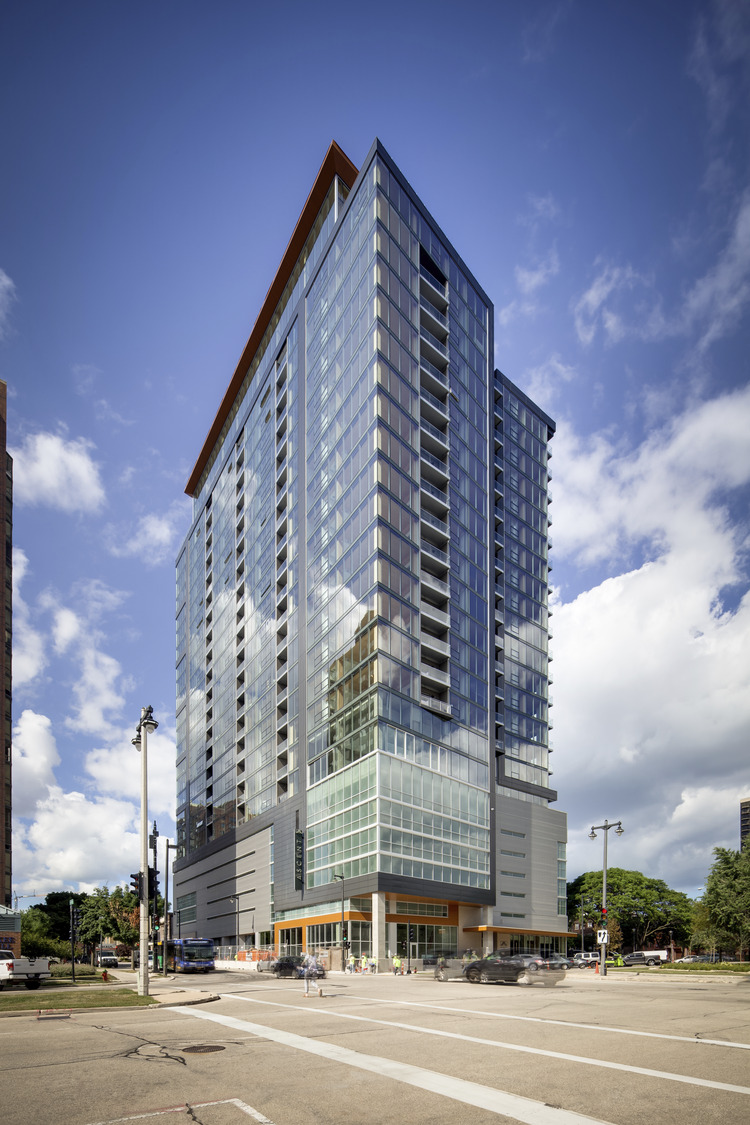
Ascent, a 25-story residential tower in Milwaukee, Wisconsin, and the world’s tallest mass timber building, employs a lightweight structural system of cross-laminated timber and glulam beams and columns over a concrete podium. Credit: Nairn Olker/Korb Architecture
Our commitment to embodied carbon reduction is interwoven with our purpose and values and supports our five-year plan, in which Climate Action is a key initiative. Climate change is one of the biggest challenges facing society today, and as such, it demands our creativity, knowledge, passion and collaboration. Our Climate Action initiative unites our engineers, scientists, architects, and sustainability experts in a shared mission to mitigate climate risks through decarbonization and resilience across our practices and projects. We are driven by the vision of helping to build and power the world–without destroying it in the process.
We hold ourselves accountable by setting measurable targets and by growing our positive “handprint” (impact) through our Climate Action work. Our Verkörperter Kohlenstoff-Aktionsplan provides the roadmap for part of our journey, including our goal of reducing embodied carbon in structural frames by 40% from our baseline. The plan also outlines objectives for education, reporting, reduction strategies, and advocacy. We are embedding Climate Action into our regular planning, onboarding and training processes, so that it becomes fully integrated into our culture.
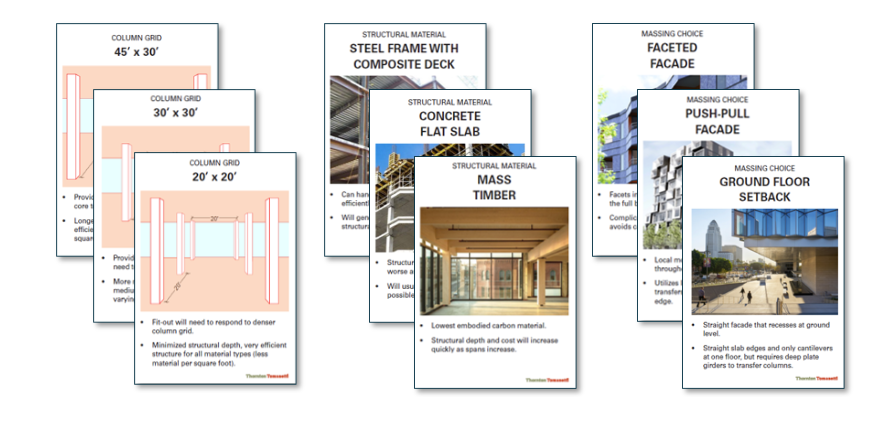
Thornton Tomasetti’s Embodied Carbon Game teaches architects, owners and other building design professionals about the major drivers of embodied carbon and how to make significant reductions while balancing competing priorities. Credit: Thornton Tomasetti
Given the narrow window available for mitigating severe climate change impacts, it is encouraging to see the increasing interest in the SE 2050 Commitment, which now has more than 150 signatory firms. As we continue this work, we also focus on educating others through activities like our embodied carbon game, which takes AEC professionals through a simulated exercise of designing for lowered embodied carbon.
We’ve always known that real progress comes from collaboration, both within our firm and across the industry. By working together, we can help more clients implement effective strategies, improve assessment methods and accelerate the adoption of innovative materials, all of which will help drive us toward a low-carbon future.

Amy Hattan, Verantwortliche für Unternehmensverantwortung, Thornton Tomasetti

Amy is the Corporate Responsibility Officer for Thornton Tomasetti. Her mission is to help more clients implement effective strategies, improve assessment methods, and accelerate the adoption of innovative materials, all of which will help drive us toward a low-carbon future.
Our commitment to embodied carbon reduction is interwoven with our purpose and values and supports our five-year plan, in which Climate Action is a key initiative. The current stage of our journey is defined by the exploration of novel materials and new strategies. Mass timber has become a defining area for our structural work and an effective approach for lowering embodied carbon.