







Back to all resources

ECOM: Embodied Carbon Estimator – Strukturen

SE 2050

Möchten Sie schnell die Embodied-Carbon-Größenordnung Ihres Projekts oder Rahmenkonzepts finden? Verwenden Sie diesen sehr einfachen Schätzer unten, den wir ECOM nennen.

ECOM steht für (E)bodied (C)arbon (O)rder of (M)agnitude und ist ein grundlegender Embodied Carbon Estimator. ECOM ermöglicht es Benutzern, ungefähre Schätzungen des verkörperten Kohlenstoffs für ein Materialprodukt, eine Rahmenbaugruppe zu Vergleichszwecken oder sogar einen gesamten strukturellen Rahmen zu bestimmen.

Die zugrunde liegenden Daten stammen aus öffentlich zugänglichen, branchenweiten Umweltproduktdeklarationen (EPDs), die für Nordamerika gelten. In den meisten Fällen handelt es sich um die von der jeweiligen Handelsorganisation erstellten EPDs und bilden die Ökobilanzmodule A1 bis A3. Weitere Erläuterungen zu den zugrunde liegenden Daten finden Sie im ECOM-Leitfaden.

Die übergeordnete Absicht dieses Schätzers besteht darin, Bauingenieuren oder Architekten einen zugänglichen Weg zur Schätzung des körpereigenen Kohlenstoffs zu bieten. Der Schätzer ist auf Benutzer aller Erfahrungsstufen anwendbar und könnte verwendet werden, um ein frühes Projekt-ROM von Embodied Carbon zu entwickeln oder um Ergebnisse einer robusteren Analyse oder etwas dazwischen zu überprüfen.

Der Schätzer berücksichtigt keine wichtigen Datenvariabilitäten im Zusammenhang mit Daten zu den Auswirkungen von Lebenszyklus-Materialien und ist nicht dazu gedacht, im Handel erhältliche Life-Cycle-Assessment- oder Materialbeschaffungstools und/oder leicht verfügbare Rechner zu ersetzen.

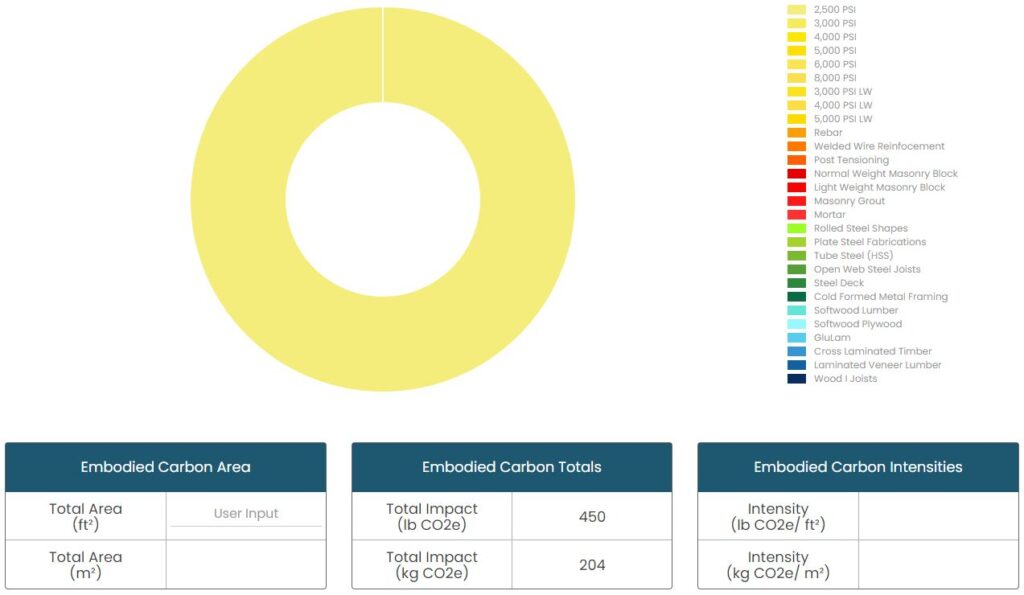
Geben Sie einfach die Materialmenge ein, um die Auswirkungen des Embodied Carbon zu erhalten, und bei größeren Systemen den Bereich zur Bewertung der Embodied Carbon Intensitäten.
Reclaimed and Reused: Recommended LCA Modeling Guidance to Support EPDs for Reused Construction Materials

Material reuse is one strategy for reducing the embodied carbon of construction. While the preparation of previously used materials for reuse has an environmental impact, it avoids many of the resource extraction and manufacturing impacts of building with newly manufactured products. Given the amount of demolition and deconstruction across North America (and beyond), there is a vast potential for material reuse to expand in scale. However, barriers to material reuse scaling exist.

DEQ Low Embodied Carbon Housing Program: Roadmap to Success

Embodied Carbon Pathways to 2050 for the United States, a collaboration between the Carbon Leadership Forum (CLF), RMI, and the University of Washington (UW) Life Cycle Lab, provides an assessment of embodied carbon from US construction materials and explores pathways to align with a 1.5°C global warming limit.

International Embodied Carbon Data Availability: A Review of Environmental Product Declaration (EPD) Availability in Europe, China, and Australia

CLF completed a landscape analysis of product-level embodied carbon data availability in regions outside North America with the goals of: (i) understanding how LCA/EPD data availability varies globally; (ii) informing where targeted initiatives are needed to increase the availability of data; and (iii) determining whether adequate EPD data exists to develop CLF Material Baselines outside North America. This report summarizes our findings and provides initial insights into what data is available to inform low-carbon procurement efforts in Australia, China, and Europe.

The CLF Benchmark Explorer

Emissions from the operations of buildings and infrastructure are significant, well-understood contributors to national and global greenhouse gas emissions. However, the contribution of embodied carbon—emissions associated with the manufacturing, transportation, installation, maintenance, and disposal of construction materials across the life cycle of a building or asset—is neglected by comparison. Even at the global level, embodied carbon estimates are typically based on manufacturing emissions from the production of a handful of the highest-impact materials (e.g. concrete, steel, aluminum, and wood).

Embodied Carbon Pathways to 2050 for the United States

Embodied Carbon Pathways to 2050 for the United States, a collaboration between the Carbon Leadership Forum (CLF), RMI, and the University of Washington (UW) Life Cycle Lab, provides an assessment of embodied carbon from US construction materials and explores pathways to align with a 1.5°C global warming limit.

Washington State Carbon Emissions Estimation: 2025 – 2050

Emissions from the operations of buildings and infrastructure are significant, well-understood contributors to national and global greenhouse gas emissions. However, the contribution of embodied carbon—emissions associated with the manufacturing, transportation, installation, maintenance, and disposal of construction materials across the life cycle of a building or asset—is neglected by comparison. Even at the global level, embodied carbon estimates are typically based on manufacturing emissions from the production of a handful of the highest-impact materials (e.g. concrete, steel, aluminum, and wood).

View all policy resources in our resource library