







Back to all resources

ECOM: Embodied Carbon Estimator – Structures

SE 2050

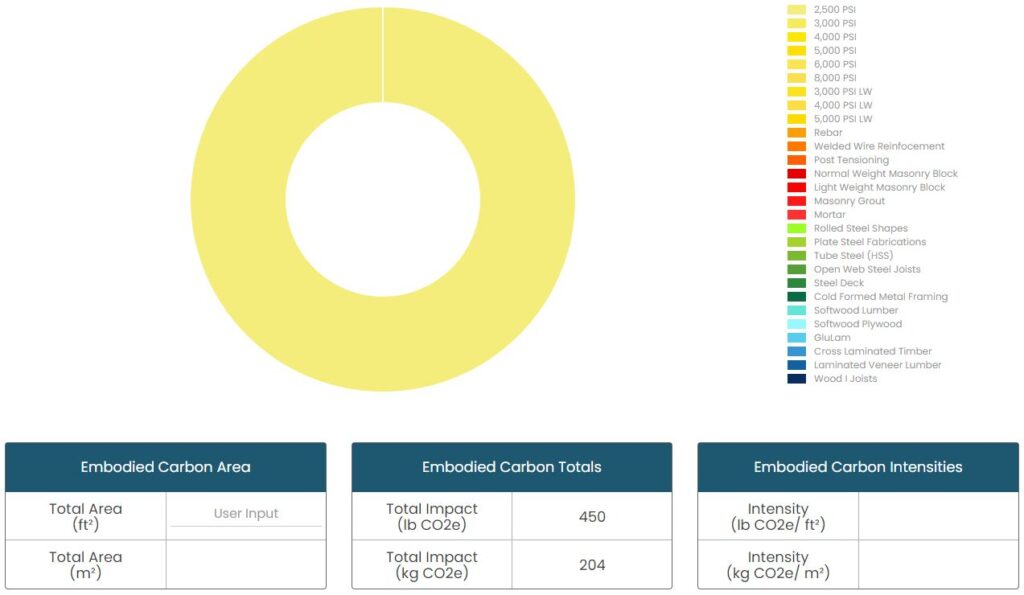
Want to quickly find the embodied carbon order of magnitude of your project or framing scheme?  Use this very simple estimator below that we call ECOM.

ECOM stands for (E)mbodied (C)arbon (O)rder of (M)agnitude and is a basic embodied carbon estimator. ECOM allows users to determine approximate estimates of embodied carbon for a material product, an assembly of framing for comparison purposes, or even an entire structural frame.

The underlying data has been gathered from publicly available industry-wide Environmental Product Declarations (EPD’s) that are applicable to North America. In most cases they are the EPD’s produced by the applicable trade organization and constitute Life-Cycle Assessment modules A1 to A3.  Please review the ECOM guidance document for further explanation of the underlying data.

This estimator’s overarching intent is to provide structural engineers or architects an approachable way to estimate embodied carbon.  The estimator is applicable to users of all experience levels and could be used to develop an early project ROM of embodied carbon or used to back check results of a more robust analysis or something in between.

The estimator does not consider important data variabilities associated with life cycle material impact data and is not intended to replace commercially available Life-Cycle Assessment or material procurement tools and/or calculators readily available.

Simply input the quantity of materials to get the embodied carbon impact and for larger schemes, the area for assessing embodied carbon intensities.
Reclaimed and Reused: Recommended LCA Modeling Guidance to Support EPDs for Reused Construction Materials

Material reuse is one strategy for reducing the embodied carbon of construction. While the preparation of previously used materials for reuse has an environmental impact, it avoids many of the resource extraction and manufacturing impacts of building with newly manufactured products. Given the amount of demolition and deconstruction across North America (and beyond), there is a vast potential for material reuse to expand in scale. However, barriers to material reuse scaling exist.

DEQ Low Embodied Carbon Housing Program: Roadmap to Success

Embodied Carbon Pathways to 2050 for the United States, a collaboration between the Carbon Leadership Forum (CLF), RMI, and the University of Washington (UW) Life Cycle Lab, provides an assessment of embodied carbon from US construction materials and explores pathways to align with a 1.5°C global warming limit.

International Embodied Carbon Data Availability: A Review of Environmental Product Declaration (EPD) Availability in Europe, China, and Australia

CLF completed a landscape analysis of product-level embodied carbon data availability in regions outside North America with the goals of: (i) understanding how LCA/EPD data availability varies globally; (ii) informing where targeted initiatives are needed to increase the availability of data; and (iii) determining whether adequate EPD data exists to develop CLF Material Baselines outside North America. This report summarizes our findings and provides initial insights into what data is available to inform low-carbon procurement efforts in Australia, China, and Europe.

The CLF Benchmark Explorer

Emissions from the operations of buildings and infrastructure are significant, well-understood contributors to national and global greenhouse gas emissions. However, the contribution of embodied carbon—emissions associated with the manufacturing, transportation, installation, maintenance, and disposal of construction materials across the life cycle of a building or asset—is neglected by comparison. Even at the global level, embodied carbon estimates are typically based on manufacturing emissions from the production of a handful of the highest-impact materials (e.g. concrete, steel, aluminum, and wood).

Embodied Carbon Pathways to 2050 for the United States

Embodied Carbon Pathways to 2050 for the United States, a collaboration between the Carbon Leadership Forum (CLF), RMI, and the University of Washington (UW) Life Cycle Lab, provides an assessment of embodied carbon from US construction materials and explores pathways to align with a 1.5°C global warming limit.

Washington State Carbon Emissions Estimation: 2025 – 2050

Emissions from the operations of buildings and infrastructure are significant, well-understood contributors to national and global greenhouse gas emissions. However, the contribution of embodied carbon—emissions associated with the manufacturing, transportation, installation, maintenance, and disposal of construction materials across the life cycle of a building or asset—is neglected by comparison. Even at the global level, embodied carbon estimates are typically based on manufacturing emissions from the production of a handful of the highest-impact materials (e.g. concrete, steel, aluminum, and wood).

View all policy resources in our resource library