






Back to all resources

Materiali per l'accumulo di carbonio

Rapporto di sintesi | Febbraio 2021

Il gruppo intergovernativo di esperti sui cambiamenti climatici (IPCC): "Limitare il riscaldamento a 1,5 gradi C richiederà la rimozione del carbonio dall'atmosfera oltre a ridurre le emissioni".

Autori

Il team di ricerca del Carbon Leadership Forum presso l'University of Washington College of Built Environments:

  • Julie Kriegh, PhD, AIA, ricercatore, Carbon Leadership Forum, Dipartimento di Architettura, College of Built Environments, Università di Washington.
  • Chris Magwood, Direttore, Endeavour Center, The Sustainable Building School, Peterborough, Ontario, Canada.
  • Wil Srubar III, PhD, Professore associato, Università del Colorado Boulder, Ingegneria civile, ambientale e architettonica, Scienza dei materiali e Programma di ingegneria.

Versione: febbraio 2021

Ringraziamenti

Il team di ricerca desidera ringraziare Microsoft per aver finanziato questa ricerca e le seguenti persone: Danielle Decatur, Microsoft, Principal Program Manager di Datacenter Sustainability; Sean James, Microsoft, Direttore della ricerca sui centri dati; Ben Stanley, consulente e project manager di WSP per la sostenibilità, l'energia e il cambiamento climatico e il team WSP Sebastian Danio-Beck, Ryan Dick, Sarah Buffaloe e Lama Bitar per il loro lavoro sul progetto, compreso il WBLCA e il supporto tecnico; Kurt Swensson, PhD, PE, consulente di ingegneria strutturale KSi per il suo lavoro sui modelli di ingegneria del data center e la revisione delle specifiche; Monica Huang, Ingegnere di ricerca, e Brook Waldman, ricercatrice e consulente del Carbon Leadership Forum per la loro assistenza nella preparazione di questo rapporto.
Citazione

Kriegh, J., Magwood, C., Srubar, W. (2021).  Materiali per lo stoccaggio del carbonio: rapporto riassuntivo.

Un futuro positivo al carbonio tra tre o cinque anni?

Il Carbon Leadership Forum presso l'Università di Washington ha recentemente completato un progetto di ricerca di quattro mesi con un'importante azienda tecnologica statunitense per comprendere il potenziale dell'utilizzo di materiali a basse emissioni di carbonio e che immagazzinano carbonio nelle nuove costruzioni. Il progetto si è concentrato su materiali hotspot ad alta intensità di carbonio (ad esempio, fondazioni in calcestruzzo e pavimenti in lastre, pannelli isolanti per tetti e pareti e intelaiature strutturali) in edifici industriali leggeri.

Lo studio ha rilevato che una riduzione considerevole (~ 60%) del carbonio incorporato è possibile in due o tre anni portando materiali a basso tenore di carbonio prontamente disponibili in un uso più ampio. Inoltre, questo lavoro prevede che la promozione di un sistema di approvvigionamento di materiali per lo stoccaggio del carbonio investendo nello sviluppo e nella produzione di nascenti industrie di materiali per lo stoccaggio del carbonio renderà possibile un futuro positivo al carbonio per i singoli progetti in tre o cinque anni (vedere la Figura 1).
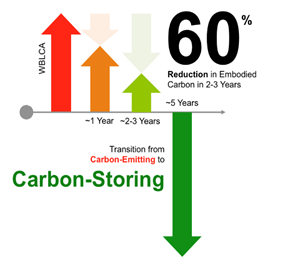
Figura 1. Potenziali riduzioni di carbonio (credito: Wil Srubar).

Reclaimed and Reused: Recommended LCA Modeling Guidance to Support EPDs for Reused Construction Materials

Material reuse is one strategy for reducing the embodied carbon of construction. While the preparation of previously used materials for reuse has an environmental impact, it avoids many of the resource extraction and manufacturing impacts of building with newly manufactured products. Given the amount of demolition and deconstruction across North America (and beyond), there is a vast potential for material reuse to expand in scale. However, barriers to material reuse scaling exist.

DEQ Low Embodied Carbon Housing Program: Roadmap to Success

Embodied Carbon Pathways to 2050 for the United States, a collaboration between the Carbon Leadership Forum (CLF), RMI, and the University of Washington (UW) Life Cycle Lab, provides an assessment of embodied carbon from US construction materials and explores pathways to align with a 1.5°C global warming limit.

International Embodied Carbon Data Availability: A Review of Environmental Product Declaration (EPD) Availability in Europe, China, and Australia

CLF completed a landscape analysis of product-level embodied carbon data availability in regions outside North America with the goals of: (i) understanding how LCA/EPD data availability varies globally; (ii) informing where targeted initiatives are needed to increase the availability of data; and (iii) determining whether adequate EPD data exists to develop CLF Material Baselines outside North America. This report summarizes our findings and provides initial insights into what data is available to inform low-carbon procurement efforts in Australia, China, and Europe.

The CLF Benchmark Explorer

Emissions from the operations of buildings and infrastructure are significant, well-understood contributors to national and global greenhouse gas emissions. However, the contribution of embodied carbon—emissions associated with the manufacturing, transportation, installation, maintenance, and disposal of construction materials across the life cycle of a building or asset—is neglected by comparison. Even at the global level, embodied carbon estimates are typically based on manufacturing emissions from the production of a handful of the highest-impact materials (e.g. concrete, steel, aluminum, and wood).

Embodied Carbon Pathways to 2050 for the United States

Embodied Carbon Pathways to 2050 for the United States, a collaboration between the Carbon Leadership Forum (CLF), RMI, and the University of Washington (UW) Life Cycle Lab, provides an assessment of embodied carbon from US construction materials and explores pathways to align with a 1.5°C global warming limit.

Washington State Carbon Emissions Estimation: 2025 – 2050

Emissions from the operations of buildings and infrastructure are significant, well-understood contributors to national and global greenhouse gas emissions. However, the contribution of embodied carbon—emissions associated with the manufacturing, transportation, installation, maintenance, and disposal of construction materials across the life cycle of a building or asset—is neglected by comparison. Even at the global level, embodied carbon estimates are typically based on manufacturing emissions from the production of a handful of the highest-impact materials (e.g. concrete, steel, aluminum, and wood).

View all policy resources in our resource library