







Back to all resources

Résultats bas carbone

Influencer le Brief

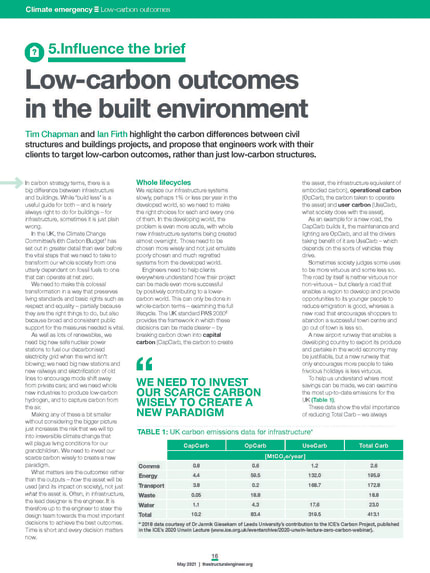
Tim Chapman et Ian Firth soulignent les différences de carbone entre les structures civiles et les projets de bâtiments, et proposent que les ingénieurs travaillent avec leurs clients pour cibler des résultats à faible émission de carbone, plutôt que simplement des structures à faible émission de carbone.

En termes de stratégie carbone, il y a une grande différence entre les infrastructures et les bâtiments. Alors que « construire moins » est un guide utile pour les deux - et est presque toujours juste à faire pour les bâtiments - pour les infrastructures, parfois c'est tout simplement faux.

Au Royaume-Uni, le 6e budget carbone du Comité sur le changement climatique1 a énoncé plus en détail que jamais les mesures vitales que nous devons prendre pour transformer l'ensemble de notre société d'une société totalement dépendante des combustibles fossiles à une société qui peut fonctionner à zéro net.

Nous devons effectuer cette transformation colossale d'une manière qui préserve le niveau de vie et les droits fondamentaux tels que le respect et l'égalité - en partie parce que ce sont les bonnes choses à faire, mais aussi parce qu'un soutien public large et cohérent aux mesures nécessaires est vital.

En plus de beaucoup d'énergies renouvelables, nous avons besoin de nouvelles grandes centrales nucléaires sûres pour alimenter notre réseau électrique décarboné lorsque le vent ne souffle pas ; nous avons besoin de nouvelles grandes gares et de nouvelles voies ferrées et de l'électrification des anciennes lignes pour encourager le changement de mode au détriment des voitures particulières ; et nous avons besoin de toutes nouvelles industries pour produire de l'hydrogène à faible teneur en carbone et pour capturer le carbone de l'air.

Rendre l'un d'entre eux un peu plus petit sans considérer la situation dans son ensemble augmente simplement le risque de basculer dans un changement climatique irréversible qui affectera les conditions de vie de nos petits-enfants. Nous devons investir judicieusement notre carbone rare pour créer un nouveau paradigme.

Ce qui compte, ce sont les résultats plutôt que les produits – comment l'actif sera utilisé (et son impact sur la société), pas seulement ce qu'est l'actif. Souvent, dans les infrastructures, le concepteur principal est l'ingénieur. Il appartient donc à l'ingénieur d'orienter l'équipe de conception vers les décisions les plus importantes pour obtenir les meilleurs résultats. Le temps presse et chaque décision compte maintenant.
Reclaimed and Reused: Recommended LCA Modeling Guidance to Support EPDs for Reused Construction Materials

Material reuse is one strategy for reducing the embodied carbon of construction. While the preparation of previously used materials for reuse has an environmental impact, it avoids many of the resource extraction and manufacturing impacts of building with newly manufactured products. Given the amount of demolition and deconstruction across North America (and beyond), there is a vast potential for material reuse to expand in scale. However, barriers to material reuse scaling exist.

DEQ Low Embodied Carbon Housing Program: Roadmap to Success

Embodied Carbon Pathways to 2050 for the United States, a collaboration between the Carbon Leadership Forum (CLF), RMI, and the University of Washington (UW) Life Cycle Lab, provides an assessment of embodied carbon from US construction materials and explores pathways to align with a 1.5°C global warming limit.

International Embodied Carbon Data Availability: A Review of Environmental Product Declaration (EPD) Availability in Europe, China, and Australia

CLF completed a landscape analysis of product-level embodied carbon data availability in regions outside North America with the goals of: (i) understanding how LCA/EPD data availability varies globally; (ii) informing where targeted initiatives are needed to increase the availability of data; and (iii) determining whether adequate EPD data exists to develop CLF Material Baselines outside North America. This report summarizes our findings and provides initial insights into what data is available to inform low-carbon procurement efforts in Australia, China, and Europe.

The CLF Benchmark Explorer

Emissions from the operations of buildings and infrastructure are significant, well-understood contributors to national and global greenhouse gas emissions. However, the contribution of embodied carbon—emissions associated with the manufacturing, transportation, installation, maintenance, and disposal of construction materials across the life cycle of a building or asset—is neglected by comparison. Even at the global level, embodied carbon estimates are typically based on manufacturing emissions from the production of a handful of the highest-impact materials (e.g. concrete, steel, aluminum, and wood).

Embodied Carbon Pathways to 2050 for the United States

Embodied Carbon Pathways to 2050 for the United States, a collaboration between the Carbon Leadership Forum (CLF), RMI, and the University of Washington (UW) Life Cycle Lab, provides an assessment of embodied carbon from US construction materials and explores pathways to align with a 1.5°C global warming limit.

Washington State Carbon Emissions Estimation: 2025 – 2050

Emissions from the operations of buildings and infrastructure are significant, well-understood contributors to national and global greenhouse gas emissions. However, the contribution of embodied carbon—emissions associated with the manufacturing, transportation, installation, maintenance, and disposal of construction materials across the life cycle of a building or asset—is neglected by comparison. Even at the global level, embodied carbon estimates are typically based on manufacturing emissions from the production of a handful of the highest-impact materials (e.g. concrete, steel, aluminum, and wood).

View all policy resources in our resource library