







Back to all resources

Resultados bajos en carbono

Influir en el resumen

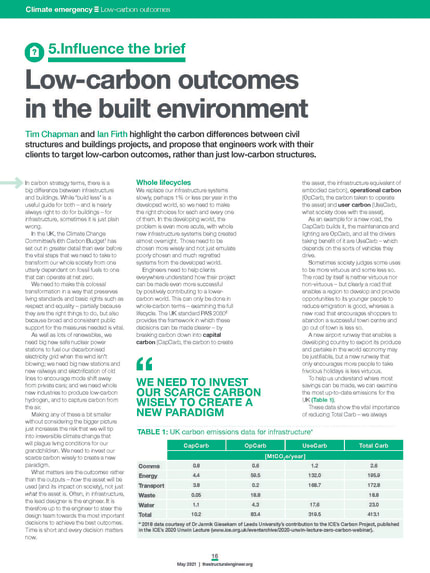
Tim Chapman e Ian Firth destacan las diferencias de carbono entre las estructuras civiles y los proyectos de edificios, y proponen que los ingenieros trabajen con sus clientes para lograr resultados bajos en carbono, en lugar de solo estructuras bajas en carbono.

En términos de estrategia de carbono, existe una gran diferencia entre infraestructura y edificios. Si bien 'construir menos' es una guía útil para ambos, y casi siempre es correcto para los edificios, para la infraestructura, a veces es simplemente incorrecto.

En el Reino Unido, el Sexto Presupuesto de Carbono del Comité de Cambio Climático1 ha establecido con más detalle que nunca los pasos vitales que debemos tomar para transformar toda nuestra sociedad de una totalmente dependiente de los combustibles fósiles a una que pueda operar a cero.

Necesitamos hacer esta transformación colosal de una manera que preserve los niveles de vida y los derechos básicos como el respeto y la igualdad, en parte porque son las cosas correctas, pero también porque es vital un apoyo público amplio y consistente para las medidas necesarias.

Además de muchas energías renovables, necesitamos grandes nuevas centrales nucleares seguras para alimentar nuestra red eléctrica descarbonizada cuando el viento no sopla; necesitamos grandes estaciones nuevas y nuevos ferrocarriles y la electrificación de las viejas líneas para alentar el cambio de modalidad de los automóviles privados; y necesitamos industrias completamente nuevas para producir hidrógeno con bajo contenido de carbono y capturar carbono del aire.

Hacer cualquiera de estos un poco más pequeño sin considerar el panorama general solo aumenta el riesgo de que caigamos en un cambio climático irreversible que afectará las condiciones de vida de nuestros nietos. Necesitamos invertir sabiamente nuestro escaso carbono para crear un nuevo paradigma.

Lo que importa son los resultados más que los productos: cómo se utilizará el activo (y su impacto en la sociedad), no solo cuál es el activo. A menudo, en infraestructura, el diseñador principal es el ingeniero. Por lo tanto, corresponde al ingeniero dirigir al equipo de diseño hacia las decisiones más importantes para lograr los mejores resultados. El tiempo es corto y cada decisión es importante ahora.
Reclaimed and Reused: Recommended LCA Modeling Guidance to Support EPDs for Reused Construction Materials

Material reuse is one strategy for reducing the embodied carbon of construction. While the preparation of previously used materials for reuse has an environmental impact, it avoids many of the resource extraction and manufacturing impacts of building with newly manufactured products. Given the amount of demolition and deconstruction across North America (and beyond), there is a vast potential for material reuse to expand in scale. However, barriers to material reuse scaling exist.

DEQ Low Embodied Carbon Housing Program: Roadmap to Success

Embodied Carbon Pathways to 2050 for the United States, a collaboration between the Carbon Leadership Forum (CLF), RMI, and the University of Washington (UW) Life Cycle Lab, provides an assessment of embodied carbon from US construction materials and explores pathways to align with a 1.5°C global warming limit.

International Embodied Carbon Data Availability: A Review of Environmental Product Declaration (EPD) Availability in Europe, China, and Australia

CLF completed a landscape analysis of product-level embodied carbon data availability in regions outside North America with the goals of: (i) understanding how LCA/EPD data availability varies globally; (ii) informing where targeted initiatives are needed to increase the availability of data; and (iii) determining whether adequate EPD data exists to develop CLF Material Baselines outside North America. This report summarizes our findings and provides initial insights into what data is available to inform low-carbon procurement efforts in Australia, China, and Europe.

The CLF Benchmark Explorer

Emissions from the operations of buildings and infrastructure are significant, well-understood contributors to national and global greenhouse gas emissions. However, the contribution of embodied carbon—emissions associated with the manufacturing, transportation, installation, maintenance, and disposal of construction materials across the life cycle of a building or asset—is neglected by comparison. Even at the global level, embodied carbon estimates are typically based on manufacturing emissions from the production of a handful of the highest-impact materials (e.g. concrete, steel, aluminum, and wood).

Embodied Carbon Pathways to 2050 for the United States

Embodied Carbon Pathways to 2050 for the United States, a collaboration between the Carbon Leadership Forum (CLF), RMI, and the University of Washington (UW) Life Cycle Lab, provides an assessment of embodied carbon from US construction materials and explores pathways to align with a 1.5°C global warming limit.

Washington State Carbon Emissions Estimation: 2025 – 2050

Emissions from the operations of buildings and infrastructure are significant, well-understood contributors to national and global greenhouse gas emissions. However, the contribution of embodied carbon—emissions associated with the manufacturing, transportation, installation, maintenance, and disposal of construction materials across the life cycle of a building or asset—is neglected by comparison. Even at the global level, embodied carbon estimates are typically based on manufacturing emissions from the production of a handful of the highest-impact materials (e.g. concrete, steel, aluminum, and wood).

View all policy resources in our resource library