






Back to all resources

LCA und Holzoptimierung

Forschungszweck:

Erkunden Sie, wie Massivholzgebäude für Materialeffizienz optimiert werden können, und unterstützen Sie eine regionalspezifische LCA-Fallstudie eines Bürogebäudes im pazifischen Nordwesten.

Report published: February, 2018

Über

Die Umstellung des Baus von niedrigen bis mittleren Gewerbe- und Nichtwohngebäuden auf Brettsperrholz (CLT) / Schwerholzbau könnte sich positiv auf die Umwelt auswirken. Es könnte auch einen neuen Markt für Holzstämme mit kleinerem Durchmesser und geringerer Qualität entwickeln, die aus Waldverdünnung und Waldgesundheit stammen, und damit einen Anreiz für Waldbewirtschaftungsmaßnahmen zur Verbesserung der Waldgesundheit und -resilienz bieten. Schließlich würde die Entwicklung einer Brettsperrholzindustrie erhebliche wirtschaftliche Vorteile und Beschäftigungsmöglichkeiten für ländliche holzabhängige Gemeinden bieten.

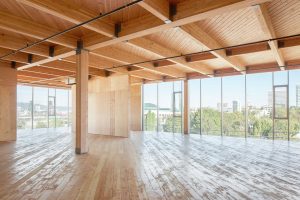
Das UW Architecture-Team definierte ein kommerzielles Referenzbürogebäude mit schwerem Holz / CLT als Ersatz für konventionelle Bauarbeiten. Das Team der School of Forest Resources entwickelte ein regional spezifisches Modell zur Bewertung des Lebenszyklus, um die Umweltauswirkungen einer potenziellen CLT-Produktion auf der Olympischen Halbinsel zu bewerten.

Ergebnisse

Zeitschriftenpublikationen

  • Pierobon, F., Huang, M., Simonen, K., Ganguly, I. Umweltvorteile der Verwendung einer Hybrid-CLT-Struktur im Nichtwohnungsbau im Mittelaufgang: Eine auf Ökobilanzen basierende vergleichende Fallstudie im Nordwesten des US-Pazifik.  Zeitschrift für Gebäudetechnik.  https://doi.org/10.1016/j.jobe.2019.100862

Forschungsgruppe

  • I. Ganguly (PI)
  • K. Simonen (Co-PI)
  • F. Pierobon
  • M. Huang
  • K. Strobel

Danksagung

Diese Forschung wurde vom USDA im Rahmen eines McIntire-Stennis-Stipendiums finanziert und umfasst Beiträge von Architekturstudenten: Mariam Hovhannisyan, Ezekiel Jones, Weston Norwood, Barbara X. Rodriguez und Kristen Strobel.
Reclaimed and Reused: Recommended LCA Modeling Guidance to Support EPDs for Reused Construction Materials

Material reuse is one strategy for reducing the embodied carbon of construction. While the preparation of previously used materials for reuse has an environmental impact, it avoids many of the resource extraction and manufacturing impacts of building with newly manufactured products. Given the amount of demolition and deconstruction across North America (and beyond), there is a vast potential for material reuse to expand in scale. However, barriers to material reuse scaling exist.

DEQ Low Embodied Carbon Housing Program: Roadmap to Success

Embodied Carbon Pathways to 2050 for the United States, a collaboration between the Carbon Leadership Forum (CLF), RMI, and the University of Washington (UW) Life Cycle Lab, provides an assessment of embodied carbon from US construction materials and explores pathways to align with a 1.5°C global warming limit.

International Embodied Carbon Data Availability: A Review of Environmental Product Declaration (EPD) Availability in Europe, China, and Australia

CLF completed a landscape analysis of product-level embodied carbon data availability in regions outside North America with the goals of: (i) understanding how LCA/EPD data availability varies globally; (ii) informing where targeted initiatives are needed to increase the availability of data; and (iii) determining whether adequate EPD data exists to develop CLF Material Baselines outside North America. This report summarizes our findings and provides initial insights into what data is available to inform low-carbon procurement efforts in Australia, China, and Europe.

The CLF Benchmark Explorer

Emissions from the operations of buildings and infrastructure are significant, well-understood contributors to national and global greenhouse gas emissions. However, the contribution of embodied carbon—emissions associated with the manufacturing, transportation, installation, maintenance, and disposal of construction materials across the life cycle of a building or asset—is neglected by comparison. Even at the global level, embodied carbon estimates are typically based on manufacturing emissions from the production of a handful of the highest-impact materials (e.g. concrete, steel, aluminum, and wood).

Embodied Carbon Pathways to 2050 for the United States

Embodied Carbon Pathways to 2050 for the United States, a collaboration between the Carbon Leadership Forum (CLF), RMI, and the University of Washington (UW) Life Cycle Lab, provides an assessment of embodied carbon from US construction materials and explores pathways to align with a 1.5°C global warming limit.

Washington State Carbon Emissions Estimation: 2025 – 2050

Emissions from the operations of buildings and infrastructure are significant, well-understood contributors to national and global greenhouse gas emissions. However, the contribution of embodied carbon—emissions associated with the manufacturing, transportation, installation, maintenance, and disposal of construction materials across the life cycle of a building or asset—is neglected by comparison. Even at the global level, embodied carbon estimates are typically based on manufacturing emissions from the production of a handful of the highest-impact materials (e.g. concrete, steel, aluminum, and wood).

View all policy resources in our resource library