






Back to all resources

Seismic Damage (ATC/FEMA P-58)

Research Purpose:

​Develop a comprehensive database of structural and non-structural building component repair.

About

In evaluating the life cycle environmental impacts of buildings, the contributions of seismic damage are rarely considered. This project developed and analyzed the largest known environmental impact database of building component seismic damage.  By extending established methods of probabilistic seismic performance evaluation to include environmental impacts, a more comprehensive assessment of a building’s expected seismic performance can be evaluated.

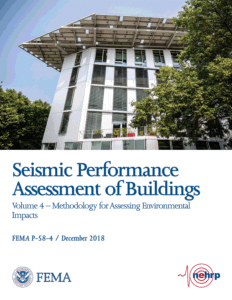
To calculate the environmental impacts, data from Carnegie Mellon University’s Green Design Institute’s Economic Input-Output Life Cycle Analysis (LCA) database were connected to previously established repair cost estimate data.  Environmental impacts, including embodied carbon, embodied energy, and other metrics, were calculated for the repair of nearly 800 building components under three or more different seismic damage levels.  This database was developed to support the Federal Emergency Management Agency’s (FEMA) Performance Assessment Calculation Tool (PACT) as a part of FEMA Project P-58.

Results

Environmental assessment work for FEMA P-58 can be found in:

Journal publications

Research Team

  • K. Simonen (UW), PI
  • M. Huang (UW)
  • P. Morris (AECOM)

Acknowledgments

This material is based upon work funded by the Federal Emergency Management Agency and managed by the Applied Technology Council (ATC) through the ATC 58-2 Project, the substance of which is dedicated to the public.  Any opinions, findings, and conclusions or recommendations expressed in the material are those of the authors and do not necessarily reflect the views of the Federal Emergency Management Agency or the Applied Technology Council.

Additional contributions from John Hooper, Anthony Court, Wayne Trusty, Mark Webster, and Jon Heinz.  We thank Chris Aicher and Professor Paul Sampson from the Department of Statistics at the University of Washington for their assistance and advisement in the statistical component of this work.  We also thank Ibrahim Almufti, his team at ARUP, and Kristen Strobel, a graduate student at the University of Washington, for their work in providing the data for the case study building as well as H. Scott Matthews at Carnegie Mellon University for his advice regarding the use of their EIO LCA database.

We would also like to acknowledge John Gillengerten, who developed the PACT model files for the case study buildings and provided guidance on their use; Vesna Terzic, who evaluated the case study buildings during their development; Scott Hagie and Russell Larson, who provided additional support for the PACT software; and Ayse Hortacsu for additional information about PACT.
Embodied Carbon Policy Reduction Calculator

The Policy Reduction Calculator is a web-based tool developed by the Carbon Leadership Forum to provide policymakers with data-driven insights on low embodied carbon policies in North America.

Reclaimed and Reused: Recommended LCA Modeling Guidance to Support EPDs for Reused Construction Materials

Material reuse is one strategy for reducing the embodied carbon of construction. While the preparation of previously used materials for reuse has an environmental impact, it avoids many of the resource extraction and manufacturing impacts of building with newly manufactured products. Given the amount of demolition and deconstruction across North America (and beyond), there is a vast potential for material reuse to expand in scale. However, barriers to material reuse scaling exist.

DEQ Low Embodied Carbon Housing Program: Roadmap to Success

Embodied Carbon Pathways to 2050 for the United States, a collaboration between the Carbon Leadership Forum (CLF), RMI, and the University of Washington (UW) Life Cycle Lab, provides an assessment of embodied carbon from US construction materials and explores pathways to align with a 1.5°C global warming limit.

International Embodied Carbon Data Availability: A Review of Environmental Product Declaration (EPD) Availability in Europe, China, and Australia

CLF completed a landscape analysis of product-level embodied carbon data availability in regions outside North America with the goals of: (i) understanding how LCA/EPD data availability varies globally; (ii) informing where targeted initiatives are needed to increase the availability of data; and (iii) determining whether adequate EPD data exists to develop CLF Material Baselines outside North America. This report summarizes our findings and provides initial insights into what data is available to inform low-carbon procurement efforts in Australia, China, and Europe.

The CLF Benchmark Explorer

Emissions from the operations of buildings and infrastructure are significant, well-understood contributors to national and global greenhouse gas emissions. However, the contribution of embodied carbon—emissions associated with the manufacturing, transportation, installation, maintenance, and disposal of construction materials across the life cycle of a building or asset—is neglected by comparison. Even at the global level, embodied carbon estimates are typically based on manufacturing emissions from the production of a handful of the highest-impact materials (e.g. concrete, steel, aluminum, and wood).

Embodied Carbon Pathways to 2050 for the United States

Embodied Carbon Pathways to 2050 for the United States, a collaboration between the Carbon Leadership Forum (CLF), RMI, and the University of Washington (UW) Life Cycle Lab, provides an assessment of embodied carbon from US construction materials and explores pathways to align with a 1.5°C global warming limit.

Washington State Carbon Emissions Estimation: 2025 – 2050

Emissions from the operations of buildings and infrastructure are significant, well-understood contributors to national and global greenhouse gas emissions. However, the contribution of embodied carbon—emissions associated with the manufacturing, transportation, installation, maintenance, and disposal of construction materials across the life cycle of a building or asset—is neglected by comparison. Even at the global level, embodied carbon estimates are typically based on manufacturing emissions from the production of a handful of the highest-impact materials (e.g. concrete, steel, aluminum, and wood).

View all policy resources in our resource library