






Back to all resources

LCA and Timber Optimization

Research Purpose:

Explore how mass timber buildings can be optimized for material efficiency, and support a regionally-specific LCA case study of an office building in the Pacific Northwest.

Report published: February, 2018

About

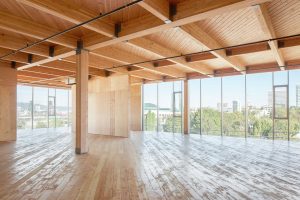
Transitioning construction of low to mid-rise commercial and non-residential structures to cross-laminated timber (CLT)/heavy timber construction could have a positive impact on the environment. It could also develop a new market for the smaller diameter and lower quality logs derived from forest thinning and forest health operations, thereby providing an incentive to undertake forest management activities designed to improve forest health and resiliency. Finally, the development of a cross-laminated timber industry would provide substantial economic benefits and employment opportunities for rural timber-dependent communities.

The UW Architecture team defined a reference commercial office building using heavy timber/CLT to substitute for conventional construction. The School of Forest Resources Team developed a regionally-specific life cycle assessment models to evaluate the environmental impact of potential CLT production in the Olympic Peninsula.

Results

Journal Publications

  • Pierobon, F., Huang, M., Simonen, K., Ganguly, I.  Environmental benefits of using hybrid CLT structure in midrise non-residential construction: An LCA based comparative case study in the U.S. Pacific Northwest.  Journal of Building Engineering.  https://doi.org/10.1016/j.jobe.2019.100862

Research team

  • I. Ganguly (PI)
  • K. Simonen (co-PI)
  • F. Pierobon
  • M. Huang
  • K. Strobel

Acknowledgments

This research was funded by the USDA under a McIntire-Stennis Grant and includes contributions from Architecture students: Mariam Hovhannisyan, Ezekiel Jones, Weston Norwood, Barbara X. Rodriguez, and Kristen Strobel.
Reclaimed and Reused: Recommended LCA Modeling Guidance to Support EPDs for Reused Construction Materials

Material reuse is one strategy for reducing the embodied carbon of construction. While the preparation of previously used materials for reuse has an environmental impact, it avoids many of the resource extraction and manufacturing impacts of building with newly manufactured products. Given the amount of demolition and deconstruction across North America (and beyond), there is a vast potential for material reuse to expand in scale. However, barriers to material reuse scaling exist.

DEQ Low Embodied Carbon Housing Program: Roadmap to Success

Embodied Carbon Pathways to 2050 for the United States, a collaboration between the Carbon Leadership Forum (CLF), RMI, and the University of Washington (UW) Life Cycle Lab, provides an assessment of embodied carbon from US construction materials and explores pathways to align with a 1.5°C global warming limit.

International Embodied Carbon Data Availability: A Review of Environmental Product Declaration (EPD) Availability in Europe, China, and Australia

CLF completed a landscape analysis of product-level embodied carbon data availability in regions outside North America with the goals of: (i) understanding how LCA/EPD data availability varies globally; (ii) informing where targeted initiatives are needed to increase the availability of data; and (iii) determining whether adequate EPD data exists to develop CLF Material Baselines outside North America. This report summarizes our findings and provides initial insights into what data is available to inform low-carbon procurement efforts in Australia, China, and Europe.

The CLF Benchmark Explorer

Emissions from the operations of buildings and infrastructure are significant, well-understood contributors to national and global greenhouse gas emissions. However, the contribution of embodied carbon—emissions associated with the manufacturing, transportation, installation, maintenance, and disposal of construction materials across the life cycle of a building or asset—is neglected by comparison. Even at the global level, embodied carbon estimates are typically based on manufacturing emissions from the production of a handful of the highest-impact materials (e.g. concrete, steel, aluminum, and wood).

Embodied Carbon Pathways to 2050 for the United States

Embodied Carbon Pathways to 2050 for the United States, a collaboration between the Carbon Leadership Forum (CLF), RMI, and the University of Washington (UW) Life Cycle Lab, provides an assessment of embodied carbon from US construction materials and explores pathways to align with a 1.5°C global warming limit.

Washington State Carbon Emissions Estimation: 2025 – 2050

Emissions from the operations of buildings and infrastructure are significant, well-understood contributors to national and global greenhouse gas emissions. However, the contribution of embodied carbon—emissions associated with the manufacturing, transportation, installation, maintenance, and disposal of construction materials across the life cycle of a building or asset—is neglected by comparison. Even at the global level, embodied carbon estimates are typically based on manufacturing emissions from the production of a handful of the highest-impact materials (e.g. concrete, steel, aluminum, and wood).

View all policy resources in our resource library