




Associate Director for Low Carbon Design
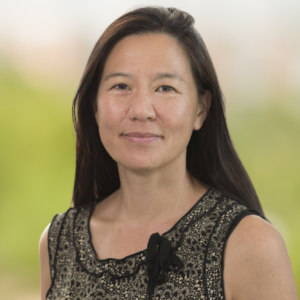
by Frances Yang
Looking back, it’s funny how a couple of seemingly-trivial choices can completely reshape your life. Back in graduate school for structural engineering, I picked up two electives purely out of curiosity. One was a course in life-cycle assessment (LCA), and the other focused on architectural design for energy and environment. As I later learned more about the massive harm that building materials and operations inflict on our natural environment, what I discovered in those classrooms introduced me to the tools that could help address them, and began to pave the path that followed.
After grad school, I spent 22 years at the engineering and design firm, Arup, and along the way, three major milestones transformed that early curiosity into a lifelong mission.
The first turning point happened during my time from 2008 to 2009 in London working with the leader of structural sustainability research for Arup, who also gave me the opportunity to work with the materials consulting team. In that time I learned of our profound paradox: the very materials we use to build shelter for humanity are often the ones doing enormous quiet harm to our planet. From that experience, it was obvious to me that we could, and should, offer a more holistic approach to evaluating the materials of our built environment. We needed to look past immediate technical performance and start accounting for the impacts hidden up in a material’s supply chain and down to its final fate, to guide ourselves and others to better choices. When I returned home, I stepped away from traditional engineering to become the first person in Arup’s Americas region focused on sustainable materials.
In the beginning, I was a team of one. But with the support of countless people, that effort blossomed into a vibrant network of over a hundred colleagues within our embodied carbon and circular economy skills network, sharing resources and strategies and influencing project outcomes. One of my favorite full-circle moments was when our 6-person regional team was dubbed a sustainable materials “center of excellence” by the global materials gurus who had given me a desk in London a decade prior.
My second milestone came through early committee work, particularly when I led authorship of the ASCE Whole Building LCA (WBLCA) Reference Structure technical guide. The people on those first years of the SEI and SEAONC sustainability committees taught me a profound lesson: the true power of working with others to create a path towards change requires us to share knowledge openly. My realization of how much more could be accomplished when we work together was a major motivator in starting up both the SE 2050 Initiative and the All for Reuse initiative. At the same time, the incredibly warm welcomes I received from established groups like the California Straw Bale Association (CASBA), Build Reuse, USGBC, and within the AIA —longtime pioneers and deep experts in natural building materials, material salvage and sustainable design, respectively—led to some of the most rewarding, forward-thinking collaborations of my career, including the Carbon-Storing Building Prototype, Material Reuse Model Specifications, the Healthier Materials Protocol, and the AIA Materials Pledge.
The third milestone was in an opportunity that came from StopWaste, to dive into policy by developing the first-of-its-kind Low Carbon Concrete Code in the Bay Area and then shepherding five pilot projects in its implementation. Seeing that localized effort ripple across the country and get emulated by other states and by the federal GSA showed me how scalable policy can change the game. I also saw how project achievements themselves can provide the basis for code change across the state (OSHPD PIN 81), through a successful alternate means of compliance for a UCSF hospital project. Subsequent policy-supportive opportunities with NRDC, NY state, Alameda County, and SF Department of Environment pushed me deeper into the policy world and closer to CLF.
Joining the Carbon Leadership Forum feels like the perfect next chapter, sharing technical guidance and developing policies through deep collaboration. As Associate Director of Low Carbon Design, I am excited to bring industry-tested insights to a global scale. I’ll be leveraging LCA and encouraging better design and procurement decisions, ignited by those two elective courses so many years ago.