






Back to all resources

Regolamentazione del carbonio incorporato

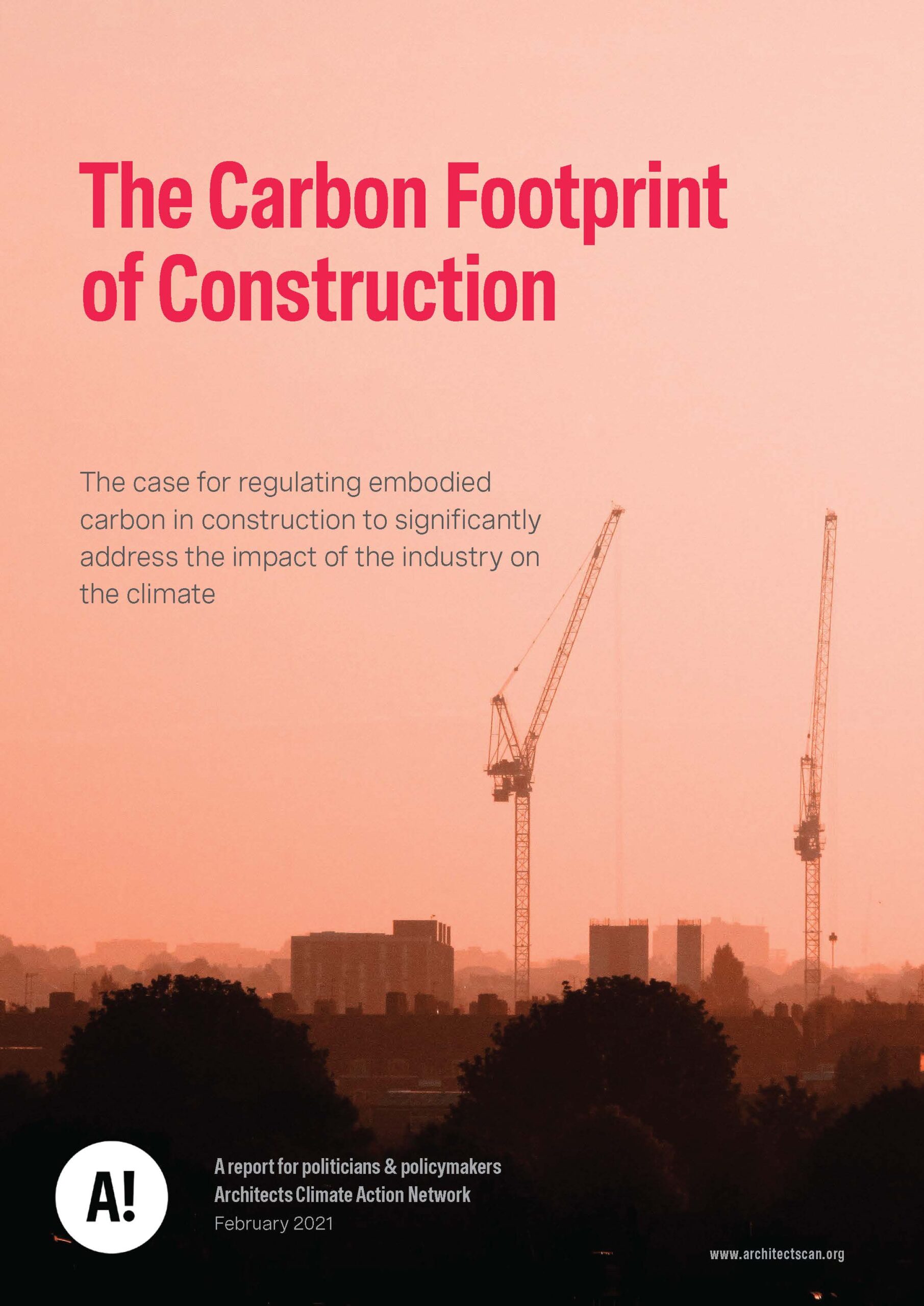
UK Architects Climate Action Network (ACAN) Report (February 2021)

ACAN is calling for the urgent introduction of legislation to regulate embodied carbon emissions generated by construction activities in the UK. Current policy and regulation focus solely on operational energy use as distinct from embodied carbon, and there are currently no national planning policy or building regulation requirements to assess, report or reduce embodied carbon emissions.

ACAN believes that only new regulations covering embodied carbon emissions will enable the UK to meet its commitments under the Paris Agreement and reduce its emissions to true net-zero (which must include both operational and embodied carbon emissions) by 2050; now a legal obligation enshrined in the Climate Change Act 2008.

In this report, ACAN asks for clear actions to be urgently adopted for the regulation and thus the dramatic reduction of embodied carbon emissions, with no further delay, including:

The Building Regulations

  • Expanding The Building Regulations to include requirements to assess, report and reduce embodied carbon, within a new part: “Part Z: Embodied Carbon Emissions”
  • Compliance to be achieved through a “Whole Life-Cycle Carbon Assessment” following the British Standard BS EN 15978
  • Limits placed on embodied carbon emissions set by building type
  • Regulation 7 to be revised to introduce carbon limits on specific materials

Planning Policy

  • Clauses to be introduced to the National Planning Policy Framework with requirements for Whole Life-Cycle Carbon Assessments to be submitted at three stages for all new buildings; as part of pre-application enquiries, full planning submissions, and at practical completion
  • As an immediate measure New London Plan Policy SI2 to be adopted by local authorities around the UK

Whole Life-Cycle Carbon Datasets

  • Create a freely accessible UK Environmental Product Declaration (EPD) database, or adopt an existing freely accessible database, to ensure consistent and reliable assessments
  • Require Environmental Product Declarations to be submitted to the database from construction material suppliers above a certain size, with trade bodies assisting smaller organisations
  • Establish a freely accessible database for anonymised Whole Life-Cycle Carbon Assessment data of new buildings, to ensure lessons are widely learnt.

In parallel ACAN has set out a timeline that will enable the UK to meet its commitments to be Net Zero Carbon by 2050 and includes the following milestones:

  • 2021: Adopt RICS “Whole Life Carbon Assessment for the Built Environment” as the nationally agreed methodology for measuring embodied carbon emissions; Revise Regulation 7; New London Plan Policy SI2 to be adopted by local authorities around the UK
  • 2022: All developments required to assess and report embodied carbon emissions
  • 2025: Introduce strict limit values on embodied carbon emissions for all developments
  • 2028: First reduction in limit values for all developments
  • 2030 – 2040: Continually review and lower the embodied carbon limit values. By 2040 whole life-cycle carbon emissions for all new and refurbished buildings should achieve net-zero.

ACAN believes that embodied carbon emissions will remain the unturned stones of the UK construction industry – with dramatic consequences for the lives of millions – as long as these proposed measures are not adopted.
Reclaimed and Reused: Recommended LCA Modeling Guidance to Support EPDs for Reused Construction Materials

Material reuse is one strategy for reducing the embodied carbon of construction. While the preparation of previously used materials for reuse has an environmental impact, it avoids many of the resource extraction and manufacturing impacts of building with newly manufactured products. Given the amount of demolition and deconstruction across North America (and beyond), there is a vast potential for material reuse to expand in scale. However, barriers to material reuse scaling exist.

DEQ Low Embodied Carbon Housing Program: Roadmap to Success

Embodied Carbon Pathways to 2050 for the United States, a collaboration between the Carbon Leadership Forum (CLF), RMI, and the University of Washington (UW) Life Cycle Lab, provides an assessment of embodied carbon from US construction materials and explores pathways to align with a 1.5°C global warming limit.

International Embodied Carbon Data Availability: A Review of Environmental Product Declaration (EPD) Availability in Europe, China, and Australia

CLF completed a landscape analysis of product-level embodied carbon data availability in regions outside North America with the goals of: (i) understanding how LCA/EPD data availability varies globally; (ii) informing where targeted initiatives are needed to increase the availability of data; and (iii) determining whether adequate EPD data exists to develop CLF Material Baselines outside North America. This report summarizes our findings and provides initial insights into what data is available to inform low-carbon procurement efforts in Australia, China, and Europe.

The CLF Benchmark Explorer

Emissions from the operations of buildings and infrastructure are significant, well-understood contributors to national and global greenhouse gas emissions. However, the contribution of embodied carbon—emissions associated with the manufacturing, transportation, installation, maintenance, and disposal of construction materials across the life cycle of a building or asset—is neglected by comparison. Even at the global level, embodied carbon estimates are typically based on manufacturing emissions from the production of a handful of the highest-impact materials (e.g. concrete, steel, aluminum, and wood).

Embodied Carbon Pathways to 2050 for the United States

Embodied Carbon Pathways to 2050 for the United States, a collaboration between the Carbon Leadership Forum (CLF), RMI, and the University of Washington (UW) Life Cycle Lab, provides an assessment of embodied carbon from US construction materials and explores pathways to align with a 1.5°C global warming limit.

Washington State Carbon Emissions Estimation: 2025 – 2050

Emissions from the operations of buildings and infrastructure are significant, well-understood contributors to national and global greenhouse gas emissions. However, the contribution of embodied carbon—emissions associated with the manufacturing, transportation, installation, maintenance, and disposal of construction materials across the life cycle of a building or asset—is neglected by comparison. Even at the global level, embodied carbon estimates are typically based on manufacturing emissions from the production of a handful of the highest-impact materials (e.g. concrete, steel, aluminum, and wood).

View all policy resources in our resource library