







Back to all resources

ECOM: stimatore di carbonio incorporato – Strutture

SE 2050

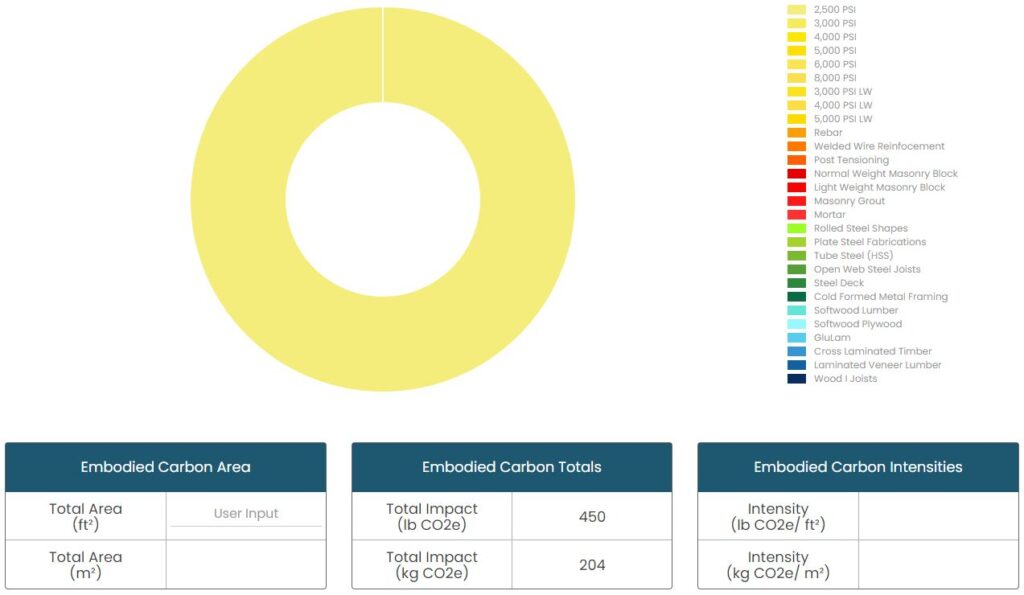
Vuoi trovare rapidamente l'ordine di grandezza del carbonio incorporato nel tuo progetto o schema di inquadratura? Usa questo stimatore molto semplice di seguito che chiamiamo ECOM.

ECOM sta per (E)mbodied (C)arbon (O)rder of (M)agnitude ed è uno stimatore di base del carbonio incorporato. ECOM consente agli utenti di determinare stime approssimative del carbonio incorporato per un prodotto materiale, un assemblaggio di telaio a scopo di confronto o persino un intero telaio strutturale.

I dati sottostanti sono stati raccolti dalle Dichiarazioni Ambientali di Prodotto (EPD) a livello di settore disponibili pubblicamente e applicabili al Nord America. Nella maggior parte dei casi sono le EPD prodotte dall'organizzazione di categoria applicabile e costituiscono i moduli di valutazione del ciclo di vita da A1 ad A3. Si prega di rivedere il documento di orientamento dell'ECOM per ulteriori spiegazioni sui dati sottostanti.

L'intento generale di questo estimatore è fornire agli ingegneri strutturali o agli architetti un modo accessibile per stimare il carbonio incorporato. Lo stimatore è applicabile agli utenti di tutti i livelli di esperienza e potrebbe essere utilizzato per sviluppare una ROM iniziale del progetto di carbonio incorporato o utilizzato per verificare i risultati di un'analisi più robusta o qualcosa nel mezzo.

Lo stimatore non considera importanti variabili di dati associate ai dati sull'impatto dei materiali del ciclo di vita e non intende sostituire la valutazione del ciclo di vita disponibile in commercio o gli strumenti e/o calcolatori di approvvigionamento dei materiali prontamente disponibili.

È sufficiente inserire la quantità di materiali per ottenere l'impatto del carbonio incorporato e, per schemi più grandi, l'area per la valutazione dell'intensità del carbonio incorporato.
Reclaimed and Reused: Recommended LCA Modeling Guidance to Support EPDs for Reused Construction Materials

Material reuse is one strategy for reducing the embodied carbon of construction. While the preparation of previously used materials for reuse has an environmental impact, it avoids many of the resource extraction and manufacturing impacts of building with newly manufactured products. Given the amount of demolition and deconstruction across North America (and beyond), there is a vast potential for material reuse to expand in scale. However, barriers to material reuse scaling exist.

DEQ Low Embodied Carbon Housing Program: Roadmap to Success

Embodied Carbon Pathways to 2050 for the United States, a collaboration between the Carbon Leadership Forum (CLF), RMI, and the University of Washington (UW) Life Cycle Lab, provides an assessment of embodied carbon from US construction materials and explores pathways to align with a 1.5°C global warming limit.

International Embodied Carbon Data Availability: A Review of Environmental Product Declaration (EPD) Availability in Europe, China, and Australia

CLF completed a landscape analysis of product-level embodied carbon data availability in regions outside North America with the goals of: (i) understanding how LCA/EPD data availability varies globally; (ii) informing where targeted initiatives are needed to increase the availability of data; and (iii) determining whether adequate EPD data exists to develop CLF Material Baselines outside North America. This report summarizes our findings and provides initial insights into what data is available to inform low-carbon procurement efforts in Australia, China, and Europe.

The CLF Benchmark Explorer

Emissions from the operations of buildings and infrastructure are significant, well-understood contributors to national and global greenhouse gas emissions. However, the contribution of embodied carbon—emissions associated with the manufacturing, transportation, installation, maintenance, and disposal of construction materials across the life cycle of a building or asset—is neglected by comparison. Even at the global level, embodied carbon estimates are typically based on manufacturing emissions from the production of a handful of the highest-impact materials (e.g. concrete, steel, aluminum, and wood).

Embodied Carbon Pathways to 2050 for the United States

Embodied Carbon Pathways to 2050 for the United States, a collaboration between the Carbon Leadership Forum (CLF), RMI, and the University of Washington (UW) Life Cycle Lab, provides an assessment of embodied carbon from US construction materials and explores pathways to align with a 1.5°C global warming limit.

Washington State Carbon Emissions Estimation: 2025 – 2050

Emissions from the operations of buildings and infrastructure are significant, well-understood contributors to national and global greenhouse gas emissions. However, the contribution of embodied carbon—emissions associated with the manufacturing, transportation, installation, maintenance, and disposal of construction materials across the life cycle of a building or asset—is neglected by comparison. Even at the global level, embodied carbon estimates are typically based on manufacturing emissions from the production of a handful of the highest-impact materials (e.g. concrete, steel, aluminum, and wood).

View all policy resources in our resource library