







Back to all resources

Considerando le estensioni verticali

Jenny Pattison discute le considerazioni tipiche che gli ingegneri strutturisti devono affrontare quando cercano di aggiungere piani a un edificio esistente e i risultati di sostenibilità delle potenziali soluzioni.

introduzione

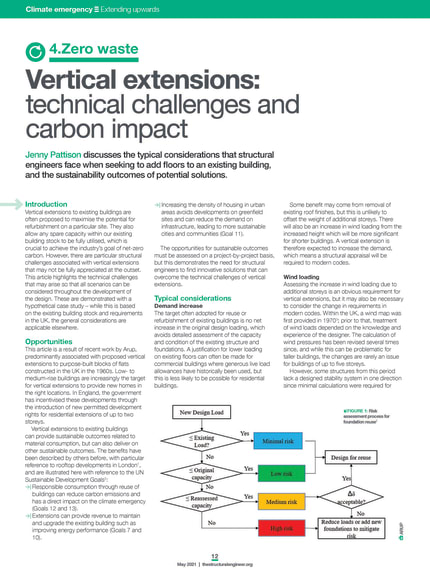
Spesso vengono proposte estensioni verticali di edifici esistenti per massimizzare il potenziale di ristrutturazione di un determinato sito. Consentono inoltre di utilizzare appieno qualsiasi capacità inutilizzata all'interno del nostro parco immobiliare esistente, il che è fondamentale per raggiungere l'obiettivo del settore di zero emissioni di carbonio. Tuttavia, ci sono particolari sfide strutturali associate alle estensioni verticali che potrebbero non essere pienamente apprezzate all'inizio. Questo articolo evidenzia le sfide tecniche che possono sorgere in modo che tutti gli scenari possano essere considerati durante lo sviluppo del progetto. Questi sono dimostrati con un caso di studio ipotetico – mentre questo si basa sul patrimonio edilizio esistente e sui requisiti nel Regno Unito, le considerazioni generali sono applicabili altrove.

Opportunità

Questo articolo è il risultato di un recente lavoro di Arup, principalmente associato a proposte di estensione verticale di blocchi di appartamenti appositamente costruiti nel Regno Unito negli anni '60. Gli edifici di bassa e media altezza sono sempre più oggetto di estensioni verticali per fornire nuove abitazioni nelle posizioni giuste. In Inghilterra, il governo ha incentivato questi sviluppi attraverso l'introduzione di nuovi diritti di sviluppo consentiti per estensioni residenziali fino a due piani.

Le estensioni verticali degli edifici esistenti possono fornire risultati sostenibili relativi al consumo di materiale, ma possono anche fornire altri risultati sostenibili. I benefici sono stati descritti da altri prima, con particolare riferimento agli sviluppi sui tetti a Londra1, e sono illustrati qui con riferimento agli obiettivi di sviluppo sostenibile delle Nazioni Unite.
Reclaimed and Reused: Recommended LCA Modeling Guidance to Support EPDs for Reused Construction Materials

Material reuse is one strategy for reducing the embodied carbon of construction. While the preparation of previously used materials for reuse has an environmental impact, it avoids many of the resource extraction and manufacturing impacts of building with newly manufactured products. Given the amount of demolition and deconstruction across North America (and beyond), there is a vast potential for material reuse to expand in scale. However, barriers to material reuse scaling exist.

DEQ Low Embodied Carbon Housing Program: Roadmap to Success

Embodied Carbon Pathways to 2050 for the United States, a collaboration between the Carbon Leadership Forum (CLF), RMI, and the University of Washington (UW) Life Cycle Lab, provides an assessment of embodied carbon from US construction materials and explores pathways to align with a 1.5°C global warming limit.

International Embodied Carbon Data Availability: A Review of Environmental Product Declaration (EPD) Availability in Europe, China, and Australia

CLF completed a landscape analysis of product-level embodied carbon data availability in regions outside North America with the goals of: (i) understanding how LCA/EPD data availability varies globally; (ii) informing where targeted initiatives are needed to increase the availability of data; and (iii) determining whether adequate EPD data exists to develop CLF Material Baselines outside North America. This report summarizes our findings and provides initial insights into what data is available to inform low-carbon procurement efforts in Australia, China, and Europe.

The CLF Benchmark Explorer

Emissions from the operations of buildings and infrastructure are significant, well-understood contributors to national and global greenhouse gas emissions. However, the contribution of embodied carbon—emissions associated with the manufacturing, transportation, installation, maintenance, and disposal of construction materials across the life cycle of a building or asset—is neglected by comparison. Even at the global level, embodied carbon estimates are typically based on manufacturing emissions from the production of a handful of the highest-impact materials (e.g. concrete, steel, aluminum, and wood).

Embodied Carbon Pathways to 2050 for the United States

Embodied Carbon Pathways to 2050 for the United States, a collaboration between the Carbon Leadership Forum (CLF), RMI, and the University of Washington (UW) Life Cycle Lab, provides an assessment of embodied carbon from US construction materials and explores pathways to align with a 1.5°C global warming limit.

Washington State Carbon Emissions Estimation: 2025 – 2050

Emissions from the operations of buildings and infrastructure are significant, well-understood contributors to national and global greenhouse gas emissions. However, the contribution of embodied carbon—emissions associated with the manufacturing, transportation, installation, maintenance, and disposal of construction materials across the life cycle of a building or asset—is neglected by comparison. Even at the global level, embodied carbon estimates are typically based on manufacturing emissions from the production of a handful of the highest-impact materials (e.g. concrete, steel, aluminum, and wood).

View all policy resources in our resource library