







Back to all resources

Cargas de piso y la emergencia climática

Will Hawkins, Angus Peters y Tim Mander abogan por que los diseñadores desafíen las especificaciones excesivas y aprovechen la oportunidad que ofrecen las cargas de suelo reducidas para el diseño estructural con bajas emisiones de carbono.

Para alinearnos con los objetivos climáticos, debemos reducir el carbono incorporado de las estructuras de construcción en 10% cada año. El uso de cargas de diseño más bajas podría considerarse una fruta madura para reducir el consumo de material; un cambio simple que afecta a todos los componentes estructurales del edificio, no requiere alteraciones en los métodos de diseño, ninguna nueva tecnología de construcción y una coordinación mínima con otros miembros del equipo de diseño. Este artículo explora las cargas impuestas reales en los edificios, cómo se comparan con varios códigos de diseño en todo el mundo y examina los ahorros potenciales en el carbono incorporado.

Carga medida en edificios

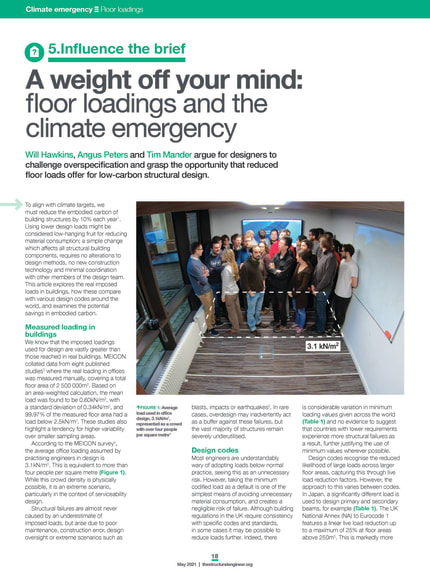
Sabemos que las cargas impuestas utilizadas para el diseño son mucho mayores que las que se alcanzan en los edificios reales. MEICON recopiló datos de ocho estudios publicados en los que la carga real en las oficinas se midió manualmente, cubriendo una superficie total de 2 500 000/m2. Según un cálculo ponderado por área, se encontró que la carga media era de 0,60 kN/m2, con una desviación estándar de 0,34 kN/m2, y 99,971 TP2T del área de piso medida tenían una carga inferior a 2,5 kN/m2. Estos estudios también destacan una tendencia a una mayor variabilidad en áreas de muestreo más pequeñas.
Reclaimed and Reused: Recommended LCA Modeling Guidance to Support EPDs for Reused Construction Materials

Material reuse is one strategy for reducing the embodied carbon of construction. While the preparation of previously used materials for reuse has an environmental impact, it avoids many of the resource extraction and manufacturing impacts of building with newly manufactured products. Given the amount of demolition and deconstruction across North America (and beyond), there is a vast potential for material reuse to expand in scale. However, barriers to material reuse scaling exist.

DEQ Low Embodied Carbon Housing Program: Roadmap to Success

Embodied Carbon Pathways to 2050 for the United States, a collaboration between the Carbon Leadership Forum (CLF), RMI, and the University of Washington (UW) Life Cycle Lab, provides an assessment of embodied carbon from US construction materials and explores pathways to align with a 1.5°C global warming limit.

International Embodied Carbon Data Availability: A Review of Environmental Product Declaration (EPD) Availability in Europe, China, and Australia

CLF completed a landscape analysis of product-level embodied carbon data availability in regions outside North America with the goals of: (i) understanding how LCA/EPD data availability varies globally; (ii) informing where targeted initiatives are needed to increase the availability of data; and (iii) determining whether adequate EPD data exists to develop CLF Material Baselines outside North America. This report summarizes our findings and provides initial insights into what data is available to inform low-carbon procurement efforts in Australia, China, and Europe.

The CLF Benchmark Explorer

Emissions from the operations of buildings and infrastructure are significant, well-understood contributors to national and global greenhouse gas emissions. However, the contribution of embodied carbon—emissions associated with the manufacturing, transportation, installation, maintenance, and disposal of construction materials across the life cycle of a building or asset—is neglected by comparison. Even at the global level, embodied carbon estimates are typically based on manufacturing emissions from the production of a handful of the highest-impact materials (e.g. concrete, steel, aluminum, and wood).

Embodied Carbon Pathways to 2050 for the United States

Embodied Carbon Pathways to 2050 for the United States, a collaboration between the Carbon Leadership Forum (CLF), RMI, and the University of Washington (UW) Life Cycle Lab, provides an assessment of embodied carbon from US construction materials and explores pathways to align with a 1.5°C global warming limit.

Washington State Carbon Emissions Estimation: 2025 – 2050

Emissions from the operations of buildings and infrastructure are significant, well-understood contributors to national and global greenhouse gas emissions. However, the contribution of embodied carbon—emissions associated with the manufacturing, transportation, installation, maintenance, and disposal of construction materials across the life cycle of a building or asset—is neglected by comparison. Even at the global level, embodied carbon estimates are typically based on manufacturing emissions from the production of a handful of the highest-impact materials (e.g. concrete, steel, aluminum, and wood).

View all policy resources in our resource library