






Back to all resources

LCA e ottimizzazione del legname

Scopo della ricerca:

Esplora come gli edifici in legno massiccio possono essere ottimizzati per l'efficienza dei materiali e supporta un caso di studio LCA specifico a livello regionale di un edificio per uffici nel Pacifico nord-occidentale.

Report published: February, 2018

Di

La transizione dalla costruzione di strutture commerciali e non residenziali di altezza medio-bassa alla costruzione in legno lamellare (CLT) / legno pesante potrebbe avere un impatto positivo sull'ambiente. Potrebbe anche sviluppare un nuovo mercato per i tronchi di diametro inferiore e di qualità inferiore derivati da operazioni di diradamento e salute delle foreste, fornendo in tal modo un incentivo a intraprendere attività di gestione forestale progettate per migliorare la salute e la resilienza delle foreste. Infine, lo sviluppo di un'industria del legno a strati incrociati fornirebbe vantaggi economici sostanziali e opportunità di lavoro per le comunità rurali dipendenti dal legno.

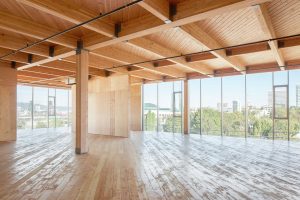
Il team di UW Architecture ha definito un edificio per uffici commerciali di riferimento utilizzando legno pesante / CLT per sostituire la costruzione convenzionale. Il team della School of Forest Resources ha sviluppato modelli di valutazione del ciclo di vita specifici per regione per valutare l'impatto ambientale della potenziale produzione di CLT nella penisola olimpica.

Risultati

Pubblicazioni su riviste

  • Pierobon, F., Huang, M., Simonen, K., Ganguly, I. Benefici ambientali dell'utilizzo di una struttura CLT ibrida in edilizia non residenziale di media altezza: un caso di studio comparativo basato su LCA nel Pacifico nord-occidentale degli Stati Uniti.  Giornale di ingegneria edile.  https://doi.org/10.1016/j.jobe.2019.100862

Gruppo di ricerca

  • I. Ganguly (PI)
  • K. Simonen (co-PI)
  • F. Pierobon
  • M. Huang
  • K. Strobel

Ringraziamenti

Questa ricerca è stata finanziata dall'USDA con una borsa di studio McIntire-Stennis e include contributi di studenti di architettura: Mariam Hovhannisyan, Ezekiel Jones, Weston Norwood, Barbara X. Rodriguez e Kristen Strobel.
Reclaimed and Reused: Recommended LCA Modeling Guidance to Support EPDs for Reused Construction Materials

Material reuse is one strategy for reducing the embodied carbon of construction. While the preparation of previously used materials for reuse has an environmental impact, it avoids many of the resource extraction and manufacturing impacts of building with newly manufactured products. Given the amount of demolition and deconstruction across North America (and beyond), there is a vast potential for material reuse to expand in scale. However, barriers to material reuse scaling exist.

DEQ Low Embodied Carbon Housing Program: Roadmap to Success

Embodied Carbon Pathways to 2050 for the United States, a collaboration between the Carbon Leadership Forum (CLF), RMI, and the University of Washington (UW) Life Cycle Lab, provides an assessment of embodied carbon from US construction materials and explores pathways to align with a 1.5°C global warming limit.

International Embodied Carbon Data Availability: A Review of Environmental Product Declaration (EPD) Availability in Europe, China, and Australia

CLF completed a landscape analysis of product-level embodied carbon data availability in regions outside North America with the goals of: (i) understanding how LCA/EPD data availability varies globally; (ii) informing where targeted initiatives are needed to increase the availability of data; and (iii) determining whether adequate EPD data exists to develop CLF Material Baselines outside North America. This report summarizes our findings and provides initial insights into what data is available to inform low-carbon procurement efforts in Australia, China, and Europe.

The CLF Benchmark Explorer

Emissions from the operations of buildings and infrastructure are significant, well-understood contributors to national and global greenhouse gas emissions. However, the contribution of embodied carbon—emissions associated with the manufacturing, transportation, installation, maintenance, and disposal of construction materials across the life cycle of a building or asset—is neglected by comparison. Even at the global level, embodied carbon estimates are typically based on manufacturing emissions from the production of a handful of the highest-impact materials (e.g. concrete, steel, aluminum, and wood).

Embodied Carbon Pathways to 2050 for the United States

Embodied Carbon Pathways to 2050 for the United States, a collaboration between the Carbon Leadership Forum (CLF), RMI, and the University of Washington (UW) Life Cycle Lab, provides an assessment of embodied carbon from US construction materials and explores pathways to align with a 1.5°C global warming limit.

Washington State Carbon Emissions Estimation: 2025 – 2050

Emissions from the operations of buildings and infrastructure are significant, well-understood contributors to national and global greenhouse gas emissions. However, the contribution of embodied carbon—emissions associated with the manufacturing, transportation, installation, maintenance, and disposal of construction materials across the life cycle of a building or asset—is neglected by comparison. Even at the global level, embodied carbon estimates are typically based on manufacturing emissions from the production of a handful of the highest-impact materials (e.g. concrete, steel, aluminum, and wood).

View all policy resources in our resource library