






Washington State Department of Transportation Greenhouse Gas Emissions Project / April 2023
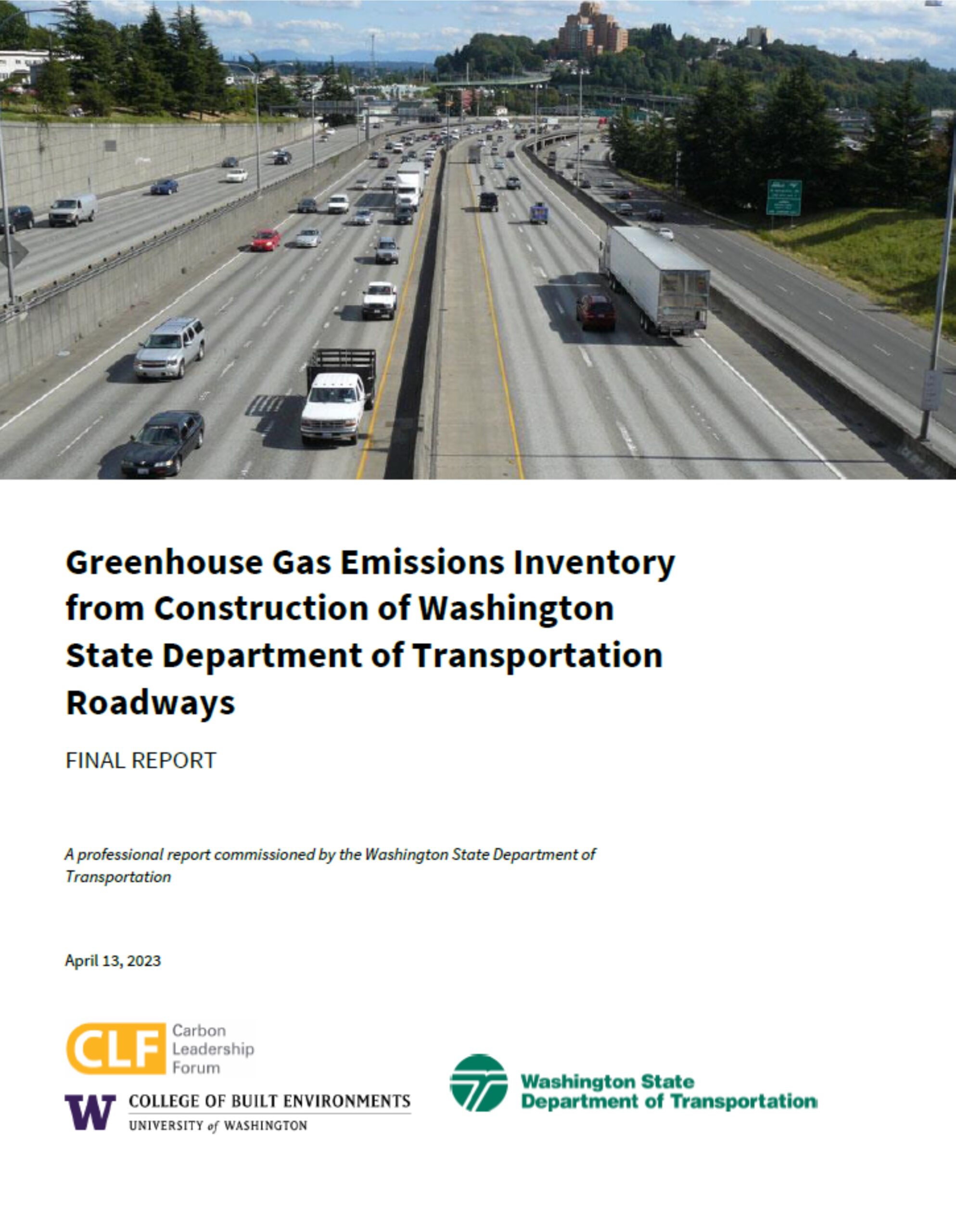
A growing number of federal and state-level policies have started requiring embodied carbon reporting from roadway construction projects. However, few have inventories and/or baselines established. This report summarizes our efforts to inventory the embodied carbon from materials used to build roadways operated by the Washington State Department of Transportation (WSDOT). In this project, we developed 1) embodied carbon baselines reflecting WSDOT’s current construction stock from the past 5 years, 2) carbon reduction targets, and 3) recommendations including decarbonization scenarios tailored to WSDOT’s roadway construction.
Di
Recent emphasis on actions to reduce large-scale greenhouse gas (GHG) emissions has pushed most state departments of transportation (DOTs) to develop carbon accounting practices compatible with their current standard data collection and storage practices. In particular, with the recently passed Buy Clean Acts in California, Colorado, and Oregon and the recently proposed Buy Clean and Buy Fair Washington Act, common construction materials such as cement concrete, steel, and asphalt are now under special attention. Once accurate and reliable accounting of GHG emissions is established, strategies can be formed that would help mitigate the adverse environmental impacts of materials utilized by state DOTs.
This project, in collaboration with the Washington State Department of Transportation (WSDOT), is an attempt to perform a life cycle assessment (LCA) on some of the agency-wide operations that emit GHGs. To date, WSDOT has not conducted a comprehensive assessment on the embodied carbon of its construction material usage (i.e., upstream Scope 3 emissions inventory) with most previous carbon accounting practices being focused on Scope 1 and Scope 2 emissions (i.e., the carbon footprint of direct and indirect energy usage).
Although several strategies are now in place to cut Scope 1 and 2 emissions, such as the use of alternative and renewable energy sources, strategies to reduce Scope 3 emissions have neither been fully recognized nor quantified. Therefore, this project uses several data sources from WSDOT in conjunction with lifecycle emission factor data to estimate GHG emissions from the materials used to build and maintain roadways under WSDOT’s jurisdiction. We found that upstream Scope 3 emissions for WSDOT as an agency contributes to more than half of its currently tracked total GHG emissions inventory by a five-year average of 310 thousand metric tons of CO2eq. This project further suggests carbon reduction targets for WSDOT and uses decarbonation scenarios to provide recommendations to achieve GHG reduction targets of 50% below the 2020 baseline in 2030 and 90% below the 2020 baseline in 2050 .
Ringraziamenti
This research was funded by the Washington State Department of Transportation (WSDOT). We would like to thank the following individuals for their help throughout the project conceptualization and delivery:
- Washington State Department of Transportation (WSDOT)
- Kurt Williams, State Construction Materials Engineer
- Steve Davis, Assistant State Materials Engineer
- Jim Weston, Roadway Operations Manager, Maintenance Division
- Jon Peterson, Research Manager
- Jonathan Olds, Senior Policy Specialist for Climate Change, Environmental Services Office
- Tran Loc (former WSDOT staff), Electrical Engineer, HQ Materials Laboratory
- Rebecca Howe, HQ Construction Division
- Dinesh Velupula, IT Application Developer
- Donny Henderson, Materials Quality Assurance Engineer
- John Henry Waugh, Maintenance Division
- Anthony Mizumori, Bridge & Structures Division
- Jon Deffenbacher, Deputy State Construction Engineer
- Steve Holloway, Operations and Inventory Manager
- Jim Rodgers, Programming & Project Delivery Manager
- Mark Smith, State Facilities Administrator
- Tomi Hume-Pontius, PS&E Engineer
- Nicole Knudson, Maintenance Division
- Trett Sutter, Maintenance Technology Resource Manager, Maintenance Operations Division
- Kevin Bartoy, Environmental Stewardship & Sustainability Program Manager, Washington State Ferries
- Jianhua Li, Pavement Engineer
- Washington Asphalt Pavement Association (WAPA)
- Kim Schofield, Technical Director
- Dave Gent, Executive Director
- National Asphalt Pavement Association (NAPA)
- Joseph Shacat, Director, Sustainable Pavements
- Richard Willis, Vice President, Engineering, Research, and Technology
- Forum sulla leadership del carbonio
- Jordan Palmeri
- Anthony Hickling
- Università di Washington
- Stephen Muench, Professor, Department of Civil and Environmental Engineering
- Mark Hallenbeck, Director, Washington State Transportation Center
Autori
The individuals from the Carbon Leadership Forum at the University of Washington College of Built Environments who worked on this report are:
- Milad Ashtiani (M.A.), Research Engineer
- Meghan Lewis (M.L.), Senior Researcher
- Monica Huang (M.H.), Research Engineer
- Kate Simonen (K.S.), Executive Director
The authors confirm their contribution to the report as follows: Conceptualization: M.L., M.H., and K.S. Background Research: M.A., M.L., M.H. Interviews and External Meetings: M.A., M.H., M.L. Data Collection and Analysis: M.A. Methodology: M.A. Graphics & Visualization: M.A. Writing – original draft: M.A. Writing – review & editing: M.A., M.L., K.S. Project Administration: M.H., M.L.
Citazione
Ashtiani, M., Lewis, M., Huang, M., Simonen, K. (2023). Greenhouse Gas Emissions Inventory from Construction of Washington State Department of Transportation Roadways. Carbon Leadership Forum, University of Washington, Seattle, WA.
Permalink: http://hdl.handle.net/1773/49963
Diritto d'autore
Greenhouse Gas Emissions Inventory from Construction of Washington State Department of Transportation Roadways è distribuito con licenza Creative Commons Attribution 4.0 International.