







Back to all resources

ECOM : Estimateur de Carbone Incarné – Structures

SE 2050

Vous souhaitez connaître rapidement l'ordre de grandeur du carbone incorporé de votre projet ou schéma d'encadrement ? Utilisez cet estimateur très simple ci-dessous que nous appelons ECOM.

ECOM signifie (E)corps (C)arbon (O)rder of (M)agnitude et est un estimateur de base du carbone incorporé. ECOM permet aux utilisateurs de déterminer des estimations approximatives de carbone incorporé pour un produit matériel, un assemblage de charpente à des fins de comparaison, ou même un cadre structurel entier.

Les données sous-jacentes ont été recueillies à partir de déclarations environnementales de produits (EPD) accessibles au public et applicables à l'Amérique du Nord. Dans la plupart des cas, ce sont des EPD produites par l'organisation professionnelle concernée et constituent les modules d'évaluation du cycle de vie A1 à A3. Veuillez consulter le document d'orientation ECOM pour plus d'explications sur les données sous-jacentes.

L'objectif principal de cet estimateur est de fournir aux ingénieurs ou architectes en structure un moyen accessible d'estimer le carbone incorporé. L'estimateur est applicable aux utilisateurs de tous les niveaux d'expérience et pourrait être utilisé pour développer une première ROM de projet de carbone incorporé ou utilisé pour vérifier les résultats d'une analyse plus robuste ou quelque chose entre les deux.

L'estimateur ne prend pas en compte les variabilités importantes des données associées aux données d'impact sur les matériaux du cycle de vie et n'est pas destiné à remplacer l'évaluation du cycle de vie ou les outils et/ou calculatrices d'approvisionnement en matériaux disponibles dans le commerce.

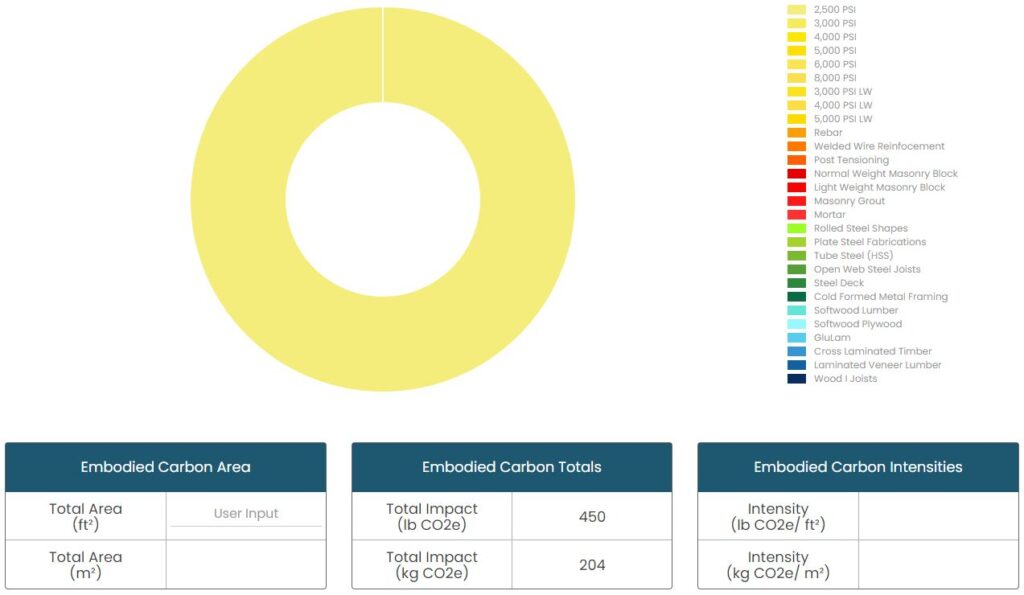
Entrez simplement la quantité de matériaux pour obtenir l'impact du carbone incorporé et pour les projets plus importants, la zone d'évaluation des intensités de carbone incorporé.
Reclaimed and Reused: Recommended LCA Modeling Guidance to Support EPDs for Reused Construction Materials

Material reuse is one strategy for reducing the embodied carbon of construction. While the preparation of previously used materials for reuse has an environmental impact, it avoids many of the resource extraction and manufacturing impacts of building with newly manufactured products. Given the amount of demolition and deconstruction across North America (and beyond), there is a vast potential for material reuse to expand in scale. However, barriers to material reuse scaling exist.

DEQ Low Embodied Carbon Housing Program: Roadmap to Success

Embodied Carbon Pathways to 2050 for the United States, a collaboration between the Carbon Leadership Forum (CLF), RMI, and the University of Washington (UW) Life Cycle Lab, provides an assessment of embodied carbon from US construction materials and explores pathways to align with a 1.5°C global warming limit.

International Embodied Carbon Data Availability: A Review of Environmental Product Declaration (EPD) Availability in Europe, China, and Australia

CLF completed a landscape analysis of product-level embodied carbon data availability in regions outside North America with the goals of: (i) understanding how LCA/EPD data availability varies globally; (ii) informing where targeted initiatives are needed to increase the availability of data; and (iii) determining whether adequate EPD data exists to develop CLF Material Baselines outside North America. This report summarizes our findings and provides initial insights into what data is available to inform low-carbon procurement efforts in Australia, China, and Europe.

The CLF Benchmark Explorer

Emissions from the operations of buildings and infrastructure are significant, well-understood contributors to national and global greenhouse gas emissions. However, the contribution of embodied carbon—emissions associated with the manufacturing, transportation, installation, maintenance, and disposal of construction materials across the life cycle of a building or asset—is neglected by comparison. Even at the global level, embodied carbon estimates are typically based on manufacturing emissions from the production of a handful of the highest-impact materials (e.g. concrete, steel, aluminum, and wood).

Embodied Carbon Pathways to 2050 for the United States

Embodied Carbon Pathways to 2050 for the United States, a collaboration between the Carbon Leadership Forum (CLF), RMI, and the University of Washington (UW) Life Cycle Lab, provides an assessment of embodied carbon from US construction materials and explores pathways to align with a 1.5°C global warming limit.

Washington State Carbon Emissions Estimation: 2025 – 2050

Emissions from the operations of buildings and infrastructure are significant, well-understood contributors to national and global greenhouse gas emissions. However, the contribution of embodied carbon—emissions associated with the manufacturing, transportation, installation, maintenance, and disposal of construction materials across the life cycle of a building or asset—is neglected by comparison. Even at the global level, embodied carbon estimates are typically based on manufacturing emissions from the production of a handful of the highest-impact materials (e.g. concrete, steel, aluminum, and wood).

View all policy resources in our resource library