







Back to all resources

Considérer les extensions verticales

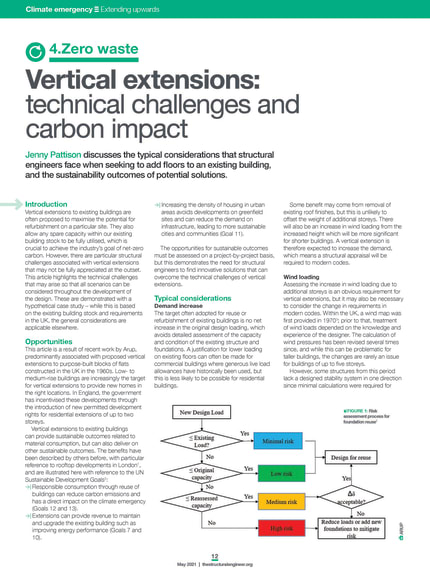
Jenny Pattison discute des considérations typiques auxquelles les ingénieurs en structure sont confrontés lorsqu'ils cherchent à ajouter des étages à un bâtiment existant, et les résultats de durabilité des solutions potentielles.

introduction

Des extensions verticales de bâtiments existants sont souvent proposées pour maximiser le potentiel de rénovation sur un site particulier. Ils permettent également d'utiliser pleinement toute capacité disponible au sein de notre parc immobilier existant, ce qui est crucial pour atteindre l'objectif de zéro carbone de l'industrie. Cependant, il existe des défis structurels particuliers associés aux extensions verticales qui peuvent ne pas être pleinement appréciés au départ. Cet article met en évidence les défis techniques qui peuvent survenir afin que tous les scénarios puissent être pris en compte tout au long du développement de la conception. Celles-ci sont démontrées par une étude de cas hypothétique - bien que celle-ci soit basée sur le parc immobilier existant et les exigences au Royaume-Uni, les considérations générales sont applicables ailleurs.

Opportunités

Cet article est le résultat des travaux récents d'Arup, principalement associés aux extensions verticales proposées aux blocs d'appartements construits à cet effet au Royaume-Uni dans les années 1960. Les immeubles de faible à moyenne hauteur sont de plus en plus la cible d'extensions verticales pour fournir de nouvelles habitations aux bons emplacements. En Angleterre, le gouvernement a encouragé ces développements par l'introduction de nouveaux droits de développement autorisés pour les extensions résidentielles d'un maximum de deux étages.

Les extensions verticales des bâtiments existants peuvent fournir des résultats durables liés à la consommation de matériaux, mais peuvent également produire d'autres résultats durables. Les avantages ont été décrits par d'autres auparavant, avec une référence particulière aux développements sur les toits à Londres1, et sont illustrés ici en référence aux Objectifs de développement durable des Nations Unies.
Reclaimed and Reused: Recommended LCA Modeling Guidance to Support EPDs for Reused Construction Materials

Material reuse is one strategy for reducing the embodied carbon of construction. While the preparation of previously used materials for reuse has an environmental impact, it avoids many of the resource extraction and manufacturing impacts of building with newly manufactured products. Given the amount of demolition and deconstruction across North America (and beyond), there is a vast potential for material reuse to expand in scale. However, barriers to material reuse scaling exist.

DEQ Low Embodied Carbon Housing Program: Roadmap to Success

Embodied Carbon Pathways to 2050 for the United States, a collaboration between the Carbon Leadership Forum (CLF), RMI, and the University of Washington (UW) Life Cycle Lab, provides an assessment of embodied carbon from US construction materials and explores pathways to align with a 1.5°C global warming limit.

International Embodied Carbon Data Availability: A Review of Environmental Product Declaration (EPD) Availability in Europe, China, and Australia

CLF completed a landscape analysis of product-level embodied carbon data availability in regions outside North America with the goals of: (i) understanding how LCA/EPD data availability varies globally; (ii) informing where targeted initiatives are needed to increase the availability of data; and (iii) determining whether adequate EPD data exists to develop CLF Material Baselines outside North America. This report summarizes our findings and provides initial insights into what data is available to inform low-carbon procurement efforts in Australia, China, and Europe.

The CLF Benchmark Explorer

Emissions from the operations of buildings and infrastructure are significant, well-understood contributors to national and global greenhouse gas emissions. However, the contribution of embodied carbon—emissions associated with the manufacturing, transportation, installation, maintenance, and disposal of construction materials across the life cycle of a building or asset—is neglected by comparison. Even at the global level, embodied carbon estimates are typically based on manufacturing emissions from the production of a handful of the highest-impact materials (e.g. concrete, steel, aluminum, and wood).

Embodied Carbon Pathways to 2050 for the United States

Embodied Carbon Pathways to 2050 for the United States, a collaboration between the Carbon Leadership Forum (CLF), RMI, and the University of Washington (UW) Life Cycle Lab, provides an assessment of embodied carbon from US construction materials and explores pathways to align with a 1.5°C global warming limit.

Washington State Carbon Emissions Estimation: 2025 – 2050

Emissions from the operations of buildings and infrastructure are significant, well-understood contributors to national and global greenhouse gas emissions. However, the contribution of embodied carbon—emissions associated with the manufacturing, transportation, installation, maintenance, and disposal of construction materials across the life cycle of a building or asset—is neglected by comparison. Even at the global level, embodied carbon estimates are typically based on manufacturing emissions from the production of a handful of the highest-impact materials (e.g. concrete, steel, aluminum, and wood).

View all policy resources in our resource library