






Back to all resources

Evaluación del ciclo de vida de Platte Fifteen

ThinkWood and Woodworks Case Study Report (July 2021)

Autores:

KL&A Ingenieros y Constructores
Adolfson & Peterson

Mass timber structural systems are relatively new to the North American construction market, but their use is growing rapidly as new manufacturers and supply chains begin operations, creating a cycle of familiarity and cost competitiveness with other structural systems. Owners, developers, architects, engineers, and builders are led to consider mass timber structural systems for a variety of reasons, among them aesthetic, biophilic design, speed of construction, renewable resource use, and carbon sequestration. The importance of reducing the embodied carbon impact of building construction gives a sense of urgency to the last category, but adoption ultimately depends on competitive pricing for mass timber which can be hindered by a lack of familiarity with the material and its construction management, at least for initial projects.Ā 

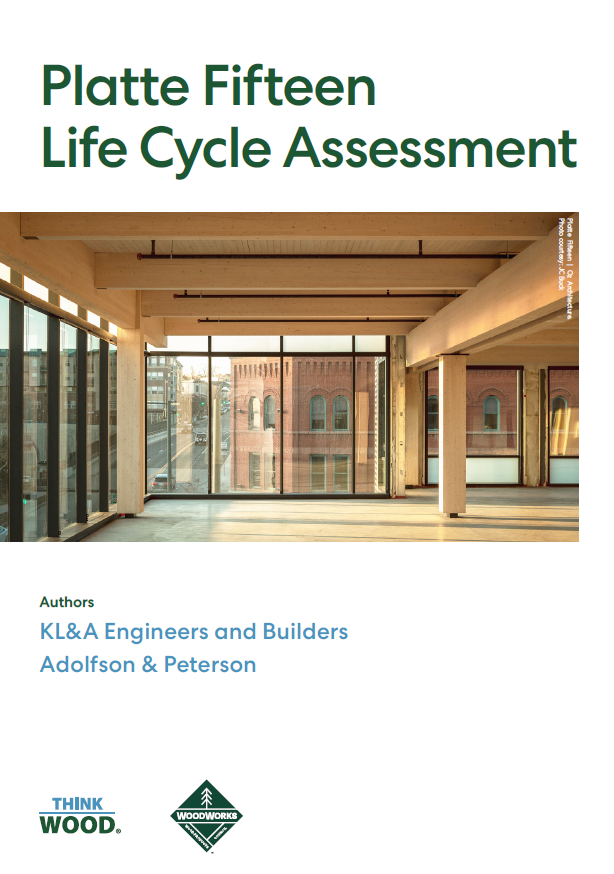
This study compares the embodied carbon, construction costs, and speed of construction of three functionally equivalent buildings in mass timber, steel, and concrete, all based on a reference building which is an actual mass timber office building in Denver, Colorado. The constructed reference building, Platte Fifteen (WoodWorks Wood Products Council, 2020), was the largest mass timber building in Denver, Colorado at the time of its construction in 2019, with an above grade floor area of 150,000 ft2 (14,000 m2), and reaching a height of 70-feet (21.4-meters) Constructed by general contractor Adolfson and Peterson (A&P) for developer Crescent Real Estate LLC. The building is four levels of Type IIIB construction over Type IA concrete podium with two levels of below- grade parking. The design team included architect OZ Architecture and structural engineer KL&A Engineers and Builders.Ā 

The Platte Fifteen building was chosen for study primarily because, as a completely designed and constructed mass timber building, the accuracy of cost and material quantity information for mass timber was excellent. However, the building design included two levels of below grade structure on a site with a high-water table, and one level of concrete above grade, so material quantities and associated embodied carbon quantities were dominated by concrete. This aspect has important implications regarding the impact of concrete on embodied carbon, but it also obscured the relative impact of comparisons between the three framing systems. To account for this, results are presented both for the entire structure and for the portion of the structure above the concrete podium. In this way, the results can be considered in the context of the whole building responding to this site, and also as a smaller building with no below-grade structure or podium.
Reclaimed and Reused: Recommended LCA Modeling Guidance to Support EPDs for Reused Construction Materials

Material reuse is one strategy for reducing the embodied carbon of construction. While the preparation of previously used materials for reuse has an environmental impact, it avoids many of the resource extraction and manufacturing impacts of building with newly manufactured products. Given the amount of demolition and deconstruction across North America (and beyond), there is a vast potential for material reuse to expand in scale. However, barriers to material reuse scaling exist.

DEQ Low Embodied Carbon Housing Program: Roadmap to Success

Embodied Carbon Pathways to 2050 for the United States, a collaboration between the Carbon Leadership Forum (CLF), RMI, and the University of Washington (UW) Life Cycle Lab, provides an assessment of embodied carbon from US construction materials and explores pathways to align with a 1.5°C global warming limit.

International Embodied Carbon Data Availability: A Review of Environmental Product Declaration (EPD) Availability in Europe, China, and Australia

CLF completed a landscape analysis of product-level embodied carbon data availability in regions outside North America with the goals of: (i) understanding how LCA/EPD data availability varies globally; (ii) informing where targeted initiatives are needed to increase the availability of data; and (iii) determining whether adequate EPD data exists to develop CLF Material Baselines outside North America. This report summarizes our findings and provides initial insights into what data is available to inform low-carbon procurement efforts in Australia, China, and Europe.

The CLF Benchmark Explorer

Emissions from the operations of buildings and infrastructure are significant, well-understood contributors to national and global greenhouse gas emissions. However, the contribution of embodied carbon—emissions associated with the manufacturing, transportation, installation, maintenance, and disposal of construction materials across the life cycle of a building or asset—is neglected by comparison. Even at the global level, embodied carbon estimates are typically based on manufacturing emissions from the production of a handful of the highest-impact materials (e.g. concrete, steel, aluminum, and wood).

Embodied Carbon Pathways to 2050 for the United States

Embodied Carbon Pathways to 2050 for the United States, a collaboration between the Carbon Leadership Forum (CLF), RMI, and the University of Washington (UW) Life Cycle Lab, provides an assessment of embodied carbon from US construction materials and explores pathways to align with a 1.5°C global warming limit.

Washington State Carbon Emissions Estimation: 2025 – 2050

Emissions from the operations of buildings and infrastructure are significant, well-understood contributors to national and global greenhouse gas emissions. However, the contribution of embodied carbon—emissions associated with the manufacturing, transportation, installation, maintenance, and disposal of construction materials across the life cycle of a building or asset—is neglected by comparison. Even at the global level, embodied carbon estimates are typically based on manufacturing emissions from the production of a handful of the highest-impact materials (e.g. concrete, steel, aluminum, and wood).

View all policy resources in our resource library