





Published June 2026
por Dirk von Below and Gordon Sharp, International Institute for Sustainable Laboratories (I2SL)
Recognizing that laboratories use five to 10 times as much energy as office buildings, the International Institute for Sustainable Laboratories (I2SL) created Labs2Zero to help reduce energy, costs, and emissions in the world’s research facilities. The program offers a variety of free building performance assessment and improvement tools to help lab owners, managers, designers, and engineers better understand and address their energy use and emissions. Labs2Zero tools are the first of their kind to benchmark and rate lab building performance.
As the foundation of the Labs2Zero program, the Lab Benchmarking Tool (LBT) allows users around the world to compare the energy use, operational emissions, and embodied carbon of their lab buildings with similar facilities. The tool’s peer-group database contains data from over 1,500 laboratories. The LBT is free, and it can be used to benchmark the energy intensity of research buildings from any sector—including commercial, academic, R&D, or government—with about a dozen data points addressing utilities and facility characteristics. On the embodied carbon side, I2SL has amassed a smaller—but growing—subset of building material lifecycle assessment (LCA) data to create the first such benchmarking tool for research facilities.

For the University of Wisconsin-Madison School of Veterinary Medicine’s addition and renovation project, Flad’s life cycle assessment demonstrated a 19 percent reduction in embodied carbon over the baseline structural model. These savings were achieved by working with the contractor to optimize the concrete mix. Copyright: Flad Architects
Addressing Labs’ Unique Embodied Carbon Issues
With 11 percent of global greenhouse gas (GHG) emissions coming from the embodied carbon-related emissions generated by the construction sector, I2SL recognized an opportunity to expand its LBT with embodied carbon data and offer lab owners a way to assess their performance. This data covers the “cradle-to-gate” lifecycle stages A1-A3 (i.e., raw material extraction, transportation of raw materials, and product manufacturing) for the materials used to build the lab structure and enclosure components, including concrete, steel, masonry, aluminum, wood, insulation, cladding, and glass. These early-stage structural materials form a significant portion of a lab building’s embodied carbon emissions and also provide the largest opportunities for reductions.
Due to their unique structural and building requirements, labs were previously unable to obtain an accurate embodied carbon comparison from existing tools. While labs’ embodied carbon can be reduced through alternative material selection and reuse of existing structures, unique requirements such as vibrational specifications and higher floor-to-ceiling heights make it important to have a dedicated benchmarking system for comparing state-of-the-art research facilities.
I2SL’s embodied carbon benchmarking methodology is based on standard LCA tools used in the LEED® rating system and ESG reporting systems such as Tally, OneClick, and the Athena Impact Estimator. The Labs2Zero embodied carbon effort is similar to Carbon Leadership Forum’s (CLF’s) data call for the latest Estudio comparativo LCA de todo el edificio, but with a focus on research facilities. To learn how to benchmark a lab building’s embodied carbon using the I2SL LBT, read this Quick-Start Guide.
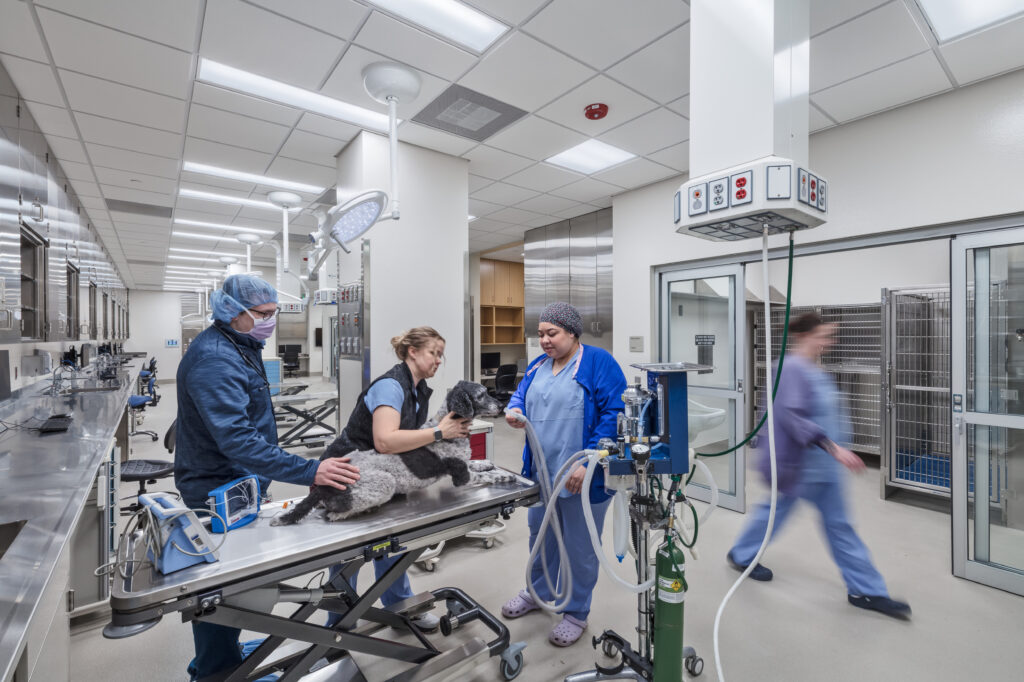
For the University of Wisconsin-Madison School of Veterinary Medicine’s addition and renovation project, Flad’s life cycle assessment demonstrated a 19 percent reduction in embodied carbon over the baseline structural model. These savings were achieved by working with the contractor to optimize the concrete mix. Copyright: Cory Klein Photography
Putting Building Performance in Perspective
Anyone who puts lab facility and utility data into I2SL’s LBT will automatically generate a free Energy Score and Operational Emissions Score. Building performance is rated from 1 to 100, where 100 represents the highest performance. The rating is a percentile score, meaning that a building with an Energy Score of 85 would have better energy performance than 85 percent of similar facilities. Users can also select a target Energy Score and determine the energy use intensity (EUI) levels necessary to achieve it. The Global Real Estate Sustainability Benchmark (GRESB) allows the Energy Score in its submissions, and the Association for the Advancement of Higher Education’s (AASHE’s) STARS program accepts LBT for its optional benchmarking credit.
The Operational Emissions Score is calculated using facility energy consumption data, including onsite renewable energy, along with emission factors for its local electrical grid and all other energy utilities consumed by the building. The score includes correction factors for the functional requirements of the building. To recognize and encourage electrification, the LBT also provides a Clean Grid Score that shows the building’s hypothetical score if it were located on an electric grid powered with 100 percent renewable energy.
The Lab Benchmarking Tool (LBT) allows users around the world to compare the energy use, operational emissions, and embodied carbon of their lab buildings with similar facilities.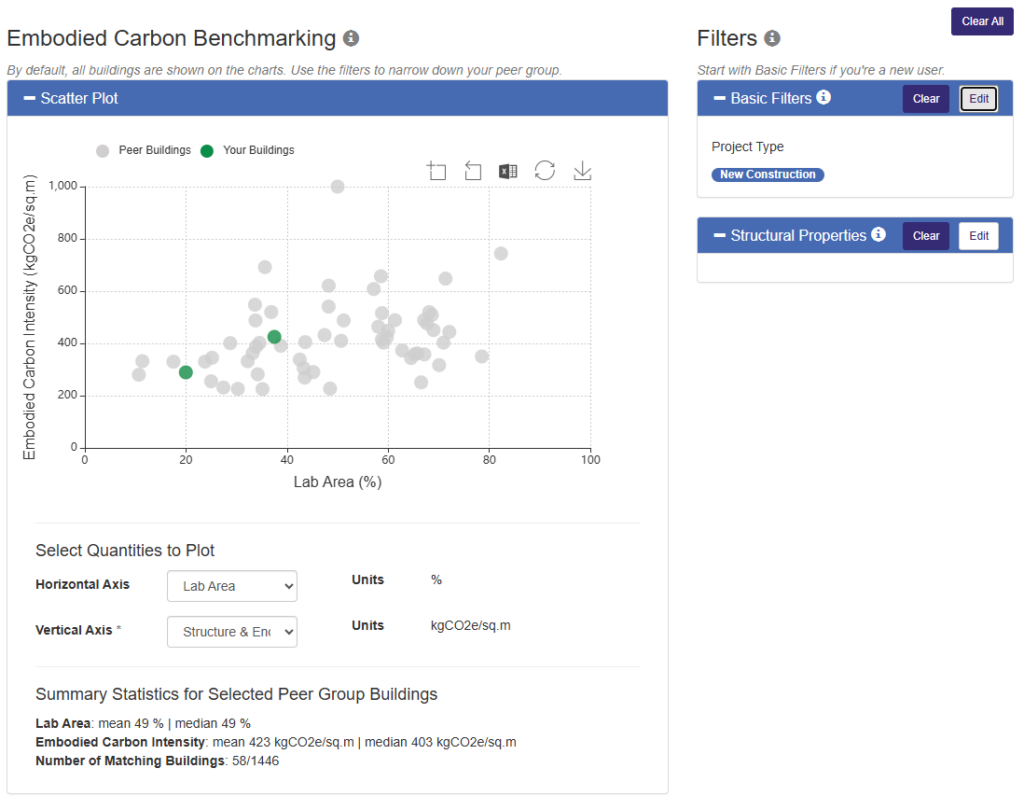
Next Steps for Labs2Zero
I2SL is continuing to develop its Labs2Zero features and tools; next up for the Emissions Score is to incorporate the impact of renewable energy certificates, green tariffs, power purchase agreements, or other market-based renewable energy purchases. Once sufficient LCA data from lab buildings has been entered, I2SL plans to create a Labs2Zero Embodied Carbon Score as well.

Gordon Sharp, President of the I2SL Board of Directors

Dirk von Below, Chair of the Labs2Zero Embodied Carbon Technical Advisory Council and retired, Flad Architects

I2SL is dedicated to advancing sustainable laboratories globally.
AIM for Improvement
The best way to reduce emissions in existing labs is to reduce energy consumption. To help labs understand where to start, I2SL recently released the Actionable Insights and Measures (AIM) software tool. AIM serves as a bridge between performance assessment and performance improvement, providing an automated, high-level energy audit that allows subscribers to select from suggested measures to create a customized report that includes projected savings, installation costs, and case studies for each possible measure.