






Back to all resources

ACV et optimisation du bois

Des fins de recherche:

Découvrez comment les bâtiments en bois massif peuvent être optimisés pour l'efficacité des matériaux et soutenez une étude de cas ACV spécifique à la région d'un immeuble de bureaux dans le nord-ouest du Pacifique.

Report published: February, 2018

À propos

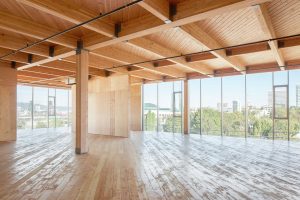
La transition de la construction de structures commerciales et non résidentielles de faible à moyenne hauteur à une construction en bois lamellé-croisé (CLT) / en bois lourd pourrait avoir un impact positif sur l'environnement. Il pourrait également développer un nouveau marché pour les grumes de plus petit diamètre et de moindre qualité provenant des opérations d'éclaircie et de santé des forêts, incitant ainsi à entreprendre des activités de gestion forestière destinées à améliorer la santé et la résilience des forêts. Enfin, le développement d'une industrie du bois lamellé-croisé offrirait des avantages économiques substantiels et des possibilités d'emploi aux communautés rurales tributaires du bois.

L'équipe UW Architecture a défini un immeuble de bureaux commerciaux de référence utilisant du bois lourd / CLT pour se substituer à la construction conventionnelle. L'équipe de l'École des ressources forestières a développé des modèles d'évaluation du cycle de vie spécifiques à la région pour évaluer l'impact environnemental de la production potentielle de CLT dans la péninsule olympique.

Résultats

Publications de revues

  • Pierobon, F., Huang, M., Simonen, K., Ganguly, I. Bénéfices environnementaux de l'utilisation de la structure hybride CLT dans la construction non résidentielle de taille moyenne: une étude de cas comparative basée sur l'ACV dans le nord-ouest du Pacifique américain.  Journal of Building Engineering.  https://doi.org/10.1016/j.jobe.2019.100862

L'équipe de recherche

  • I. Ganguly (PI)
  • K. Simonen (co-PI)
  • F. Pierobon
  • M. Huang
  • K. Strobel

Remerciements

Cette recherche a été financée par l'USDA dans le cadre d'une bourse McIntire-Stennis et comprend des contributions d'étudiants en architecture: Mariam Hovhannisyan, Ezekiel Jones, Weston Norwood, Barbara X. Rodriguez et Kristen Strobel.
Reclaimed and Reused: Recommended LCA Modeling Guidance to Support EPDs for Reused Construction Materials

Material reuse is one strategy for reducing the embodied carbon of construction. While the preparation of previously used materials for reuse has an environmental impact, it avoids many of the resource extraction and manufacturing impacts of building with newly manufactured products. Given the amount of demolition and deconstruction across North America (and beyond), there is a vast potential for material reuse to expand in scale. However, barriers to material reuse scaling exist.

DEQ Low Embodied Carbon Housing Program: Roadmap to Success

Embodied Carbon Pathways to 2050 for the United States, a collaboration between the Carbon Leadership Forum (CLF), RMI, and the University of Washington (UW) Life Cycle Lab, provides an assessment of embodied carbon from US construction materials and explores pathways to align with a 1.5°C global warming limit.

International Embodied Carbon Data Availability: A Review of Environmental Product Declaration (EPD) Availability in Europe, China, and Australia

CLF completed a landscape analysis of product-level embodied carbon data availability in regions outside North America with the goals of: (i) understanding how LCA/EPD data availability varies globally; (ii) informing where targeted initiatives are needed to increase the availability of data; and (iii) determining whether adequate EPD data exists to develop CLF Material Baselines outside North America. This report summarizes our findings and provides initial insights into what data is available to inform low-carbon procurement efforts in Australia, China, and Europe.

The CLF Benchmark Explorer

Emissions from the operations of buildings and infrastructure are significant, well-understood contributors to national and global greenhouse gas emissions. However, the contribution of embodied carbon—emissions associated with the manufacturing, transportation, installation, maintenance, and disposal of construction materials across the life cycle of a building or asset—is neglected by comparison. Even at the global level, embodied carbon estimates are typically based on manufacturing emissions from the production of a handful of the highest-impact materials (e.g. concrete, steel, aluminum, and wood).

Embodied Carbon Pathways to 2050 for the United States

Embodied Carbon Pathways to 2050 for the United States, a collaboration between the Carbon Leadership Forum (CLF), RMI, and the University of Washington (UW) Life Cycle Lab, provides an assessment of embodied carbon from US construction materials and explores pathways to align with a 1.5°C global warming limit.

Washington State Carbon Emissions Estimation: 2025 – 2050

Emissions from the operations of buildings and infrastructure are significant, well-understood contributors to national and global greenhouse gas emissions. However, the contribution of embodied carbon—emissions associated with the manufacturing, transportation, installation, maintenance, and disposal of construction materials across the life cycle of a building or asset—is neglected by comparison. Even at the global level, embodied carbon estimates are typically based on manufacturing emissions from the production of a handful of the highest-impact materials (e.g. concrete, steel, aluminum, and wood).

View all policy resources in our resource library