







Back to all resources

ECOM: Estimador de Carbono Incorporado – Estructuras

SE 2050

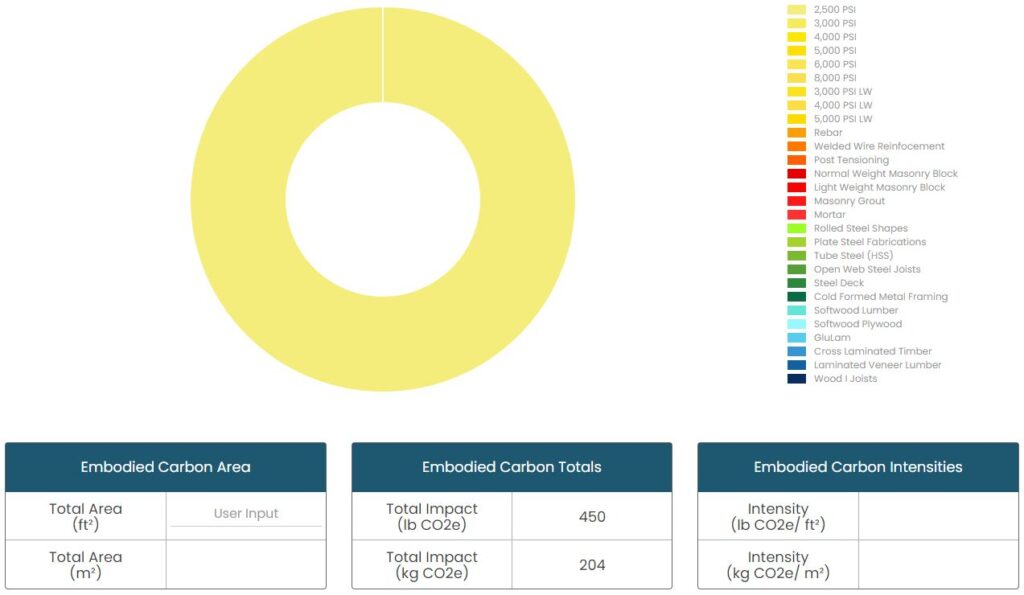
¿Quiere encontrar rápidamente el orden de magnitud del carbono incorporado de su proyecto o esquema de estructura? Use este estimador muy simple a continuación que llamamos ECOM.

ECOM significa (E)arbon (C)arbon (Orden de (M)agnitud) incorporado y es un estimador básico de carbono incorporado. ECOM permite a los usuarios determinar estimaciones aproximadas de carbono incorporado para un producto material, un conjunto de marcos con fines de comparación o incluso un marco estructural completo.

Los datos subyacentes se recopilaron de las Declaraciones ambientales de productos (EPD) de toda la industria disponibles públicamente que se aplican a América del Norte. En la mayoría de los casos, son las EPD producidas por la organización comercial correspondiente y constituyen los módulos A1 a A3 de la evaluación del ciclo de vida. Consulte el documento de orientación de ECOM para obtener una explicación más detallada de los datos subyacentes.

La intención general de este estimador es proporcionar a los ingenieros o arquitectos estructurales una forma accesible de estimar el carbono incorporado. El estimador es aplicable a usuarios de todos los niveles de experiencia y podría usarse para desarrollar un ROM de proyecto inicial de carbono incorporado o para verificar los resultados de un análisis más sólido o algo intermedio.

El estimador no considera las variabilidades de datos importantes asociadas con los datos de impacto material del ciclo de vida y no pretende reemplazar la evaluación del ciclo de vida comercialmente disponible o las herramientas y/o calculadoras de adquisición de materiales fácilmente disponibles.

Simplemente ingrese la cantidad de materiales para obtener el impacto del carbono incorporado y, para esquemas más grandes, el área para evaluar las intensidades de carbono incorporado.
Reclaimed and Reused: Recommended LCA Modeling Guidance to Support EPDs for Reused Construction Materials

Material reuse is one strategy for reducing the embodied carbon of construction. While the preparation of previously used materials for reuse has an environmental impact, it avoids many of the resource extraction and manufacturing impacts of building with newly manufactured products. Given the amount of demolition and deconstruction across North America (and beyond), there is a vast potential for material reuse to expand in scale. However, barriers to material reuse scaling exist.

DEQ Low Embodied Carbon Housing Program: Roadmap to Success

Embodied Carbon Pathways to 2050 for the United States, a collaboration between the Carbon Leadership Forum (CLF), RMI, and the University of Washington (UW) Life Cycle Lab, provides an assessment of embodied carbon from US construction materials and explores pathways to align with a 1.5°C global warming limit.

International Embodied Carbon Data Availability: A Review of Environmental Product Declaration (EPD) Availability in Europe, China, and Australia

CLF completed a landscape analysis of product-level embodied carbon data availability in regions outside North America with the goals of: (i) understanding how LCA/EPD data availability varies globally; (ii) informing where targeted initiatives are needed to increase the availability of data; and (iii) determining whether adequate EPD data exists to develop CLF Material Baselines outside North America. This report summarizes our findings and provides initial insights into what data is available to inform low-carbon procurement efforts in Australia, China, and Europe.

The CLF Benchmark Explorer

Emissions from the operations of buildings and infrastructure are significant, well-understood contributors to national and global greenhouse gas emissions. However, the contribution of embodied carbon—emissions associated with the manufacturing, transportation, installation, maintenance, and disposal of construction materials across the life cycle of a building or asset—is neglected by comparison. Even at the global level, embodied carbon estimates are typically based on manufacturing emissions from the production of a handful of the highest-impact materials (e.g. concrete, steel, aluminum, and wood).

Embodied Carbon Pathways to 2050 for the United States

Embodied Carbon Pathways to 2050 for the United States, a collaboration between the Carbon Leadership Forum (CLF), RMI, and the University of Washington (UW) Life Cycle Lab, provides an assessment of embodied carbon from US construction materials and explores pathways to align with a 1.5°C global warming limit.

Washington State Carbon Emissions Estimation: 2025 – 2050

Emissions from the operations of buildings and infrastructure are significant, well-understood contributors to national and global greenhouse gas emissions. However, the contribution of embodied carbon—emissions associated with the manufacturing, transportation, installation, maintenance, and disposal of construction materials across the life cycle of a building or asset—is neglected by comparison. Even at the global level, embodied carbon estimates are typically based on manufacturing emissions from the production of a handful of the highest-impact materials (e.g. concrete, steel, aluminum, and wood).

View all policy resources in our resource library