






Back to all resources

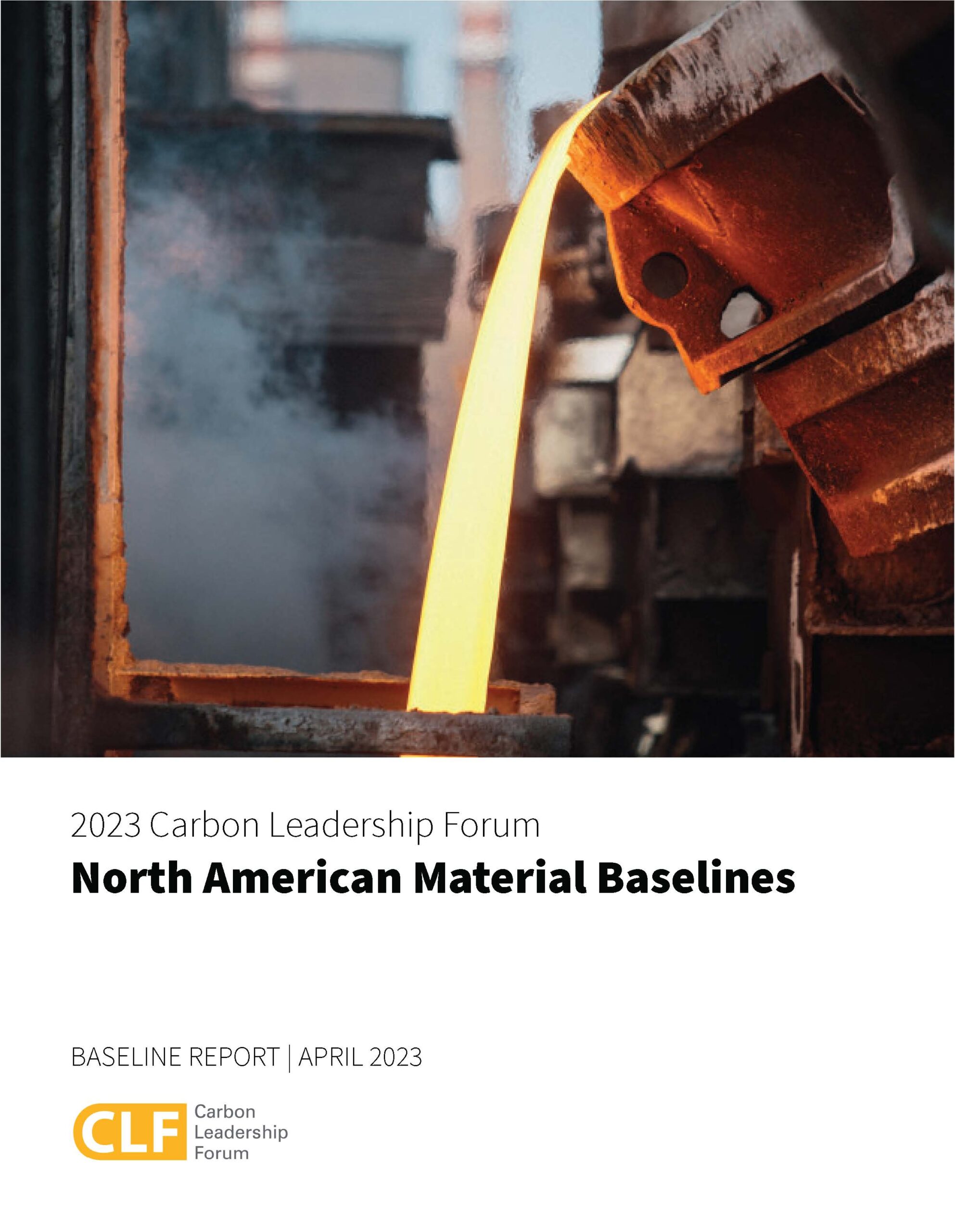
2023 CLF North American Material Baselines Report

Carbon Leadership Forum Material Baselines for North  America / August 2023

The CLF North American Material Baselines Report provides a snapshot of the state of Environmental Product Declarations (EPDs) for North American-produced building materials. This report includes:

  1. Background and methodology
  2. CLF Baselines
  3. Appendices

We’ve recently published the 2025 CLF North American Material Baselines. For the latest version, please visit the report webpage, published in June 2025.

Acerca de

The CLF Baseline values represent an estimate of industry-average GHG emissions for construction materials manufactured in North America. An overwhelming majority of the CLF Baselines published in this report are based on a North American industry-wide EPD if one was available at the time of publication. As such, it is appropriate to use this number as a rough estimate of a product type’s embodied carbon before a specific product has been selected or as a reference value against which product-level comparisons can be made.

Each material category has a detailed appendix that includes a description of the embodied carbon impacts, the available EPDs, and summary statistics. The Appendices in this report allow users to better understand the availability of existing industry-wide and product EPDs, and the variability of product types across a category. The snapshot of available EPDs summarized in each Appendix was assembled using the EC3 database in Fall 2022.

Version 2 Updates

Version 2 (August 2023) of the report fixes typos, adds the remaining 8 appendices, and improves accessibility of the report and appendices by adding bookmarks and hyperlinks to the PDF files. There were no changes made to the Baseline Table of Values content.

Expresiones de gratitud

The research team would like to thank Breakthrough Energy for supporting this research and Building Transparency for continued access to the data within the EC3 tool. The team would also like to thank Monica Huang for her careful copyediting and review of the document and Stephanie Carlise for the report graphic design.

Derechos de autor

2023 CLF North American Material Baselines Report tiene licencia de Creative Commons Attribution 4.0 International License.
2023 Material Baselines

Autores

El equipo de investigación del Carbon Leadership Forum de la Facultad de Ambientes Construidos de la Universidad de Washington:

  • Brook Waldman, investigador
  • Allison Hyatt, Researcher
  • Stephanie Carlisle, investigadora principal
  • Jordan Palmeri, Senior Researcher
  • Kathrina Simonen, directora ejecutiva

Author contributions: B.W., S.C., A.H & K.S. Conceptualization; B.W., A.H., and J.P. Formal analysis; J.P., S.C., B.W., A.H., and K.S. Writing-review & editing; J.P. Writing-original draft of report; B.W. & A.H. Writing-original draft of appendices; A.H. & B.W. Data visualization in appendices: K.S. Funding acquisition.

Citación

Waldman, B., Hyatt, A., Carlisle, S., Palmeri, J., and Simonen, K. (2023).
2023 Carbon Leadership Forum North American Material Baselines (version 2).
Carbon Leadership Forum, University of Washington. Seattle, WA. August 2023.
http://hdl.handle.net/1773/49965

Reclaimed and Reused: Recommended LCA Modeling Guidance to Support EPDs for Reused Construction Materials

Material reuse is one strategy for reducing the embodied carbon of construction. While the preparation of previously used materials for reuse has an environmental impact, it avoids many of the resource extraction and manufacturing impacts of building with newly manufactured products. Given the amount of demolition and deconstruction across North America (and beyond), there is a vast potential for material reuse to expand in scale. However, barriers to material reuse scaling exist.

DEQ Low Embodied Carbon Housing Program: Roadmap to Success

Embodied Carbon Pathways to 2050 for the United States, a collaboration between the Carbon Leadership Forum (CLF), RMI, and the University of Washington (UW) Life Cycle Lab, provides an assessment of embodied carbon from US construction materials and explores pathways to align with a 1.5°C global warming limit.

International Embodied Carbon Data Availability: A Review of Environmental Product Declaration (EPD) Availability in Europe, China, and Australia

CLF completed a landscape analysis of product-level embodied carbon data availability in regions outside North America with the goals of: (i) understanding how LCA/EPD data availability varies globally; (ii) informing where targeted initiatives are needed to increase the availability of data; and (iii) determining whether adequate EPD data exists to develop CLF Material Baselines outside North America. This report summarizes our findings and provides initial insights into what data is available to inform low-carbon procurement efforts in Australia, China, and Europe.

The CLF Benchmark Explorer

Emissions from the operations of buildings and infrastructure are significant, well-understood contributors to national and global greenhouse gas emissions. However, the contribution of embodied carbon—emissions associated with the manufacturing, transportation, installation, maintenance, and disposal of construction materials across the life cycle of a building or asset—is neglected by comparison. Even at the global level, embodied carbon estimates are typically based on manufacturing emissions from the production of a handful of the highest-impact materials (e.g. concrete, steel, aluminum, and wood).

Embodied Carbon Pathways to 2050 for the United States

Embodied Carbon Pathways to 2050 for the United States, a collaboration between the Carbon Leadership Forum (CLF), RMI, and the University of Washington (UW) Life Cycle Lab, provides an assessment of embodied carbon from US construction materials and explores pathways to align with a 1.5°C global warming limit.

Washington State Carbon Emissions Estimation: 2025 – 2050

Emissions from the operations of buildings and infrastructure are significant, well-understood contributors to national and global greenhouse gas emissions. However, the contribution of embodied carbon—emissions associated with the manufacturing, transportation, installation, maintenance, and disposal of construction materials across the life cycle of a building or asset—is neglected by comparison. Even at the global level, embodied carbon estimates are typically based on manufacturing emissions from the production of a handful of the highest-impact materials (e.g. concrete, steel, aluminum, and wood).

View all policy resources in our resource library