




Acerca de
In the spring of 2022, ARPA-E announced a cohort of material and building design teams for the “Harnessing Emissions into Structures Taking Inputs from the Atmosphere” (HESTIA) Program. Each team in the program is working on a project to develop a carbon-negative material or building design solution. CLF, along with a team of researchers at the University of Washington (the Centro de Comercio Internacional de Productos Forestales y el Laboratorio de Diseño Integrado), was awarded $3.7 million over 4 years to lead the Parametric Open Data (POD) | LCA Project, during which we are working with each HESTIA material and building design team to develop custom, parametric LCA screening tools to evaluate their performance at a material and building scale. The CLF team is also working on a holistic framework for comparative LCA modeling of building materials that includes biogenic carbon, dynamic LCA, and carbon storage over the full life cycle of a building.
Read more about the funding program here: Subvención ARPA-E $3.7M para financiar la I+D básica de LCA.
Problem statement
- There is a massive potential to use carbon-storing materials in building construction to reduce global greenhouse gas emissions.
- However, the environmental assessment data and methods for novel carbon-storing materials is currently limited.
- Due to the unknowns, building designers are hesitant about adopting these materials in their building designs.
- Manufacturers of carbon- storing materials are struggling to gain traction at scale.
Project goal
We will create a suite of methods and tools to assess the environmental impacts of novel carbon-storing materials and building designs in the rapid prototyping and design process.
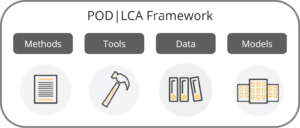
Deliverables of the POD|LCA Framework (methods, tools, data, and models).
Who will this project help?
- Material scientists and manufacturers of novel carbon- storing materials
- Design teams who want to use these materials
- Policymakers who want to have accurate and fair comparisons of materials for policy programs
What are the anticipated wider impacts?
- Reduced life cycle GHG emissions of building materials
- More carbon storage in building materials
- Expanded market for carbon-storing materials
- Policy incentives for use of carbon-storing materials
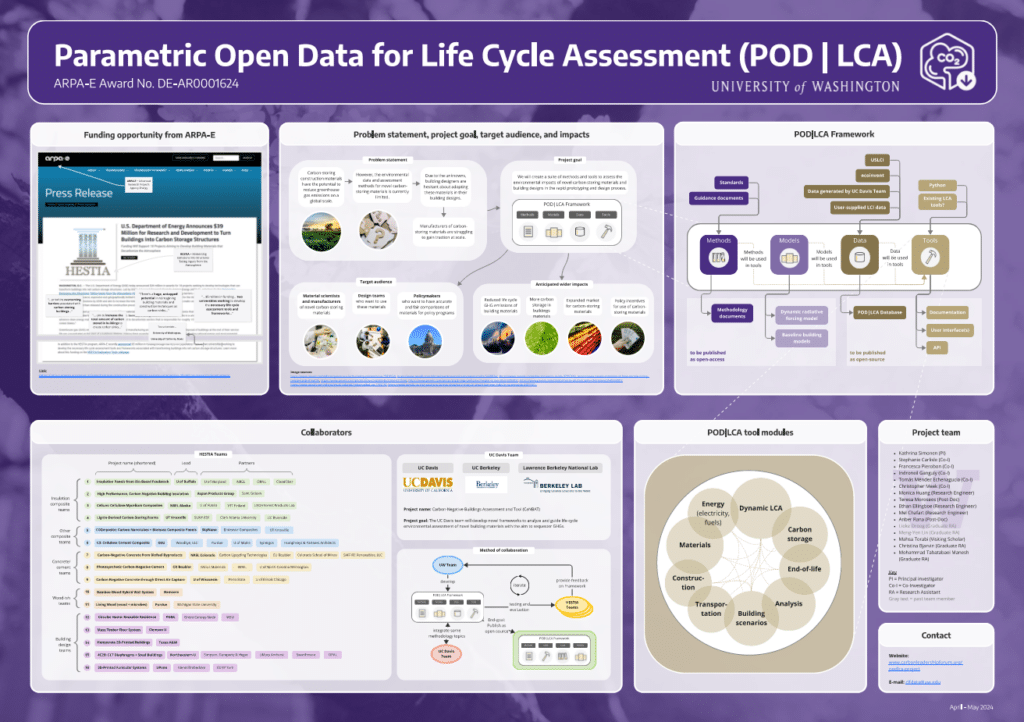
POD|LCA Project Poster 2024 (click to download PDF). Describes the funding opportunity, research problem statement, project goal, target audience, anticipated wider impacts, the framework, collaborators, and tool modules.
What is the POD|LCA Framework?
The “POD|LCA Framework” the final deliverable for this project. It is a suite of methods and tools that we are creating that will assess the environmental impacts of novel carbon-storing materials and building designs in the rapid prototyping and design process. The diagram below shows the overall plan for the POD|LCA Framework. Specifically, the Framework will have four components:
-
- Methods. The methods will be informed by existing standards and guidance documents.
- Models. Models will include the foundational equations that will be used for specific calculations in the tool. These equations may or may not be included in a resource such as an Excel spreadsheet for the purpose of demonstrating core functions of the framework. Models would include a dynamic radiative forcing model for global warming potential, or various baseline building models.
- Datos. Data will include data from the USLCI database, ecoinvent, data generated by the UC Davis Team, and any user-supplied LCI data, if appropriate.
- Tools. Tools will include functions and features that can either be accessed by an API or via a specific user interface.
- The methods, models, and data developed for the POD|LCA Framework will be incorporated into the tools.
- Products that will be published open-source include:
- Methodology documents
- Model files
- LCI data that can be used by LCA teams (likely both open-source and accessed via license)
- Documentation (i.e., user manuals) for the tools
- User interface(s) for the tools
- API’s that will allow other software/tools to use functions from our tools.
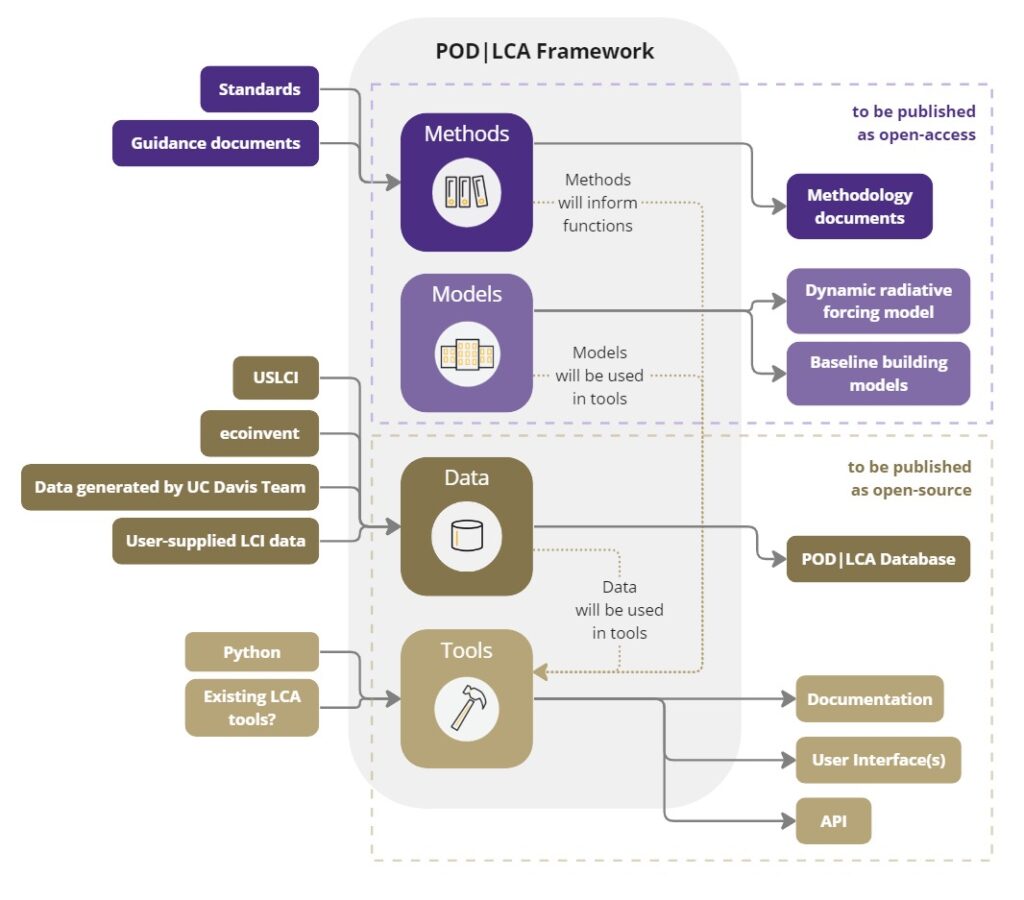
Diagram showing how the POD|LCA Framework will be assembled, and how the products of the project will be published as open-access and open-source.
The tool will likely be subdivided into the topics or “modules” as shown in the figure below. These modules will likely rely on each other, but exactly how these modules will be interconnected will be determined as tool development continues for this project
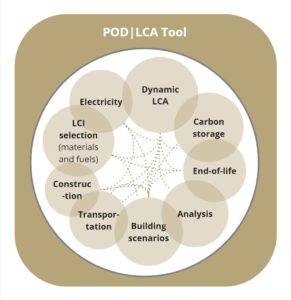
Modules of the POD|LCA tool.
This work is deeply collaborative, drawing from a team of UW researchers with expertise in climate modeling, forestry, dynamic LCA, material science, design, engineering, data science, and tool development. This grant supports CLF in growing its research team and continuing its commitment to accurate, trusted, rigorous, and open access LCA data and tools.
Here is the Resource Page for HESTIA Teams for downloading collaboration materials provided by the UW Team (webinar recordings, slides, templates, surveys, etc). Email [email protected] for the password.