






Back to all resources

LCA y optimización de la madera

Propósito de la investigación:

Explore cómo se pueden optimizar los edificios de madera maciza para lograr la eficiencia de los materiales y respalde un estudio de caso de LCA específico de la región de un edificio de oficinas en el noroeste del Pacífico.

Report published: February, 2018

Sobre

La transición de la construcción de estructuras comerciales y no residenciales de altura baja a mediana a construcciones de madera contralaminada (CLT)/madera pesada podría tener un impacto positivo en el medio ambiente. También podría desarrollar un nuevo mercado para las trozas de menor diámetro y menor calidad derivadas de las operaciones de raleo y sanidad forestal, proporcionando así un incentivo para emprender actividades de gestión forestal diseñadas para mejorar la salud y la resiliencia de los bosques. Finalmente, el desarrollo de una industria de madera contralaminada proporcionaría beneficios económicos sustanciales y oportunidades de empleo para las comunidades rurales que dependen de la madera.

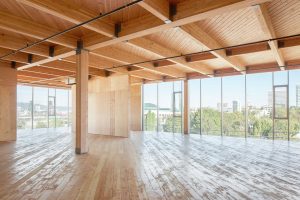
El equipo de UW Architecture definió un edificio de oficinas comerciales de referencia utilizando madera pesada/CLT para sustituir la construcción convencional. El equipo de la Escuela de Recursos Forestales desarrolló modelos de evaluación del ciclo de vida específicos de la región para evaluar el impacto ambiental de la producción potencial de CLT en la Península Olímpica.

Resultados

Publicaciones en revistas

  • Pierobon, F., Huang, M., Simonen, K., Ganguly, I. Beneficios ambientales del uso de estructuras CLT híbridas en construcciones no residenciales de altura media: un estudio de caso comparativo basado en LCA en el noroeste del Pacífico de EE. UU.  Revista de Ingeniería de la Construcción.  https://doi.org/10.1016/j.jobe.2019.100862

Equipo de investigación

  • I. Ganguly (PI)
  • K. Simonen (co-investigador investigador)
  • F. Pierobón
  • m huang
  • K. Strobel

Expresiones de gratitud

Esta investigación fue financiada por el USDA bajo una subvención McIntire-Stennis e incluye contribuciones de estudiantes de arquitectura: Mariam Hovhannisyan, Ezekiel Jones, Weston Norwood, Barbara X. Rodriguez y Kristen Strobel.
Reclaimed and Reused: Recommended LCA Modeling Guidance to Support EPDs for Reused Construction Materials

Material reuse is one strategy for reducing the embodied carbon of construction. While the preparation of previously used materials for reuse has an environmental impact, it avoids many of the resource extraction and manufacturing impacts of building with newly manufactured products. Given the amount of demolition and deconstruction across North America (and beyond), there is a vast potential for material reuse to expand in scale. However, barriers to material reuse scaling exist.

DEQ Low Embodied Carbon Housing Program: Roadmap to Success

Embodied Carbon Pathways to 2050 for the United States, a collaboration between the Carbon Leadership Forum (CLF), RMI, and the University of Washington (UW) Life Cycle Lab, provides an assessment of embodied carbon from US construction materials and explores pathways to align with a 1.5°C global warming limit.

International Embodied Carbon Data Availability: A Review of Environmental Product Declaration (EPD) Availability in Europe, China, and Australia

CLF completed a landscape analysis of product-level embodied carbon data availability in regions outside North America with the goals of: (i) understanding how LCA/EPD data availability varies globally; (ii) informing where targeted initiatives are needed to increase the availability of data; and (iii) determining whether adequate EPD data exists to develop CLF Material Baselines outside North America. This report summarizes our findings and provides initial insights into what data is available to inform low-carbon procurement efforts in Australia, China, and Europe.

The CLF Benchmark Explorer

Emissions from the operations of buildings and infrastructure are significant, well-understood contributors to national and global greenhouse gas emissions. However, the contribution of embodied carbon—emissions associated with the manufacturing, transportation, installation, maintenance, and disposal of construction materials across the life cycle of a building or asset—is neglected by comparison. Even at the global level, embodied carbon estimates are typically based on manufacturing emissions from the production of a handful of the highest-impact materials (e.g. concrete, steel, aluminum, and wood).

Embodied Carbon Pathways to 2050 for the United States

Embodied Carbon Pathways to 2050 for the United States, a collaboration between the Carbon Leadership Forum (CLF), RMI, and the University of Washington (UW) Life Cycle Lab, provides an assessment of embodied carbon from US construction materials and explores pathways to align with a 1.5°C global warming limit.

Washington State Carbon Emissions Estimation: 2025 – 2050

Emissions from the operations of buildings and infrastructure are significant, well-understood contributors to national and global greenhouse gas emissions. However, the contribution of embodied carbon—emissions associated with the manufacturing, transportation, installation, maintenance, and disposal of construction materials across the life cycle of a building or asset—is neglected by comparison. Even at the global level, embodied carbon estimates are typically based on manufacturing emissions from the production of a handful of the highest-impact materials (e.g. concrete, steel, aluminum, and wood).

View all policy resources in our resource library