






At the end of their service lives, building materials are either recovered (e.g., reused, recycled, incinerated) or disposed of in landfills. In life cycle assessment (LCA) terms, the environmental impacts due to material recovery or disposal are accounted for within the end-of-life (EOL) stage.
Through interviews, a survey, and a workshop, this research explores the functions that existing whole building LCA (WBLCA) tools offer to create models that can best represent EOL processes. This research further explores tool functionalities and data needs and provides recommendations and future research directions to improve EOL modeling in WBLCA tools.
Sobre
This document summarizes the Carbon Leadership Forum (CLF) research on end-of-life (EOL) modeling for a selection of building materials in whole building life cycle assessment (WBLCA) tools conducted as part of a larger project in collaboration with the National Renewable Energy Lab (NREL), Building Transparency (BT), and Skidmore, Owings & Merrill (SOM). The overarching goals of the project are to:
- Improve EOL modeling in WBLCA tools by exploring data gaps and current tool capabilities.
- Explore opportunities for developing and testing an open-access EOL database. This can potentially enable WBLCA tools to draw from this database and better harmonize the modeling of EOL impacts.
The recommendations, limitations, and future research ideas are based on: 1) a review of EOL data and modeling functions for three North American WBLCA tools, 2) direct interviews with North American WBLCA tool providers, and 3) a survey and an online workshop with experienced WBLCA tool users.
Autores
- Milad Ashtiani, Research Scientist
- Jordan Palmeri, Senior Researcher
- Kathrina Simonen, directora ejecutiva
Citación
Ashtiani, M., Palmeri, J., and Simonen, K. (2024). End of Life Modeling and Data in North American Whole Building Life Cycle Assessment Tools. Carbon Leadership Forum, University of Washington. Seattle, WA.
Publicado
April 2024
Derechos de autor
End life of Modeling and Data in North American Whole Building Life Cycle Assessment Tools tiene una licencia Creative Commons Attribution 4.0 International License.
Expresiones de gratitud
The research team would like to thank the REMADE Institute for funding this research. We would also like to thank our collaborators who provided valuable insights to inform this report:
- Michael Deru, NREL
- Naveen Kuman Muthumanickam, NREL
- Heather Goetsch, NREL
- Swaroop Atnoorkar, NREL
- Vaclav Hasik, Building Transparency
- Mirko Farnetani, SOM
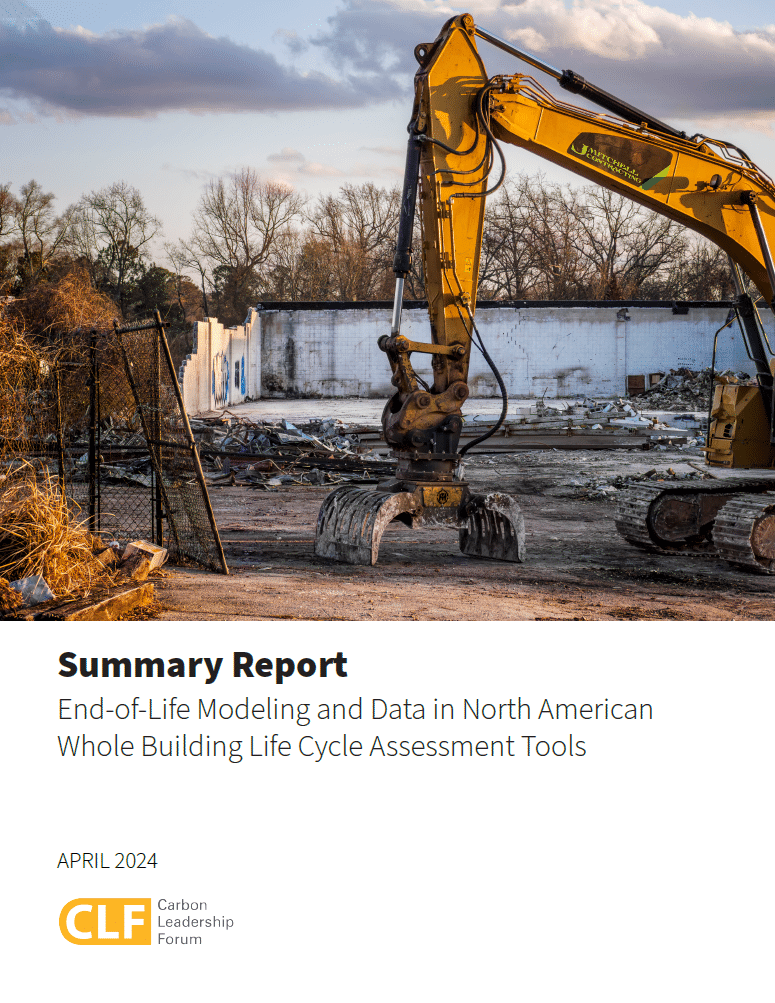
Cover image from Thomas Cizauskas, © Flickr
A special thank you to these individuals for direct conversations, interviews, and feedback that informed this report:
- Matt Bowick (Athena Sustainable Materials Institute)
- Vaclav Hasik (Building Transparency / tallyLCA)
- Vasilis Kalfountzos (One Click LCA)
- Stephanie Carlisle (Carbon Leadership Forum)
- Brad Benke (Carbon Leadership Forum)
- Sindhu Raju (Carbon Leadership Forum) – formatted report
Workshop Participants
We would also like to thank the survey and workshop participants for their participation. While their input informed this publication, inclusion of their names does not indicate agreement with all aspects of the publication and inclusion of their employer’s name is for informational purposes only and does not represent an endorsement of the publication.
- Anthony Pak (Priota)
- Aurora Jensen (Brightworks)
- Brie McCarthy (Miller Hull)
- Chris Flint Chatto (ZGF)
- David Moore (Atlelier 10)
- Duncan Cox (Thornton Tomasetti)
- Efrie Escott (Schieder Electric)
- Frances Yang (Arup)
- Jack Rusk (EHDD)
- Jeremy Field (Introba)
- Jesce Walz (Perkins Will)
- Jessica Martinez (DCI Engineers)
- Jessie Templeton (Brightworks)
- Jordan Palmeri (Carbon Leadership Forum)
- Justin Schwartzhoff (LMN Architects)
- Kathryn Peretti (US Dept of Energy)
- Katie Felver (Mahlum Architects)
- Kjell Anderson (LMN Architects)
- Laura Karnath (Walter P Moore)
- Lindsey Kahler (SERA)
- Mandi Wesley (Mantle Development)
- Mel Chafart (Carbon Leadership Forum)
- Melissa Kelly (Gensler)
- Michael Deru (NREL)
- Milad Ashtiani (Carbon Leadership Forum)
- Mirko Farnetani (SOM)
- Naveen Muthumanickam (NREL)
- Ryan Welch (Kieran Timberlake)
- Swaroop Atnoorkar (NREL)
- Vaclav Hasik (Building Transparency)
- Varusha Venkatraj (Brightworks)