Unsubscribe
View in your browser
Whole-life Carbon, the Key to a Zero Emission Building

by Yang Shen, research engineer for the Life Cycle Lab at the University of Washington and a Research Affiliate for CLF 

Recently, the White House released a document titled “National Definition of a Zero Emissions Building, Part 1: Operational Emissions from Energy Use,” which sets criteria for determining that a building generates zero emissions from energy use in building operations. Soon, we expect to see the publication of Part 2 of this definition, focused on embodied carbon and refrigerants. Finally, the federal government recognizes the importance of addressing operational and embodied carbon equally and holistically. This federal recognition can be the basis for more effective guidelines for the building sector in the future.

Read Yang's full essay

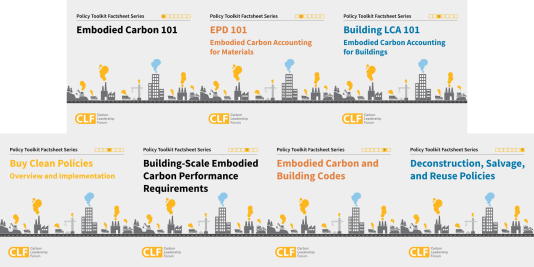
Carbon Leadership Forum Announces the Launch of a New, Improved and Expanded Embodied Carbon Policy Toolkit!

The Toolkit provides a collection of resources designed to provide policymakers with the tools to understand the current landscape of embodied carbon policy and to support the crafting of policies to radically reduce embodied carbon in buildings and infrastructure. The Toolkit is packed with a wide range of policy-focused essentials including seven downloadable policy factsheets on a variety of topics, an updated global policy tracker map, an array of policy-specific reports and case studies, and an introductory video series that takes a deeper dive into core embodied carbon policy concepts and implementable frameworks. 

Please visit the new Verkörpertes Carbon Policy Toolkit section of the CLF website and learn everything you need to know about how policy can be an effective lever to reduce embodied carbon in the built environment.

Entdecken Sie das Toolkit
A Publication from CLF's WBLCA Benchmark Study

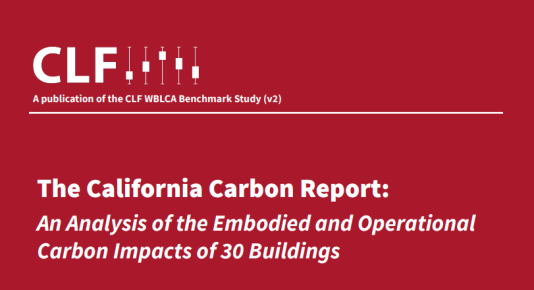
Carbon Leadership Forum announces the publication of The California Carbon Report: An Analysis of the Embodied and Operational Carbon Impacts of 30 Buildings

This report is the first in a series of reports that will be released as a part of the CLF WBLCA Benchmark Study (v2), which will build upon research and insights from the 2017 Embodied Carbon Benchmark Study. The project will expand our research methodology and result in embodied carbon benchmarks for buildings, systems, and assemblies modeled with consistent scope and background data. This will allow designers and decision-makers to set reliable embodied carbon targets and understand the potential for reduction throughout the design and construction processes.

Explore the Report
Please Provide Your Feedback on CLF's 2023 Material Baselines and Category Appendices!

As we begin work on the 2025 CLF Material Baselines, we’d like your feedback. Can you please take this brief survey (~5-10 minutes) to tell us about your experience with the 2023 Material Baselines and Category Appendices? 

Complete the Survey
The Past, Present, and Future of Embodied Carbon, a Conversation with the Carbon Leadership Forum

To celebrate 10 years as a CLF sponsor, Thornton Tomasetti convened a group of the organization’s leaders and members to discuss the past, present and future of understanding, measuring and reducing embodied carbon in buildings and infrastructure.

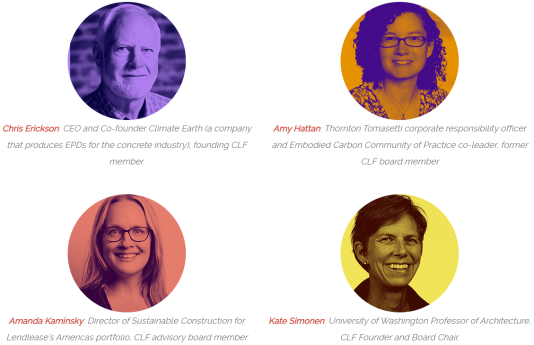
KATE: The CLF began with a small group of people who were excited about understanding the carbon footprint of building materials. Usually that was one or two people in a single firm that were trying to advance this work. By 2020, it was still a relatively small group looking at embodied carbon. That year we changed tactics, empowering more people to act by founding regional hubs. We also moved into engaging more explicitly with policy.

CHRIS: I’ve been involved in this with Kate since day one, and it was a lonely, small group, so that outreach has been important. The wider sustainability community began to recognize that embodied carbon was critical, especially around what we call the "time value" of carbon. That’s the idea that saving X amount of carbon emissions now is much more crucial than saving the same amount 40 years from now, when it's too little, too late. That’s been a fundamental driver. And the CLF instigated a lot of the communication about that.

AMY: I got involved with the CLF when Thornton Tomasetti joined in 2012, and the window of opportunity has been opening since then. Attention to climate change has increased as we’ve experienced more impacts. At the same time, there was an expanding community – of academics, government and people in the building sector – that was enabled by the CLF and the discussions it was holding. Industry groups started paying attention and certification programs began providing points for measuring and offsetting embodied carbon. And then tools were developed that enabled designers to take action.

AMANDA: Those tools enabled measuring. And measuring embodied carbon led to technological advancements when people realized that some materials have egregious impacts. We’re seeing so much innovation, spurred by a demand for improvement. We work a lot with concrete procurement, and there are so many interesting new materials. Embodied carbon is frequently synergistic with issues like material toxicity; something lower in embodied carbon is often also healthier.

Read the Whole Discussion
Be a Catalyst for Change: Tell Your Impact Story!

by Meghan Byrne, Engagement and Communications Lead

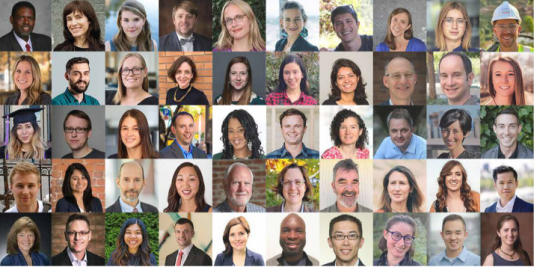
In the vibrant tapestry of our CLF Newsletter, the Auswirkungen auf die Mitglieder section stands as a testament to the power of individual action in the pursuit of sustainability. Over the past four years, we've woven together narratives from nearly 200 members across our network, each one a unique thread in the fabric of embodied carbon leadership. From seasoned veterans of environmental advocacy to fresh faces stepping into the realm of carbon reduction, these stories pulse with a shared energy—a conviction that change is not only possible but essential.

Now, we want to know: What are you and your organization doing to help reduce embodied carbon emissions? Share your impact story and ignite inspiration in others as we journey towards a more sustainable future together.

Submit Your Story!

Über das Carbon Leadership Forum

Wer wir sind

  • The Carbon Leadership Forum accelerates transformation of the building sector to radically reduce the embodied carbon in building materials and construction.
  • We pioneer research, create resources, foster cross-sector collaboration, and incubate member-led initiatives to bring embodied carbon emissions of buildings down to zero.
  • We are architects, engineers, contractors, material suppliers, building owners, and policymakers who care about the future and take bold steps to eliminate embodied carbon from buildings and infrastructure.

www.carbonleadershipforum.org

© Copyright 2024

Carbon Leadership Forum

4100 Redwood Rd #20A
Oakland, CA. 94619-5726
Vereinigte Staaten


You received this message because you subscribed to receive mailings from us, are a member of one of our groups, or have requested information.

Unsubscribe | Forward | Contact us: [email protected]