BIG NEWS: EPA Grant Program to Help Reduce Embodied Carbon for Construction Materials and Products 

Meghan lewis
Investigador principal, Carbon Leadership Forum

We are thrilled to share that just last Thursday, the U.S. Environmental Protection Agency (EPA) announced a groundbreaking $100 million Grant Program to Reduce Embodied GHG Emissions for Construction Materials and Products.  These grants are a remarkable opportunity to expand market access to lower carbon construction materials through investing in the ecosystem of standards, data sources, and tools that allow us to measure and find truly low carbon construction materials.

The EPA will award up to 40 grants, each approximately $250,000 - $10 million, for development of new environmental product declarations (EPDs), robust public background data, strong product category rules, tools and resources to streamline and minimize the cost of EPD development, and create platforms to share EPD data. 

In other words, these grants can fund every solution laid out in the product roadmap of our Advancing the LCA Ecosystem roadmap, published just weeks ago! 

Time is of the Essence

Seizing this remarkable opportunity requires swift action. Organizations must register with SAM (System for Award Management) to apply (which may take a month to process), and final grant applications are due January 8, 2024. You can sign up for informational webinars on the opportunities on November 2 or 14 aquí.

Nearly every organization in the CLF network holds the potential to lead or contribute to one of these grants. Your active participation can ensure the effective leveraging of this funding. Consider applying or supporting others in their efforts, and don’t hesitate to reach out to brainstorm and for help in identifying partners for collaboration.

Learn about the EPA Grant Program
Announcing the Embodied Carbon Harmonization and Optimization (ECHO) Project

A group of built environment industry groups and movement leaders is proud to share a new collaborative initiative — the Embodied Carbon Harmonization and Optimization (ECHO) Project — to tackle the challenge to rapidly reduce embodied carbon in built environments by ensuring that all embodied carbon reporting at the whole building and whole project scale (including landscapes and infrastructure) in the US follow the same clear definitions and scopes of included impacts.

CLF will lead the coordination and facilitation of the ECHO Project as it enters its second phase going forward into 2024, taking on the role after a successful launch led by Architecture 2030. The ECHO Project intends to continue meeting to further define scopes and accounting practices for embodied carbon in the built environment, as well as to discuss future projects including the potential for joint participation in a central data repository of whole project embodied carbon data points for building and infrastructure projects, to assist in policy making and standards setting efforts.

First drafts of the North American Minimum Project Embodied Carbon Reporting Framework V1.0 and the data reporting schema are being shared with partners, and we expect to publish public-facing resources in early 2024.

Learn More about ECHO
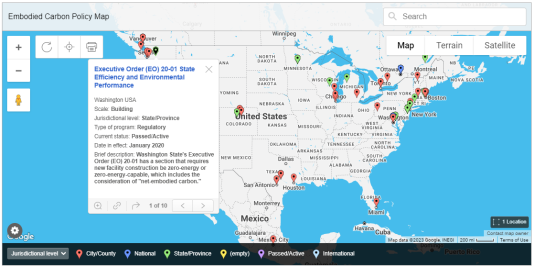
New CLF Embodied Carbon Policy Map

Embodied carbon policies are spreading rapidly across the United States and the world. In February, 2020, CLF launched a new map displaying public policies at various levels of government aimed at reducing embodied carbon emissions in materials and construction. At the moment of the map's launch, we were able track a handful of such policies in just seven US states, along with a few promising initiatives and policies in Europe. Since then, embodied carbon policies have exploded in number, both in North American and across the globe.

Our new map tracks over 230 government policies at all levels — local, state, national, and international. The map is an invaluable component of CLF's Embodied Carbon Policy Toolkit, which also includes an educational video series and downloadable PDF modules for essential embodied carbon understanding, summary of Buy Clean legislation, guidance on disclosure, steps to develop Buy Clean policy, guidance on implementing Buy Clean, and more.

Explore the Policy Map
Life Cycle Management and Embodied Carbon

by Anber Rana

I am a professional architectural engineer with over five years of experience in researching and teaching sustainable built environments. My passion for sustainable construction was ignited by the environmental impacts of construction industry. This instilled in me the significance of finding solutions for sustainable built environment.

My educational journey includes a bachelor’s and master’s degree in building engineering, where I honed my expertise in building sciences. However, my direct exposure to life cycle assessment and embodied carbon of buildings began when I joined the Life Cycle Management Laboratory program (UBC Okanagan) for my PhD studies.

Read Anber's Essay
Natalie Douglas
Nelson, British Columbia: A Small Rural Community Leads the Way to Reduce Embodied Carbon

by Natalie Douglas
Climate Resilience Planner, City of Nelson, British Columbia

Over the past 2.5 years, Nelson has focused on relationship building and education as a means of addressing embodied carbon emissions. Building up capacity and trust is a crucial and complementary step to sustained action.

Accounting for consumption-based emissions has been something that we have known that we needed to do for decades. While risks of double-counting emissions have often been cited as a key reason for delay, the lack of action may be more substantively impacted by the fact that much of the world measures its progress through the consumption of material goods.

Read Natalie's Essay
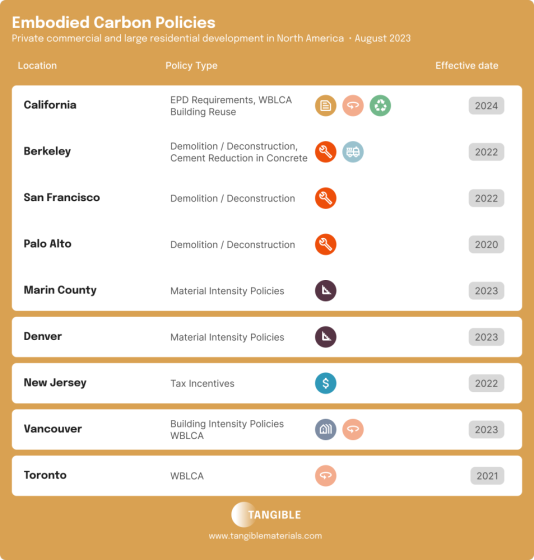
Tangible: Embodied Carbon and the Next Era of Building Codes

Article by Emily Flynn, Founding Researcher at Tangible
Illustrations by Farah Assir, Designer at Tangible

Over the past few decades, building performance in North America has improved largely as a result of building codes. The opportunity for impact is substantial, as buildings account for almost 40% of global greenhouse gas emissions, of which building operations make up 27% and building materials such as concrete and steel make up 11% (this is also known as embodied carbon). To date, the industry has mostly focused on improving the operational performance of buildings. Since the introduction of building energy efficiency measures in the 1970s, there has been a groundswell of operational energy code requirements for buildings at the national, state, and local level.

Read the Tangible Story
Video from the September 14 Quarterly Forum:
Focus on the Carbon Balance for MEP Systems

The Carbon Leadership Forum issued the Challenge for MEP engineers to design all projects to meet net zero carbon goals by 2040. Over 100 firms have now signed on to join the movement.

The whole-carbon balance for energy-using MEP systems has been an elusive topic for many. As operational carbon continues to be a focus, our understanding of embodied carbon ramps up, and low-GWP refrigerants consistently face regulatory challenges, making informed decisions based on the whole picture is a complex problem that our industry has yet to solve. The Seventh Quarterly Forum on September 14, 2023 focused on the whole-carbon balance between operational and embodied carbon for energy-using MEP systems.

View Video of the September 14 Forum
Webinar Announcement:
Advancing the LCA Ecosystem: A Policy-Focused Roadmap for Reducing Embodied Carbon

Please join us for a webinar presentation on "Advancing the LCA Ecosystem: A Policy-Focused Roadmap for Reducing Embodied Carbon." We'll describe the standards, data sources, tools, and actors that make up the current LCA ecosystem, and outline our roadmap towards an ideal LCA ecosystem optimized for policy and private sector decarbonization action.

Read more about the project and download the recently published report.

Webinar date: Oct 25, 2023, 10:00 - 11:30 AM Pacific Time

Regístrese por adelantado

Impacto de los miembros

What is your personal motivation for addressing climate change, and what are you and your organization doing to help reduce embodied carbon emissions?

Julia Wattick

Materials Team Lead, BranchPattern

Read the Answer
Surybala Sah

Sustainability Specialist, Gensler

Read the Answer
Tim Hemsath

Senior Associate, BVH Architecture

Read the Answer

This month’s action checklist

Únase a la comunidad CLF en línea – focus groups, information, collaboration, research, resources, exploration, innovation.
Watch Andrew Himes' TEDx Talk: "Change Our Buildings, Save Our Planet" Buildings can be an existential solution to climate change -- not an existential threat.
MEP 2040 Challenge: A rapidly growing movement to decarbonize building systems. Sign the Commitment!

About the Carbon Leadership Forum at the University of Washington

Quienes somos

  • The Carbon Leadership Forum accelerates transformation of the building sector to radically reduce the embodied carbon in building materials and construction.
  • We pioneer research, create resources, foster cross-sector collaboration, and incubate member-led initiatives to bring embodied carbon emissions of buildings down to zero.
  • We are architects, engineers, contractors, material suppliers, building owners, and policymakers who care about the future and take bold steps to eliminate embodied carbon from buildings and infrastructure.


www.carbonleadershipforum.org

© Copyright 2023

4100 Redwood Rd #20A
Oakland, California 94619-5726
Estados Unidos

You received this message because you subscribed to receive mailings from us, are a member of one of our groups, or have requested information.              

Unsubscribe  |  Forward Email  |  Contact us: [email protected]