CLF
  Agosto 2021

Change Only Begins With Data

by Anthony Hickling, Managing Director, Carbon Leadership Forum

As we’ve noted in previous newsletters, the Carbon Leadership Forum’s “theory of change” is a kind of roadmap to guide our work. We say that through collective action, informed by data and motivated by policy we can build for a better planet. In this newsletter you’ll see each of those key strategies are making an impact to decarbonize buildings and construction.  

For example, we have exciting news on the topic of embodied carbon data.This month we are officially releasing a significant update to our 2021 Material Baselines to help you calculate the carbon footprint for a wider range of building materials (see below). This is a resource you can start using today, and you can expect further updates to the Material Baselines as we continue to refine the data and broaden the range of materials covered. 

With resources like this, we expect builders and policy-makers like yourself will get a better sense of where to focus your efforts to drive improvements now. Together with you, our network and community partners, we can make a measurable difference.

CLF Webinar:
10 Minutes of Brilliance!


Join Five Awesome CLF Members as They Explore the Frontiers of Radical Conservation and Materials Reuse

  • Emma Reif - Project Director at Thornton Tomasetti
  • Luke Lombardi - Project Engineer at Thornton Tomasetti
  • Catherine Paplin - Senior Consultant at Steven Winter
  • Walter Cain - Principal at WaCa Design LLC
  • Aditya Bhagath - Associate at Thornton Tomasetti

August 13, 2021, 9:00 am PST

Luke Lombardi, Emma Reif, and Aditya Bhagath will present "Conserving Carbon Assets through Resilient Thinking" a brief look into reframing the embodied carbon challenge with a lens toward protecting and preserving our building stock that is vulnerable to natural hazards.

Catherine Paplin will present "Climate salvation through building salvage," covering how key policy and practice changes could effect radical, immediate carbon emissions reductions by prioritizing building preservation and reuse over new construction.

And Walter Cain will share "Reusing Building Materials: from Obligation to Opportunity" Reusing salvaged materials is an effective strategy for designers obliged to minimize embodied energy in construction projects, but these materials also present opportunities for innovative design.

Register to Attend
Material Baselines
July Update
 

Updated Version of the 2021 Carbon Leadership Forum Material Baselines Report Published

"Newly added materials include concrete masonry units (CMU), steel wire and mesh, steel decking, aluminum extrusions, thermally improved aluminum extrusions, insulated metal panels (IMP), and metal roof and wall panels."

Los arquitectos, ingenieros y constructores a menudo se enfrentan al desafío de elegir productos o materiales y evaluar sus impactos de carbono incorporados relativos junto con una serie de otros factores. 

A principios de este año, la CLF publicó el Líneas de base de materiales del Foro de Liderazgo de Carbono 2021 to support decision makers and their efforts toward embodied carbon reduction by providing information on the typical embodied carbon of construction materials, and the expected range and variability within a category. Instead of providing a single number, the CLF baselines help users understand the range of values and find opportunities for improvement and goal-setting throughout a project: from early design approximations to final evaluation and benchmarking. 

Review Updated Baselines
 
Thornton Tomasetti  

CLF
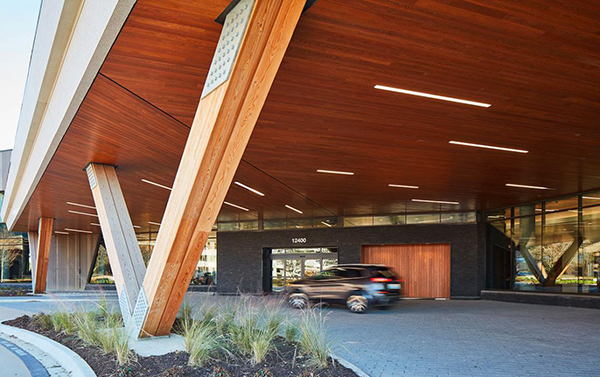
Thornton Tomasetti’s project for the Texas Health Hospital uses timber instead of steel or concrete as a key part of a more resilient future. When managed sustainably, timber can be a renewable resource that substantially reduces the embodied carbon in a building’s design. "We develop our own expertise and experience with embodied carbon reduction, while hoping what we are doing is inspiring others in the industry so that together we can make real change happen...this is our best opportunity to demonstrate positive impact."

In the Embodied Carbon Game for Over 10 Years

​by Amy Hattan
Vicepresidente de Responsabilidad Corporativa, Thornton Tomasetti

Nine years ago, I began working at the engineering services firm Thornton Tomasetti as its first Corporate Responsibility Officer. My earliest task was to manage the annual reporting required for members of the American Institute of Architects (AIA) 2030 Commitment – and to engage in this reporting with a unique twist.

The Commitment, whose members are mostly architects, asks that member firms submit the predicted energy use intensity for their projects.

At that time, my firm was primarily engaged in structural engineering, and measuring the operational energy of our projects did not seem to be the best assessment of our direct contribution.  Because of the large impact of structural materials on a building’s carbon footprint, we proposed to the AIA that we would report on the embodied carbon in our structural engineering projects. Thus, we began our multi-year R&D project on embodied carbon.

Over the course of our years as a member of the Commitment, we developed a sizeable embodied carbon database of over 600 projects. This comprehensive database gave us the opportunity to engage in several collaborations with the goal of identifying benchmarks for embodied carbon in structures. We collaborated with the Massachusetts Institute of Technology and with the Carbon Leadership Forum.

These collaborations fed into the CLF Embodied Carbon Benchmark Study and to the initiation of the Structural Engineers 2050 Challenge. After sending our embodied carbon report to the AIA year after year for a program that was focused on operational energy use, I was very excited to help start a new commitment that was tailor-made for structural engineers. We need the data from other firms like us to make our own data more relevant to the entire field.

Read the Full Story!

Share Your Whole Building LCA Software Experience!


A Survey for Users of Multiple LCA Applications 

Thais Sartori, a CLF member from the School of Architecture & Built Environment at Queensland University of Technology (QUT) in Australia, is conducting a PhD project on current practices and future developments in the use of Whole Building Life Cycle Assessment (WBLCA) in decision-making. To learn more about the survey from Thais, email [email protected].

Take the Survey
RMI: Reducing Embodied Carbon in Buildings  

Oportunidades de alto valor y bajo costo
Informe / julio 2021

Los edificios representan al menos 39% de emisiones globales de carbono relacionadas con la energía anualmente. Al menos una cuarta parte de estas emisiones son el resultado del carbono incorporado o las emisiones de carbono asociadas con los materiales de construcción y la construcción. Las soluciones para abordar el carbono incorporado en los edificios no se han estudiado ampliamente en los Estados Unidos, lo que deja una brecha de conocimiento significativa para ingenieros, arquitectos, contratistas, legisladores y propietarios de edificios.

Embodied carbon can be reduced significantly at little to no additional up-front cost. The case studies showcased in this report show an embodied carbon savings potential of 24%–46% at cost premiums of less than 1%. Current practice indicates that we can achieve these reductions by specifying and substituting material alternatives with lower embodied carbon during the design and specification process. Far greater reductions are possible when a whole-building design approach is taken.

Read the Report
 

This month’s action checklist

Únase a la comunidad CLF en línea – focus groups, information, collaboration, research, resources, exploration, innovation.
Check out News You Can Use with comprehensive coverage of the movement to reduce embodied carbon.
Time to sign up for Getting to Zero Forum! Register Now, October 27-29, 2021, New York City.

About the Carbon Leadership Forum at the University of Washington

Quienes somos

  • The Carbon Leadership Forum accelerates transformation of the building sector to radically reduce the embodied carbon in building materials and construction.
  • We pioneer research, create resources, foster cross-sector collaboration, and incubate member-led initiatives to bring embodied carbon emissions of buildings down to zero.
  • We are architects, engineers, contractors, material suppliers, building owners, and policymakers who care about the future and take bold steps to eliminate embodied carbon from buildings and infrastructure.


www.carbonleadershipforum.org


© Copyright 2023

4100 Redwood Rd #20A
Oakland, California 94619-5726
Estados Unidos

You received this message because you subscribed to receive mailings from us, are a member of one of our groups, or have requested information.              

Unsubscribe  |  Forward Email  |  Contact us: [email protected]