At CLF, we’re working to bring those opportunities to the forefront – showing how today’s solutions can meaningfully reduce embodied carbon and move the built environment towards a more climate-aligned future.
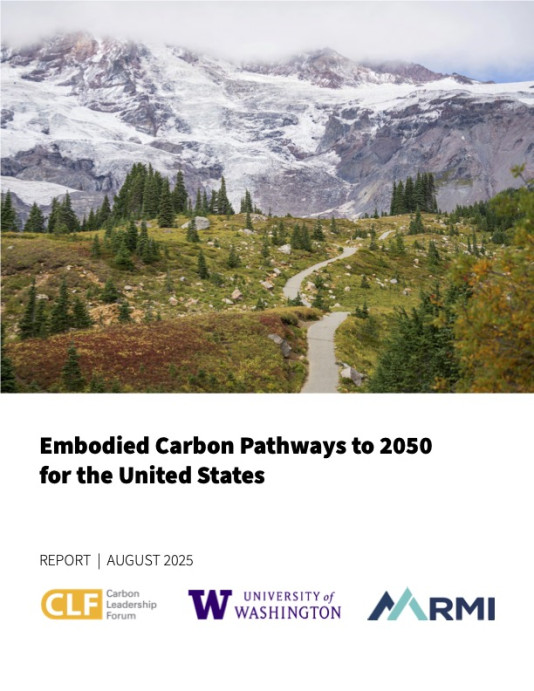
A clear signal of that opportunity comes from The Embodied Carbon Pathways to 2050 for the United States, a collaborative report by CLF, RMI, and the UW Life Cycle Lab. This report offers the most comprehensive analysis to date on the future of US embodied carbon and how embodied carbon emissions could evolve, and be reduced, across US buildings and materials. Rapid decarbonization is essential to meet the emissions reductions required for a 1.5°C-aligned future. With limited time and mounting pushback, prioritizing the highest-impact strategies is critical, and this report identifies a broad set of existing and emerging solutions with immediate potential.
Our analysis shows that a combination of strategies — from material substitution and design optimization to electrification and carbon capture — is essential to achieving the necessary emissions reductions. It also shows that everyone in CLF’s network has a role to play: changes in manufacturing, design, and procurement, supported by private- and public-sector policies and incentives, are key to accelerating the transition to a lower-carbon construction sector.
We hope this report helps you see embodied carbon reduction not as an abstract challenge, but as a set of concrete opportunities. Dive in, and identify one way these pathways can inform your work — whether you’re shaping policy, specifying materials, or influencing procurement decisions. Progress is already underway, and there’s a role for everyone in moving it forward. |