by Brad Benke, Low Carbon Buildings Manager

It’s a privilege and a joy to share the release of the CLF’s new Embodied Carbon Benchmark Report and four additional new resources from the University of Washington’s Life Cycle Lab. Our benchmark report offers major improvements to CLF’s previous research by providing empirically derived embodied carbon benchmarks of buildings and related analyses to drive decarbonization at scale.

Additionally, exciting new work from the Life Cycle Lab offers insights into statistically significant drivers of embodied carbon, in-depth material-level analysis of buildings, and dynamic visualization dashboards to compare project impacts. While I’ll focus on the details of our report below, make sure to check out all of the amazing resources newly available as part of the CLF WBLCA Benchmark Study V2. 

Our benchmark report fills a critical gap within the design and construction industry by providing defensible, bottom-up, data-driven embodied carbon benchmarks for buildings in the US and Canada and guidance on their implementation. Derived from our recently published open-access WBLCA dataset, we provided benchmarks for multiple building use types to support WBLCA-based policy development and industry decision-makers in setting limits and targets for building decarbonization.  The report also explores key drivers and trends in building impacts, advancing efforts by practitioners and policymakers alike to reduce emissions across projects, portfolios, and policies. We hope this report will empower industry leaders with better data to analyze and compare the impacts of buildings, set performance targets, and motivate impact reductions. 

We’re so excited to share these new resources with you - dive into them, share widely, and help drive the shift towards low-carbon buildings - the time for data-informed action is now! Huge thanks to the contributors and collaborators who made this work possible, especially the Alfred P. Sloan Foundation, the ClimateWorks Foundation, and the Breakthrough Energy Foundation – we’re grateful for your partnership in this effort!

Embodied Carbon Benchmark Report

In this report, we fill a critical gap within the design and construction industry by providing bottom-up, empirically derived embodied carbon benchmarks for buildings in the US and Canada to aid in the development of WBLCA policies and programs. Additionally, we explored drivers and trends of the embodied carbon impacts of buildings across multiple project features to increase knowledge in the industry and inform building decarbonization efforts. All of this was done using one of the richest and most methodologically consistent datasets of WBLCA results currently available for North America. Thus, the benchmarks and findings from this report provide greater consistency and reliability than previous studies and offer clearer and more actionable pathways to industry-wide decarbonization.

Explore the Report
 
Additional New WBLCA Publications

As part of the CLF WBLCA Benchmark Study V2, we are thrilled to announce the release of four additional publications from the University of Washington Life Cycle Lab. These resources reflect years of work and collaboration between the CLF and Life Cycle Lab and show what’s possible with the recently published open-access WBLCA dataset. They offer insights and tools for exploring building and material-level embodied carbon impacts and the driving forces behind higher and lower carbon projects. 

WBLCA Benchmark Study v2
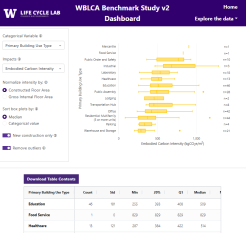
WBLCA Benchmark Study v2 Dashboard

Mel Chafart led the development of a visualization tool to explore the impact intensities of buildings in the CLF dataset. Users can select the type of impact (embodied carbon or other TRACI category) and compare buildings using various project features (use type, structural system, etc.). 

Mehr erfahren
Exploratory Data Analysis of a North American Whole Building Life Cycle Assessment Dataset paper
Exploratory Data Analysis of a North American Whole Building Life Cycle Assessment Dataset

Yang Shen led a study which introduces a systematic exploratory data analysis (EDA) framework for WBLCA data using the CLF dataset, serving as a foundation for advanced data analysis and predictive modeling. It provides a structured approach for identifying patterns, distributions, and relationships between project and LCA parameters and their influence on embodied carbon impacts.

Mehr erfahren
Material Use and Embodied Carbon Intensity of New Construction Buildings in North America paper
Material Use and Embodied Carbon Intensity of New Construction Buildings in North America

Milad Ashtiani led research investigating material use intensity (MUI) and embodied carbon intensity (ECI) of the CLF dataset with a focus on material-level A1-A3 impacts. It supports benchmarking at the material level, material stock and flow analyses, and provides insights for carbon reduction strategies.

Mehr erfahren
Embodied carbon and Material Use Intensity Visualizer

Milad Ashtiani led the development of an accompanying visualization dashboard for the paper above that allows high-resolution comparisons of material use and embodied carbon intensity of materials and buildings. Users can explore MUI and ECI across building typologies, structural systems, and materials using a wide range of filters and categories.

Mehr erfahren
 
Join the Conversation on LinkedIn

Over the past few weeks, the LinkedIn community has been buzzing with insights, reflections, and real-world applications of the Benchmark Study — and we’re thrilled by the response. Here’s a roundup of highlights from CLF, the Life Cycle Lab, and our amazing contributors. Dive into the conversation and let us know how you’re using the WBLCA resources

From the Project Teams

In our March 2025 Newsletter, CLF announced the release of the Harmonized Dataset of High-Resolution WBLCA Results in North America — and our project teams took to LinkedIn to share the news:

  • CLF: Brad Benke und Mel Chafart
  • LCL Posts: Kate Simonen und Yang Shen
Spotlight on Contributors

This dataset wouldn’t be possible without the support of our contributors. Many helped spread the word — here’s what they had to say:

  • Jessie Scott Templeton @ Brightworks
  • reLoad Sustainable Design Inc
  • Tim Hemsath @ BVH Architecture
  • Katherine Bubriski @ Arrowstreet
  • Nate Maniktala @ BranchPattern
Dataset in Action

We’ve loved seeing how the community is already using and visualizing the data:

  • C.Scale – Dataset Insights
  • Jared Friedman – Exploring the CLF WBLCA Dataset
  • Jesse Walton – Data Visualization
ICYMI: WBLCA Dataset Resource Spotlight

Curious about what’s in the dataset and how to get started? Our ICYMI LinkedIn post broke it down — what the data means, why it matters, and how to take action. You can find now find the Resource Spotlight PDF on the WBLCA Project Page.

 
Take Action

Help us keep the momentum going — share the Embodied Carbon Benchmark Report with your network and let us know how you’re using it in your work. We’d love to hear how you’re applying these benchmarks — tag us on LinkedIn or reach out to the authors of these resources to share your story.

Besuchen Sie LinkedIn

Über das Carbon Leadership Forum

Wer wir sind

  • The Carbon Leadership Forum accelerates transformation of the building sector to radically reduce the embodied carbon in building materials and construction.
  • We pioneer research, create resources, foster cross-sector collaboration, and incubate member-led initiatives to bring embodied carbon emissions of buildings down to zero.
  • We are architects, engineers, contractors, material suppliers, building owners, and policymakers who care about the future and take bold steps to eliminate embodied carbon from buildings and infrastructure.

www.carbonleadershipforum.org

© Copyright 2024

Carbon Leadership Forum

4100 Redwood Rd #20A
Oakland, CA. 94619-5726
Vereinigte Staaten


You received this message because you subscribed to receive mailings from us, are a member of one of our groups, or have requested information.

Unsubscribe | Forward | Contact us: [email protected]