New collaborative report by CLF, RMI, and UW Life Cycle Lab projects that US cradle-to-gate embodied carbon from buildings and infrastructure is projected to increase 35% by 2050 under a “business-as-usual” (BAU) scenario.

par Meghan Lewis

Rapid decarbonization of the U.S. industrial and building sectors is essential to meet the emissions reductions required for a 1.5°C-aligned future. With limited time and mounting pushback, prioritizing the highest-impact strategies is critical.

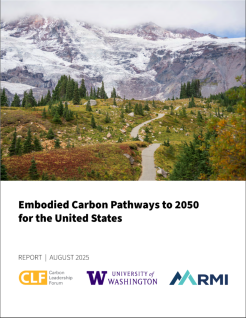
Today, CLF—alongside RMI and the UW Life Cycle Lab—releases Embodied Carbon Pathways to 2050 for the United States, the most comprehensive analysis to date on the future of US embodied carbon.

It includes: (1) business-as-usual emissions and material quantity projections through 2050 for 30 key materials, (2) 1.5°C-aligned embodied carbon intensity targets for buildings, and (3) key strategies and policies to meet those targets.

The report identifies a broad set of existing and emerging solutions with immediate potential. Cement and clinker substitution shows the highest economy-wide impact. Design approaches like structural optimization and material substitution—supported by strong building-level targets in codes and policies —also offer major reductions. Achieving US 1.5°C-aligned targets will also require manufacturing facilities to increase adoption of energy efficiency, low-carbon electricity, and carbon capture technologies and strategies.

The analysis reveals that everyone in CLF’s network has a role to play: changes in manufacturing, design, and procurement supported by private and public sector policies and incentives are all key to accelerating this transition to a lower carbon construction sector.

Embodied Carbon Pathways to 2050 for the United States

Embodied Carbon Pathways to 2050 for the United States, a collaboration between the Carbon Leadership Forum (CLF), RMI, and the University of Washington (UW) Life Cycle Lab, provides an assessment of embodied carbon from US construction materials and explores pathways to align with a 1.5°C global warming limit.

This report serves as a call to action, urging the industrial and construction sectors to continue progress towards global targets.

The embodied carbon of key construction materials used in buildings and infrastructure in the United States is significant and requires deployment of a large range of strategies. While challenges remain, existing technologies and strategies can deliver meaningful reductions in the near term. Success will depend on rapid policy action, cross-sector collaboration, and sustained investment in both proven and emerging solutions.

Explore the Report
  • How States Can Lead the Charge on Industrial Decarbonization
  • New York Becomes First State to Commit to All-electric New Buildings - Building Decarbonization Coalition Statement in Response to New York Leading the Nation by Enacting All-Electric Buildings Code
  • Washington Council Reviews Carbon Reduction Proposals for Building Codes
  • Meta Replaces Steel, Concrete with Wood to Cut Data Center Carbon Footprint
  • This Massachusetts Town Banned Gas — and Housing Boomed Anyway
  • California Halts Building Code Updates in a Blow to Electrification
CLF 2025 North American Baselines Webinar

Monday, August 25, 2025 at 10am pst | The Carbon Leadership Forum published the 2025 CLF North American Material Baselines Report in June of 2025. Our fourth major edition since 2019, this new report provides an extensive “state of EPDs” snapshot of the North American construction materials industry, including a set of industry-average “baseline” carbon emissions values for hundreds of product types.

In this webinar, the authors will present an overview of the project and walk through the report’s methods and results, highlighting significant updates compared to previous versions. CLF staff will be available to respond to audience questions.

[You can watch the recording of the 2023 CLF Material Baselines webinar for additional background.] 

Register Now
Rocky Mountain Natural Building Conference

September 18–20, 2025 | More Than a Conference — It’s a Community!

The Rocky Mountain Natural Building Conference brings together the people who are changing the way we think about shelter.

Come connect with:

  • Regenerative builders
  • Homesteaders & off-grid dwellers
  • Architects & code changers
  • Educators & trade instructors
  • Curious learners of all ages

From breakfasts/lunches to keynotes to hands-on demos, every moment is an opportunity to build relationships as well as walls.

Register Now

À propos du Carbon Leadership Forum

Qui nous sommes

  • The Carbon Leadership Forum accelerates transformation of the building sector to radically reduce the embodied carbon in building materials and construction.
  • We pioneer research, create resources, foster cross-sector collaboration, and incubate member-led initiatives to bring embodied carbon emissions of buildings down to zero.
  • We are architects, engineers, contractors, material suppliers, building owners, and policymakers who care about the future and take bold steps to eliminate embodied carbon from buildings and infrastructure.

www.carbonleadershipforum.org

© Copyright 2025

Forum du leadership carbone

4100 Redwood Rd #20A
Oakland, Californie 94619-5726
États Unis


You received this message because you subscribed to receive mailings from us, are a member of one of our groups, or have requested information.

Unsubscribe | Forward | Contact us: [email protected]