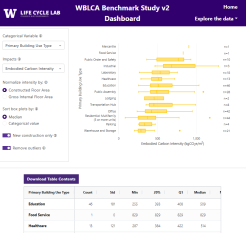
Additionally, exciting new work from the Life Cycle Lab offers insights into statistically significant drivers of embodied carbon, in-depth material-level analysis of buildings, and dynamic visualization dashboards to compare project impacts. While I’ll focus on the details of our report below, make sure to check out all of the amazing resources newly available as part of the CLF WBLCA Benchmark Study V2.
Our benchmark report fills a critical gap within the design and construction industry by providing defensible, bottom-up, data-driven embodied carbon benchmarks for buildings in the US and Canada and guidance on their implementation. Derived from our recently published open-access WBLCA dataset, we provided benchmarks for multiple building use types to support WBLCA-based policy development and industry decision-makers in setting limits and targets for building decarbonization. The report also explores key drivers and trends in building impacts, advancing efforts by practitioners and policymakers alike to reduce emissions across projects, portfolios, and policies. We hope this report will empower industry leaders with better data to analyze and compare the impacts of buildings, set performance targets, and motivate impact reductions.
We’re so excited to share these new resources with you - dive into them, share widely, and help drive the shift towards low-carbon buildings - the time for data-informed action is now! Huge thanks to the contributors and collaborators who made this work possible, especially the Alfred P. Sloan Foundation, the ClimateWorks Foundation, and the Breakthrough Energy Foundation – we’re grateful for your partnership in this effort! |