Unsubscribe
View in your browser
Exploring Transformative Change: Insights from the CalPortland Plant

by Mel Chafart, research engineer for the Life Cycle Lab at the University of Washington

Recently, I joined the CLF-LA Hub on a tour of the CalPortland plant in Mojave. It was really illuminating to learn more about how the sausage gets made. I tend to think about cement as the bad guy of concrete production, with a vast majority of the emissions from concrete coming from the manufacturing of Ordinary Portland Cement. However, meeting the CalPortland people wasn’t like meeting a villain, it was like meeting a coworker. They were experimenting with new ways to reduce their environmental impact. They touted new solutions, and were excited to geek out on all the minutiae of lower carbon products. 

Read Mel's Essay

New Publications from the Embodied Carbon Harmonization and Optimization Project:
— Version 1.0 of Data Reporting Schema
— Project Life Cycle Assessment Requirements

In 2023, ECHO project members recognized the need for a consistent approach to reporting whole project life cycle assessment (LCA) results. To address this, a dedicated working group analyzed existing frameworks, LCA standards, and database structures, leading to the creation of ECHO's first publication, Version 1.0 of the Data Reporting Schema. This first version aligns LCA reporting fields across North American geographies and platforms, filling gaps where no alignment previously existed.

The Project's second publication, Project Life Cycle Assessment Requirements: ECHO Recommendations for Alignment, Version 1.0, summarizes ECHO’s findings and recommendations around project LCA requirements to drive alignment in the modeling and reporting of project LCAs submitted to the commitment and certification programs included in ECHO. 

Explore New ECHO Publications
Tsandi Chen

Structural EIT at HDR and co-leader of the CLF Los Angeles Regional Hub

Read Tsandi's Essay
Jessie Templeton

Embodied Carbon Service Lead, Brightworks Sustainability | CLF Seattle Co-lead

Read Jessie's Essay
Celebrating Collective Impact:
Five Years of the CLF Boston | NE Hub

by The CLF Boston | NE Hub Leadership Team

In 2019 the Boston Society of Architects organized a summit, called “Embodied Carbon in Buildings,” which sparked interest in forming a place to share information about reducing embodied carbon emissions - and from that summit, the CLF Boston | NE Hub was born. From the beginning, the Hub has been about strengthening relationships and working in concert across disciplines for the greatest impact and the furthest reach. As the hub has grown, the focus has shifted to fill gaps in education and providing support for best practices in research and implementation.

This past June, Hub leaders organized a follow-up summit to the first Embodied Carbon in Buildings event. The five-year anniversary allowed us to celebrate the significant advancements we've made as a region and industry while reinforcing our commitment to the work ahead. It served both as a celebration and a reminder that there is still more to accomplish.

Read the Boston Story
CLF and Partners Propose Federal Blueprint for Real Estate Decarbonization

A coalition of leading sustainable building organizations has released a detailed agenda for the next administration, aimed at helping commercial buildings recover from the current downturn and better prepare for the future.

Following a global pandemic, the commercial real estate sector is grappling with a growing number of challenges. High interest rates, declining occupancy rates, and soaring insurance and construction costs have placed significant pressure on property owners and developers.

“Federal investments in the building sector have the potential to make buildings a part of the climate solution while improving health and quality of life in communities across the U.S.," said Meghan Lewis, program director at the Carbon Leadership Forum. "Continued federal leadership in advancing innovation and data used to measure the emissions of buildings and products will be critical in positioning the US as a competitor in the global market for low-embodied carbon construction materials.” 

Learn More and Download the Blueprint
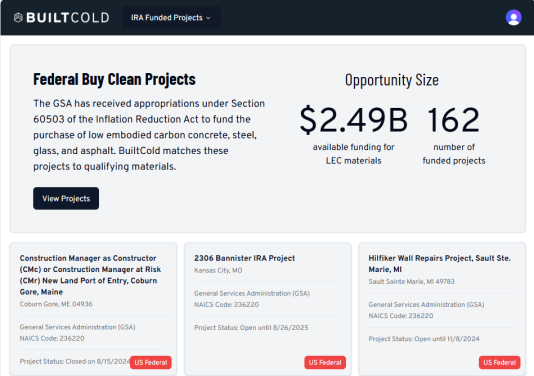
BuiltCold: Helping Governments Accelerate Buy Clean Adoption

by Taylor Linnell, CEO and Founder of BuiltCold

If governments could access modern, purpose-built technology, would they create and implement ‘Buy Clean’ policies faster? This was the critical question we set out to answer when founding BuiltCold.

Our mission is to reduce the administrative burden on agencies implementing low-carbon construction policies like the Federal Buy Clean Initiative and the Buy Clean Colorado Act.

Buy Clean policies reduce embodied carbon by mandating or incentivizing low-carbon construction materials in the public and private sectors. This drives investment from suppliers eager to decarbonize and meet the growing demand. In theory, Buy Clean programs could be one of the most powerful tools in the fight against climate change. However, the path from policy creation to agency implementation presents significant challenges.

Read the BuiltCold Story
The Challenge to Innovate

It is simply not possible to reinvent the future of construction by modeling the past. There has to be a better way.

by Allen J. Dusault, Founder and Owner, Dusault Engineering

We need to reimagine the construction industry’s future if we are going to radically reduce its carbon footprint. That is — largely — not what is now happening. Most of the innovations proposed, funded, and implemented today are based on construction models at least 50, 75, or 100 years old, and are primarily refinements, often with a tech overlay. That is not to say we shouldn’t enhance and improve old methods. But we also need radically new approaches to create powerful, unimagined innovations in building design and construction. Historical context informs this argument.

Read Allen's Viewpoint
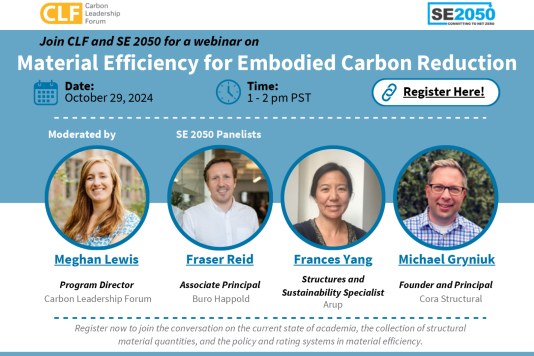
Register for the Webinar

Acerca del Foro de Liderazgo de Carbono

Quienes somos

  • The Carbon Leadership Forum accelerates transformation of the building sector to radically reduce the embodied carbon in building materials and construction.
  • We pioneer research, create resources, foster cross-sector collaboration, and incubate member-led initiatives to bring embodied carbon emissions of buildings down to zero.
  • We are architects, engineers, contractors, material suppliers, building owners, and policymakers who care about the future and take bold steps to eliminate embodied carbon from buildings and infrastructure.

www.carbonleadershipforum.org

© Copyright 2024

Foro de liderazgo de carbono

4100 Redwood Rd #20A
Oakland, California 94619-5726
Estados Unidos


You received this message because you subscribed to receive mailings from us, are a member of one of our groups, or have requested information.

Unsubscribe | Forward | Contact us: [email protected]