by Brook Waldman, Low Carbon Product Lead

Help Scale Up Material Reuse! Build on this Report to Advance the EPD Ecosystem for Reused Construction Products

The environmental benefits of material reuse seem intuitively obvious to many of us. But we currently lack the carbon case for material reuse  — i.e., a credible and quantitative demonstration of greenhouse gas emission reductions compared to conventional products. This makes it hard for low-carbon procurement policies and programs to incorporate and help scale reused materials.

EPDs for reused construction products could provide that carbon case. But currently, there are zero (as far as we know) examples of North American EPDs for reused construction products. And there is no general North American PCR guidance for material reuse. To address this gap, in this report:

  • We propose LCA methods and PCR language for reused construction product EPDs.
  • We share initial LCA model results for three reused product types — lumber, structural steel, and brick.
  • We recommend next steps for data collection, PCR development, and industry-average EPDs for reuse construction products.

We hope that PCR committees, program operators, and LCA developers can use our proposed methods, draft models, and recommended next steps as a basis to develop formal PCR guidance and LCA models for reuse. These steps will support a robust LCA ecosystem for reuse and ultimately help scale material reuse and its environmental benefits.

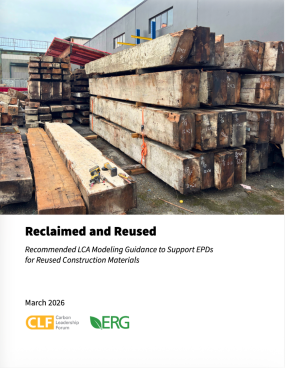
Reclaimed and Reused: A Recommended LCA Modeling Approach to Support EPDs for Reused Construction Materials

Material reuse is one strategy for reducing the embodied carbon of construction. It avoids many of the resource extraction and manufacturing impacts of building with newly manufactured products. Given the amount of demolition and deconstruction across North America (and beyond), there is a vast potential for material reuse to expand in scale. However, barriers to material reuse scaling exist. 

The current North American construction product EPD ecosystem lacks LCA guidance and related resources for developing EPDs for salvaged and reused products. 

To address this gap, CLF and Eastern Research Group (ERG) collaborated to advance the discussion on reuse construction product PCR guidance and modeling. In this report:

  • We recommend life cycle assessment (LCA) methods y propose PCR language for reuse product EPDs.
  • We present initial LCA model results for reuse lumber, steel, and brick.
  • We make recommendations for future work.

We hope others will build upon these efforts to advance LCA and EPDs for reuse construction products. We envision the following four main steps.

  1. Develop an industry-wide dataset for reuse. 
  2. Develop industry-average LCA models for reused construction products.
  3. Develop PCR guidance for category-specific PCRs (steel, wood, brick, flooring, etc.) to incorporate or reference.
  4. Develop industry-average EPDs for reuse construction product types and support future pathways for more specific EPDs.
Read the Report

If you’re interested in learning more or are new to EPDs, salvage, and reuse, here are some CLF resources to help you get up to speed.

Recursos CLF
2 – EPD 101: Embodied Carbon Accounting for Materials

This factsheet explains what Environmental Product Declarations (EPDs) are, how they are created and the pathways to use them in policy.

View Resource
7 – Deconstruction, Salvage, and Reuse Policies

This factsheet provides an overview of reuse concepts and how government policies and programs can contribute to a circular building and material reuse ecosystem.

View Resource
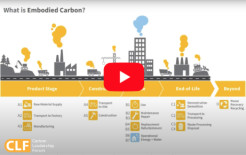
Embodied Carbon Policy Training Series - Module 3: Environmental Product Declarations (EPDs)

These pre-recorded video training modules are intended to be modular, allowing them to be presented in isolation or as an ongoing training series.

View Resource
External Resources
los Build Reuse EPD Project

Build Reuse is currently advancing work on many of the items we recommend in our report to support EPDs for building material reuse.

View Resource
Hub Resources
Boston Deconstruction and Material Reuse Roadmap

los CLF-Boston Reuse working group developed this roadmap. Check it out for current best practices and strategies to implement reuse, whether you're a designer, contractor, or owner.

View Resource
How to Get Involved

Join a growing movement of researchers, policymakers, practitioners, and advocates working to decarbonize the building sector.

Ways to participate:

  • Join the CLF Network – Connect with 10,000+ professionals worldwide

  • Participate in regional CLF hubs

  • Share or submit resources and case studies

  • Attend CLF-hosted events and webinars

  • Advocate for embodied carbon policies in your state

Your voice strengthens the community and accelerates progress.

Visit CLF Website

Acerca del Carbon Leadership Forum

Quienes somos

  • The Carbon Leadership Forum accelerates transformation of the building sector to radically reduce the embodied carbon in building materials and construction.
  • We pioneer research, create resources, foster cross-sector collaboration, and incubate member-led initiatives to bring embodied carbon emissions of buildings down to zero.
  • We are architects, engineers, contractors, material suppliers, building owners, and policymakers who care about the future and take bold steps to eliminate embodied carbon from buildings and infrastructure.

www.carbonleadershipforum.org

© Copyright 2026

Foro de liderazgo de carbono

4100 Redwood Rd #20A
Oakland, California 94619-5726
Estados Unidos


You received this message because you subscribed to receive mailings from us, are a member of one of our groups, or have requested information.

Unsubscribe | Forward | Contact us: [email protected]