Cradle to Gate to Cradle

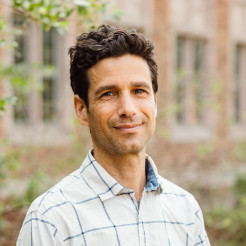
Brook Waldman
Researcher, Carbon Leadership Forum

Hello! We recently completed two CLF project milestones: we presented a webinar for the 2023 CLF Material Baselines in late August, and we just published the report for our “Advancing the LCA Ecosystem” project, which will also include an upcoming webinar.

Here’s the metaphor on my mind:
A typical construction product LCA has a “cradle-to-gate” scope: it accounts for the production and transport of raw materials and the manufacturing of the product – everything up until the moment the product is ready to leave the factory “gate.” As we know from whole-building (and other project-scale) LCA, it’s critical to also consider what happens downstream of that factory gate – during the product’s use and end-of-life.

Read Brook's Full Essay
New CLF Roadmap Report: Advancing the LCA Ecosystem for Policy / August 2023

por Meghan Lewis
Senior Policy Researcher, CLF

The rapid growth of embodied carbon policies has created a unique opportunity to leverage current funding and interest to maximize the potential of LCA as a tool for decarbonization.

In this report, the CLF lays out steps to strengthen and build upon existing LCA standards, data sources, and tools for construction products, building, and infrastructure to optimize LCA as an effective policy tool for industrial and building decarbonization. The roadmap lays out a vision for an “ideal” LCA ecosystem for policy that is:

  • Open and transparent through shifting the balance from proprietary data and models to open, high-quality data in public repositories and investing in open data infrastructure
  • Accessible through expanded access to training, streamlined processes and tools for reporting, and financial support for those who really need it
  • More comparable and reliable. Differences in LCA results should reflect differences in products or projects, rather than differences in data, tools, or practitioner choices.
  • Globally harmonized to streamline the use of LCA data and tools across borders and sectors
  • Keep pace with new materials, technologies, and processes by filling gaps in standards, data, and tools for new and alternative materials and technologies
Read the Report
Introducing Yang Shen

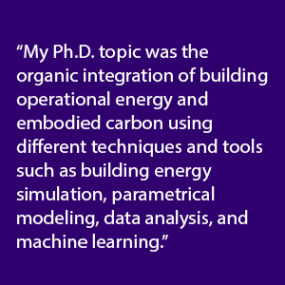
I regard myself as an interdisciplinary engineer/researcher/learner—so my learning journey never ends. After completing my degree, I worked as a postdoc Research Fellow at George Mason University focused on the hot-spot applications of computer vision, deep learning, and time series analysis in different disciplines. Though my work was not obviously related to carbon, I’ve learned that it’s possible for me to understand much later how something in my work turned out to be valuable for me even when it didn’t seem so at first. Meanwhile, I got actively involved as a committee member for the SEI Sustainability Committee (ASCE), and as a Provisional Corresponding Member for several ASHRAE committees.My passion is to use interdisciplinary studies to achieve the goal of decarbonization.

Read Yang's Essay
MEMBER IMPACT
¿Qué están haciendo usted y su empresa para ayudar a reducir las emisiones de carbono incorporadas?
Kateřina Eklová

Co-founder
Rethink Architecture

Lee mas
Kristof Irwin

Consulting Engineer and Principal with Positive Energy

Lee mas
Victoria Oestreich

Senior Manager, Centers & Initiatives, Urban Land Institute (ULI)

Lee mas
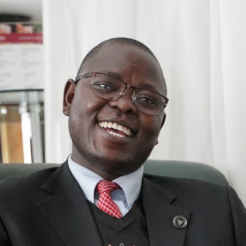
Nickson Otieno
Africa Will Lead the World’s Transition Towards a Decarbonized Built Environment

by Nickson Otieno
Chairman, NIKO Green
Nairobi, Kenya

Africa should not be confined to the peripheries of the building decarbonization conversations and action. I am convinced that Africa has a huge potential in leading the transition to a just climate-positive building design and construction. By 2050, Africa will be home to 1.1 billion more people than it is today. That’s nearly 75% of the world’s projected population growth of 1.5 billion more people. This means a huge demand for buildings, with 80 percent of those that will exist in 2050 yet to be built. While fulfilling this demand, the continent has a chance to lead the world in developing what Bruce King and Chris Magwood have described as a “carbon-smart architecture”.

Read Nickson's Essay
SERA: Integrating Carbon Analysis into Design

by Beth Lavelle, Senior Associate, and Lindsey Kahler, Architectural/Sustainability Designer

SERA Architects has a long history of integrating performance analysis into our design work, including conceptual energy modeling, daylighting and solar analysis, as well as future climate projections. It was a natural evolution for our Sustainability Resources Group (SuRG) to take on the challenge of embodied carbon analysis of our projects and develop workflows to integrate the analysis into SERA’s design processes.

Inspired by our firm’s values, which highlight our responsibility as practitioners with significant opportunity to reduce emissions through mindful design and material selections, we at SERA began our journey of working to radically decarbonize our project work around 2019 by exploring whole building life cycle assessment (WBLCA) analysis tools like Tally and OneClick. In 2020 we began a process of analyzing our entire portfolio, expanding the work that we have done to report our operational energy for the 2030 Challenge since its inception.

Read the SERA Story
 
September 14 Quarterly Forum:
Focus on the Carbon Balance for MEP Systems

The Carbon Leadership Forum issued the Challenge for MEP engineers to design all projects to meet net zero carbon goals by 2040. Over 100 firms have now signed on to join the movement.

The whole-carbon balance for energy-using MEP systems has been an elusive topic for many. As operational carbon continues to be a focus, our understanding of embodied carbon ramps up, and low-GWP refrigerants consistently face regulatory challenges, making informed decisions based on the whole picture is a complex problem that our industry has yet to solve. Please join us for MEP2040's next quarterly forum, where we will shed light on this complex topic and begin to identify a roadmap toward solutions.

The Seventh Quarterly Forum coming up on September 14, 2023 will focus on the whole-carbon balance between operational and embodied carbon for energy-using MEP systems.

Register for the September 14 Forum

This month’s action checklist

Únase a la comunidad CLF en línea – focus groups, information, collaboration, research, resources, exploration, innovation.
Watch Andrew Himes' TEDx Talk: "Change Our Buildings, Save Our Planet" Buildings can be an existential solution to climate change -- not an existential threat.
MEP 2040 Challenge: A rapidly growing movement to decarbonize building systems. Sign the Commitment!

About the Carbon Leadership Forum at the University of Washington

Quienes somos

  • The Carbon Leadership Forum accelerates transformation of the building sector to radically reduce the embodied carbon in building materials and construction.
  • We pioneer research, create resources, foster cross-sector collaboration, and incubate member-led initiatives to bring embodied carbon emissions of buildings down to zero.
  • We are architects, engineers, contractors, material suppliers, building owners, and policymakers who care about the future and take bold steps to eliminate embodied carbon from buildings and infrastructure.


www.carbonleadershipforum.org

© Copyright 2023

4100 Redwood Rd #20A
Oakland, California 94619-5726
Estados Unidos

You received this message because you subscribed to receive mailings from us, are a member of one of our groups, or have requested information.              

Unsubscribe  |  Forward Email  |  Contact us: [email protected]