CLF
  noviembre 2021

Movement-building

by Anthony Hickling, Managing Director, Carbon Leadership Forum

This month’s newsletter highlights the essential character of CLF as well as a core component of our strategy for change: nurturing a collective impact movement that draws together all of the threads of an engaged and educated building community -- individuals, organizations, and companies -- to collaborate on every aspect of decarbonizing buildings, infrastructure, and materials.

  • The MEP 2040 Challenge is only weeks old, but already 24 major companies and organizations have joined the initiative, either as MEP signatories or supporting organizations, and the tempo is picking up.
  • In Member Impact, we hear the stories of four amazing leaders of the CLF Community who report on the extraordinary work they are doing on crucial components of the decarbonization puzzle.
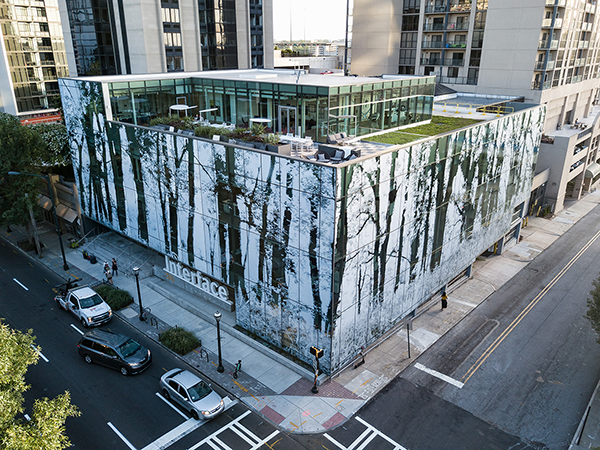
  • Our Sponsor Spotlight this month is by Lisa Conway of Interface, who describes the company’s  Climate Take Back™ program which commits Interface to become a carbon negative enterprise by 2040.
  • CLF’s new report, Transformative Materials, demonstrates the potential for meaningful climate impact through materials that serve as carbon sinks, a potential that will only become a reality when brought to life by building designers and material suppliers across the industry.

This is what we mean by building a movement: tools, data, policies, and collective action. Thank you so much for being part of this community of change agents!

Impacto de los miembros  

Jason Grant
Manager, Forests & Corp. Engagement World Wildlife Fund

Deepshi Kaushal
Academic, Architect, Urbanist, Consultant, Switzerland

Kelsey Wotila
Arquitecto, EskewDumezRipple

Renilde Becque
Engineer, Author, Consultant for WRI, UN, ClimateWorks, Laudes Foundation

Find out what our members are doing to address embodied carbon
Aprende más
MEP 2040 Challenge Campaign Accelerates!  

Who Were the First Twenty Major Companies and Organizations to Join and Support the MEP 2050 Initiative?

In October, CLF announced the MEP 2040 Challenge, a new initiative from CLF to galvanize efforts to decarbonize building systems across the MEP (mechanical, electrical, plumbing) industry":

El desafío MEP 2040:

“All systems engineers shall advocate for and achieve net zero carbon in their projects: operational carbon by 2030 and embodied carbon by 2040.”


El Desafío exige más que promesas vagas por parte de los diseñadores de edificios para hacerlo mejor. Requiere un conjunto de compromisos sólidos para tomar acciones específicas, incluida la reducción de refrigerantes, solicitar datos a los fabricantes y convertirse en participantes activos en los esfuerzos de toda la industria para descarbonizar los sistemas de construcción.

Mechanical equipment, delivery, refrigerants, and refrigerant leaks are commonly excluded from life-cycle analysis studies, so we don’t know the full extent of their impacts. With a continually shortening timeline and increasing necessity to cut emissions, understanding where there is opportunity to minimize the impacts of MEP systems is critical. Achieving zero carbon requires gaining knowledge, then catalyzing change in our industry.

Unete al movimiento
Interfaz  

Interface Carpet

Guided by the framework of its Climate Take Back mission, Interface set out to consider how the company could continue to reduce the carbon footprint of its product portfolio, which already included carpet tiles with the lowest carbon footprint in the commercial flooring industry.

"In October 2020, we took a significant step forward in our journey to become a carbon negative enterprise with the introduction of the world’s first carbon negative carpet tile, measured cradle to gate.* This breakthrough builds on the 2018 expansion of our third-party verified Carbon Neutral Floors™ program and enables us to make simultaneous progress towards our 2040 goal while helping our customers deliver on their own sustainability objectives."

A Collaborative Approach to Reducing Embodied Carbon

​by Lisa Conway
Vicepresidente de Sostenibilidad, Interface Americas

In 1994, Interface’s founder Ray Anderson set our company’s first moonshot goal. Coming on the heels of his famous “spear in the chest moment” that changed his perspective on business and sustainability, he set a goal of zero negative impact on the planet by the year 2020 when others were just beginning to talk about sustainability. He shook the foundation of the flooring industry by declaring Interface’s pursuit toward becoming one of the world’s first environmentally sustainable and restorative companies.

Our goal to transform our business, later named Mission Zero®, led Interface to focus on making changes to our factories, products and supply chain. After deeply reducing the environmental impacts of our business and operations, we declarado éxito de Mission Zero por delante de nuestro objetivo para 2020.

Después de lograr este importante hito, nos propusimos lograr nuestro próximo ambicioso viaje a la luna, Climate Take Back™, que tiene como objetivo revertir el calentamiento global. Con este objetivo agresivo, nos esforzamos por convertirnos en una empresa con emisiones de carbono negativas para 2040.

Read the Full Story!

New CLF Report:
Transformative
Materiales que almacenan carbono


Accelerating an Ecosystem

Principal Authors
Julie Kriegh, PhD, AIA,Research Scientist for CLF
Chris Magwood, Director, Endeavor Center
Wil Srubar III, PhD, Associate Professor, University of Colorado Boulder

El potencial de impacto climático significativo a través de materiales que sirven como sumideros de carbono ahora les da a dichos materiales una clara ventaja, con el potencial de revertir el perfil climático de los edificios de un impulsor principal de emisiones de carbono a depósitos de carbono que pueden ayudar a revertirlo.

Recent recognition of the severity of the climate crisis and the need for major, impactful interventions has accelerated interest in low-carbon and carbon-storing materials that can redress the significant upfront emissions associated with conventional building materials.  Decades of previous work to develop, improve, and implement these materials now provide a strong base of research, product development, and case studies that can support the drive to bring these materials to market quickly and help meet global climate targets.

Past experience with low-carbon and carbon-storing building materials has shown that specification and use of materials are indeed feasible and can match conventional alternatives in terms of cost, code compliance, and construction schedules.  However, the significant investments required to scale many of these materials has largely impaired their shift into the mainstream. The potential for meaningful climate impact through materials that serve as carbon sinks now gives such materials a clear advantage, with the potential to reverse the climate profile of buildings from a leading driver of carbon emissions to carbon reservoirs that can help reverse it.

Leer el informe completo

2021 Report Out Now!


Twelve Months of Transformation

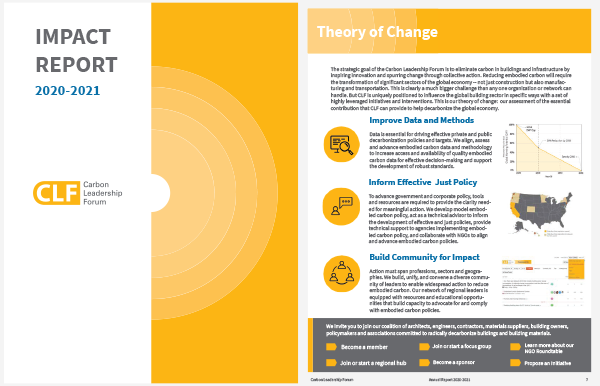
We are excited to share that we have just published the CLF Impact Report for the 2020-2021 fiscal year. 

This report demonstrates the impact that all of you, our CLF members, have had on the building sector over the last year. Thanks to you, we’re enabling a rapidly growing movement of engaged building professionals, policy makers and other leaders to rapidly reduce embodied carbon from buildings and infrastructure. 

Descarga el Informe

We're about to hire!


Momentum is building to decarbonize how we plan, design and construct buildings and infrastructure. As the eminent North American organization focusing on embodied carbon, the CLF is growing quickly and will have a few career opportunities become available in the near future. Read more about these exciting opportunities and let us know if you'd like to be updated when the jobs are officially posted!

Sign Up for Job Updates

This month’s action checklist

Únase a la comunidad CLF en línea – focus groups, information, collaboration, research, resources, exploration, innovation.
Check out News You Can Use with comprehensive coverage of the movement to reduce embodied carbon.
MEP 2040 Challenge: A rapidly growing movement to decarboinize building systems. Sign the Commitment!

About the Carbon Leadership Forum at the University of Washington

Quienes somos

  • The Carbon Leadership Forum accelerates transformation of the building sector to radically reduce the embodied carbon in building materials and construction.
  • We pioneer research, create resources, foster cross-sector collaboration, and incubate member-led initiatives to bring embodied carbon emissions of buildings down to zero.
  • We are architects, engineers, contractors, material suppliers, building owners, and policymakers who care about the future and take bold steps to eliminate embodied carbon from buildings and infrastructure.


www.carbonleadershipforum.org


© Copyright 2023

4100 Redwood Rd #20A
Oakland, California 94619-5726
Estados Unidos

You received this message because you subscribed to receive mailings from us, are a member of one of our groups, or have requested information.              

Unsubscribe  |  Forward Email  |  Contact us: [email protected]